AI is now writing code, tests and documentation faster than teams can check them. An opinion piece in Prothom Alo argues that this has moved the bottleneck in software delivery from production to verification — and that Bangladesh's export ambitions turn on it.
Declare the interest first. The author is Dr Mohammad Nurruzzaman, president of the Bangladesh Software Testing Board and chief executive of the Daffodil Group. He is arguing that the country needs more of the certified testing capability his organisation certifies. That does not make the argument wrong, and it does mean it should be read with the interest in view.
The numbers he is arguing from
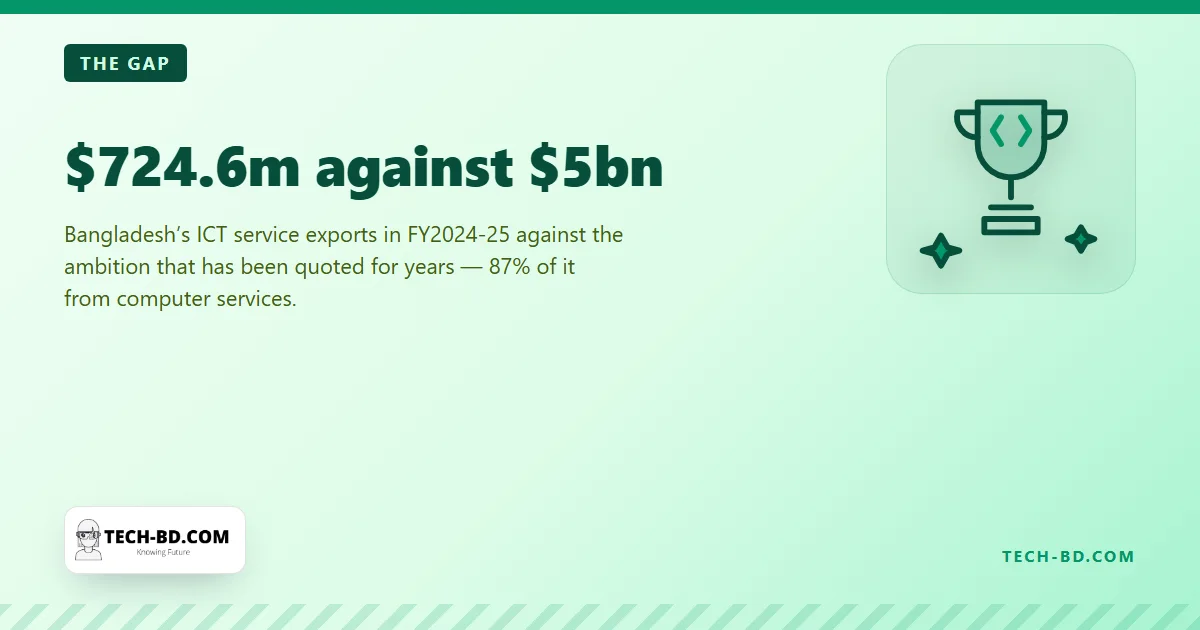
Bangladesh earned about $724.6m from ICT service exports in FY2024-25, roughly 87% of it from computer services — software development, outsourcing and IT-enabled services. The long-quoted ambition of $5bn remains a long way off.
Those two figures together are the real argument. The gap is not a rounding error to be closed by working harder at the same thing.
The claim worth taking seriously
Strip away the advocacy and one idea stands up on its own: buyers are not purchasing lines of code. They are purchasing the expectation that software will work, scale, stay secure and not break existing features when updated.
When writing code was the expensive part, being able to write it cheaply was a competitive advantage — which is the basis on which Bangladesh's industry was built. If AI makes writing code cheap everywhere, that advantage thins, and what remains scarce is the ability to demonstrate that what was produced can be trusted.
The author's sharper point is that AI changes testing in two directions at once: testing with AI — generation, automation, defect prediction — and testing AI, meaning checking the accuracy, reliability, safety and bias of AI systems themselves. The second is a capability almost nobody has at scale yet.
Where to be careful
He suggests the developer-to-tester ratio may move toward roughly 1:1 in high-risk sectors — banking, fintech, healthcare, telecom, government services and AI systems. He states plainly that this is not an established industry standard, and that honesty is worth noting, because the figure would otherwise circulate as one.
On certification: ISTQB reports about 1.5 million exams taken and over 1.1 million certifications issued across more than 130 countries as of May 2025. BSTB has been its Bangladesh member board since 2006 and targets 10,000 certified test engineers by 2030.
Certifications are a measure of training, not of capability delivered. The author's own ninth recommendation makes the same point — measure success by jobs, international projects and foreign currency earned, not by the number of trainees. It is the most useful line in the piece.
The part that is checkable
Arguments about national strategy are easy to make and hard to test. This one comes with a date: the fourth SQAT Bangladesh Symposium on 5 December at the Sheraton in Dhaka, themed "Quality in the Age of AI", with ISTQB global president Claudia Dussa-Zieger and former president Olivier Denoo expected.
Whether the room contains bank and telecom technology leaders, as the author asks, or only testers talking to each other, will say more about the prospects than the white paper does.