Software written in Pallabi, Dhaka is now used by more than 6,200 travel businesses in over 40 countries. The company is Innovate Solution, founded in Dhaka in 2013.
Its chief executive, Md Abdus Samad, told Prothom Alo: "In 2013 we started in Dhaka with one simple belief — that Bangladeshi engineers can build world-class software for a global industry."
What the software actually does
This is the part that separates a real export business from a press release. The platform connects to more than 110 suppliers, including 37 airlines running NDC-based distribution and the global distribution systems Amadeus, Travelport and Sabre.
Around that sit the products: InnoTravelTech as the integrated platform, ReservationHub for agency booking websites, Umrahcore for Umrah agencies, plus unified messaging, an AI travel assistant, accounting, revenue intelligence, hotel management, hotel price-drop tracking and TransferArc for airport transfers.
The AI assistant speaks Bangla alongside English, Arabic and Urdu — which, for an Umrah agency serving Bangladeshi pilgrims, is the difference between a feature and a usable product.
The number that makes the case
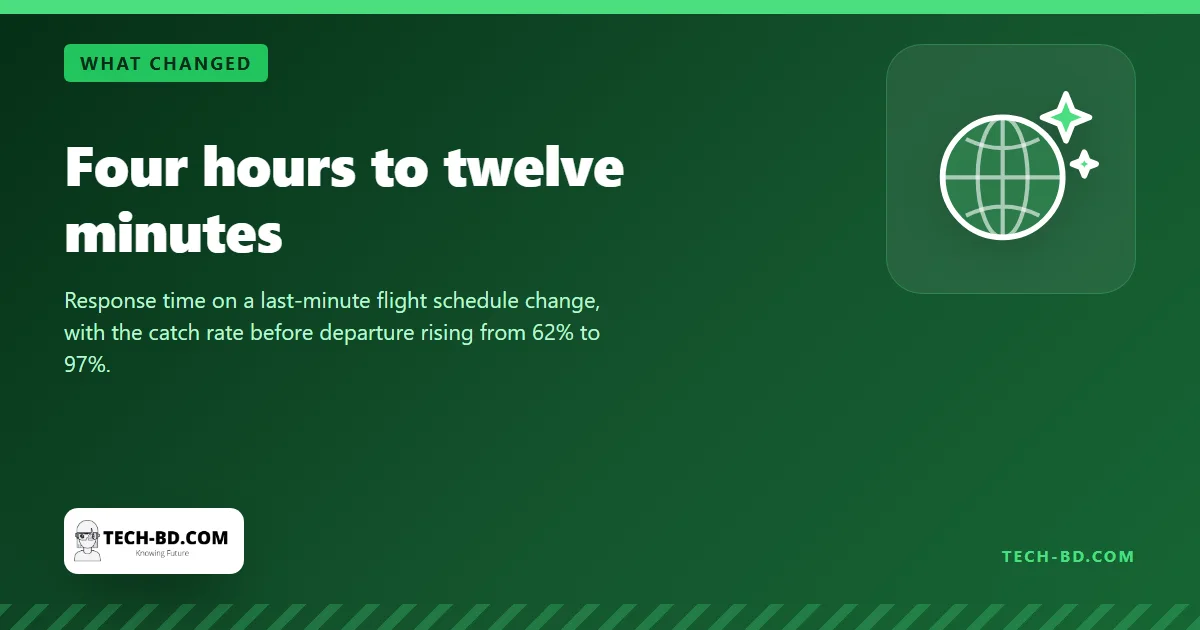
The example the company gives is a last-minute flight schedule change affecting Umrah pilgrims. Response time fell from about four hours to twelve minutes, and the share of schedule changes caught before departure rose from 62% to 97%.
Those two figures are worth separating. Twelve minutes instead of four hours is a speed gain. Catching 97 instead of 62 in every hundred is the one that matters, because the thirty-five changes previously missed were pilgrims arriving at an airport for a flight that had moved.
Three offices, one engineering room
From a single team in one city, Innovate Solution now has offices in three countries: a Middle East office opened in Ras Al Khaimah in the UAE in 2025, and a global headquarters in Singapore in 2026.
The roots stayed. Engineering, research and product development are done in Dhaka, and most of the 120-plus staff across ten departments work there. The company is hiring in Bangladesh.
Pricing is published rather than quoted on request: ReservationHub starts at $99 a month and Umrahcore at $51 a month, with source-code purchases priced per project.
Why the structure is the story
Bangladesh's software export conversation usually runs through outsourcing — selling hours to someone else's project. This is the other model: a product, sold by subscription, to customers who never need to know where it was built.
The Singapore headquarters is worth noticing rather than resenting. Travel software is sold against contracts, and a Singapore entity settles the question of jurisdiction that a Dhaka entity would have to argue. The engineering stayed in Pallabi, which is where the value is actually added.
The question to ask next year
A global headquarters in Singapore raises a question worth tracking rather than assuming the answer to: where the revenue is booked. If subscriptions are invoiced from Singapore, the work is done in Dhaka but the earnings may not appear in Bangladesh's software export figures — which is how several regional firms have ended up looking smaller in national statistics than they are in reality.
That is not an accusation; it is the ordinary consequence of selling internationally, and the company has not said how it handles it. But it is the difference between a success story for Bangladeshi engineers and a success story for Bangladesh's export account, and those are not automatically the same thing.
The hiring line is the real signal
The detail that carries the most weight is the plainest one: the company is still recruiting in Bangladesh after opening offices abroad. Firms that move their centre of gravity usually stop growing the original team first and announce it later.