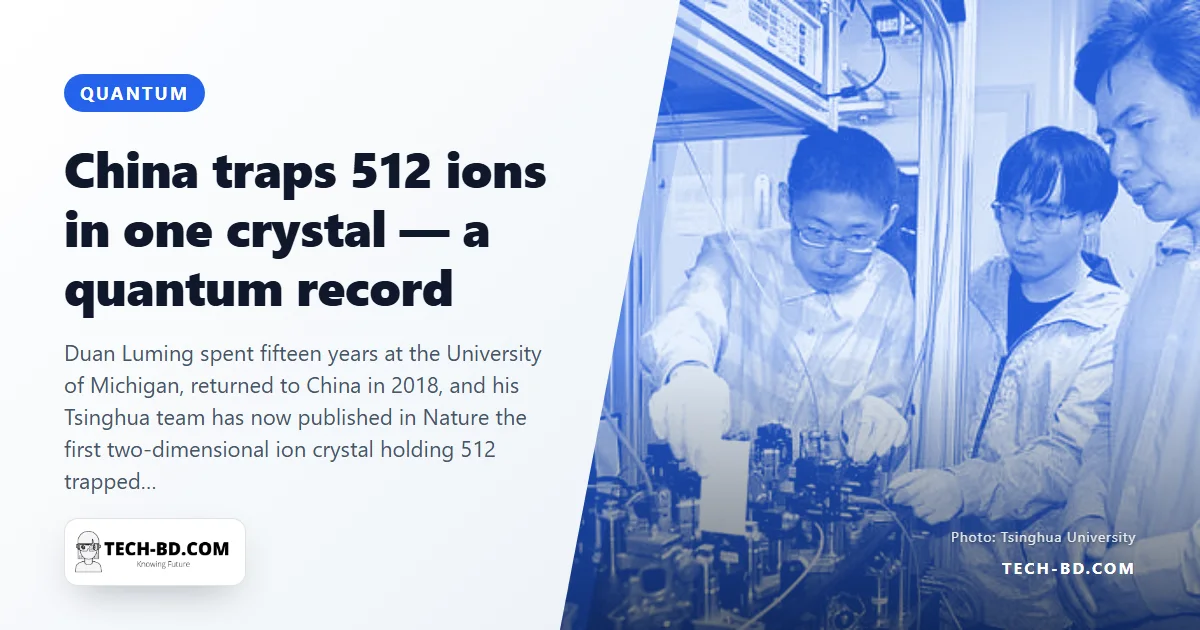
For a decade the United States and China have fought a quiet technology war, and quantum computing is one of its fronts. This week China claimed a record. A team at Tsinghua University, led by Duan Luming, reported in Nature that it had trapped 512 ions in a stable two-dimensional crystal and used them as a quantum simulator — the largest ion-based quantum system ever built, roughly ten times the previous 2D records.
The scientist
Duan is a name in the field. He joined the University of Michigan in 2000 and spent fifteen years there on the theory that underlies most trapped-ion machines, including those built by the US company IonQ, which he helped found. In 2018 he returned to China to lead Tsinghua’s Institute for Interdisciplinary Information Sciences. His path — trained and productive in America, recruited home — is the pattern Washington’s export controls and visa restrictions are trying, with mixed results, to interrupt.
What a trapped ion is
A classical bit is on or off. A qubit can be both at once — superposition — which is what lets a quantum algorithm explore many answers in parallel and, for certain problems, outpace any supercomputer. There are several ways to make a qubit; an ion is one of the cleanest. Strip an electron from an atom, hold the charged atom in place with electromagnetic fields, and its internal states become the qubit, controlled with lasers. Ions are identical, stable and long-lived; the difficulty is holding many of them together. Most ion machines line them up in a one-dimensional chain, which stops scaling well past a few dozen.
Why two dimensions matter
Tsinghua’s team held its ions in a flat lattice — a 2D ion crystal — and showed it could address and read out each of the 512 individually and keep the crystal stable. That opens a route to thousands of ions in a single trap, which a chain cannot offer. The device is a simulator, built to model quantum magnetism, not a general-purpose computer; it cannot run Shor’s algorithm or break encryption. But scaling the number of controllable qubits is the whole problem in quantum computing, and this is a new data point on the curve.
The race
IBM and Google lead in superconducting qubits; IonQ and Quantinuum in trapped ions; China’s USTC has claimed “quantum advantage” with photons and superconductors. Nobody has a machine that does useful work an ordinary computer cannot. The Tsinghua result does not change that, but it puts the largest trapped-ion system in Beijing, built by someone the American programme trained — which is exactly the outcome the technology war was meant to prevent.
Sources: Interesting Engineering, South China Morning Post, via Prothom Alo.