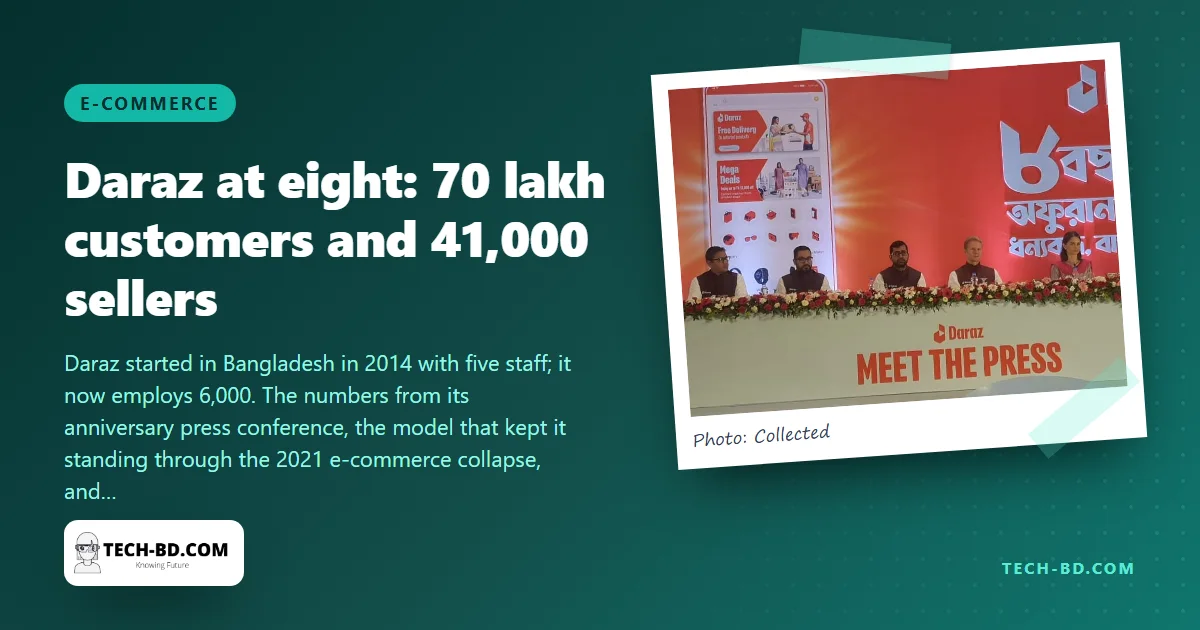
Daraz began selling in Bangladesh in 2014 with five employees. On Thursday, 25 August 2022, at a hotel in Dhaka, it marked its eighth anniversary with about 6,000 staff, more than 70 lakh customers and 41,000 sellers on the platform, and an anniversary campaign from 4 to 11 September offering discounts of up to Tk 15,000. Group founder and chief executive Bjarke Mikkelsen said Daraz had "added a new dimension to how people in Bangladesh shop", and the point of the sale was to share the milestone with buyers and sellers.
Where it came from
Daraz was founded in Pakistan in 2012 by the German incubator Rocket Internet, expanded to Bangladesh, Myanmar, Sri Lanka and Nepal, and was bought by Alibaba in 2018, which brought Chinese logistics know-how, the Daraz Mall verified-brand section and the 11.11 sale that is now the biggest shopping day in the country. In Bangladesh it is run by managing director Syed Mostahidal Hoq, with Tajdin Hasan as chief marketing officer and Khondoker Tasfin Alam as chief operating officer, all of whom were at the press conference.
The company that outlived the boom
The more interesting anniversary is the one nobody mentioned. In 2021 Bangladesh's e-commerce sector imploded: Evaly, Eorange, Dhamaka and a dozen others that had sold motorbikes and phones at half price on advance payment collapsed, owing customers hundreds of crore, and their owners went to jail. Daraz never played that game. It is a marketplace: sellers list, Daraz handles payment and delivery, and it takes a commission. Prices were never fantastical, and the money was never held for months. When the Digital Commerce rules of 2021 imposed escrow and delivery deadlines, Daraz was already compliant. Its 41,000 sellers are the surviving small businesses of that era.
What buyers still need to watch
- Daraz Mall versus everyone else. Mall sellers are verified brands with a 14-day return policy; the rest of the marketplace is individual sellers of varying honesty. Check the seller's rating and the number of reviews, not just the price.
- Cash on delivery is your protection. Pay on delivery for anything from an unfamiliar seller, and open the parcel in front of the rider if the app allows it.
- Anniversary and 11.11 "discounts" are often against inflated list prices. Compare with a physical shop before you believe a 60 per cent off tag.
- Warranty. Electronics bought from a non-Mall seller may carry no official Bangladeshi warranty; ask before ordering.
Eight years in, Daraz's real achievement is dull and important: it made ordering something online in Bangladesh a normal thing to do, and it is still here.
What the eight years actually proved
The anniversary numbers are the least interesting thing about the milestone. What Daraz demonstrated is that the hard part of e-commerce in Bangladesh was never the website.
It was delivery into addresses that are descriptions rather than postcodes, cash on delivery with its returns and its float, a seller base that mostly had never shipped anything before, and the slow work of persuading buyers to pay before they could touch the goods. Competitors with more capital and louder marketing failed on exactly those unglamorous problems. Surviving them is the achievement, and it is why the company was still standing when the boom ended.