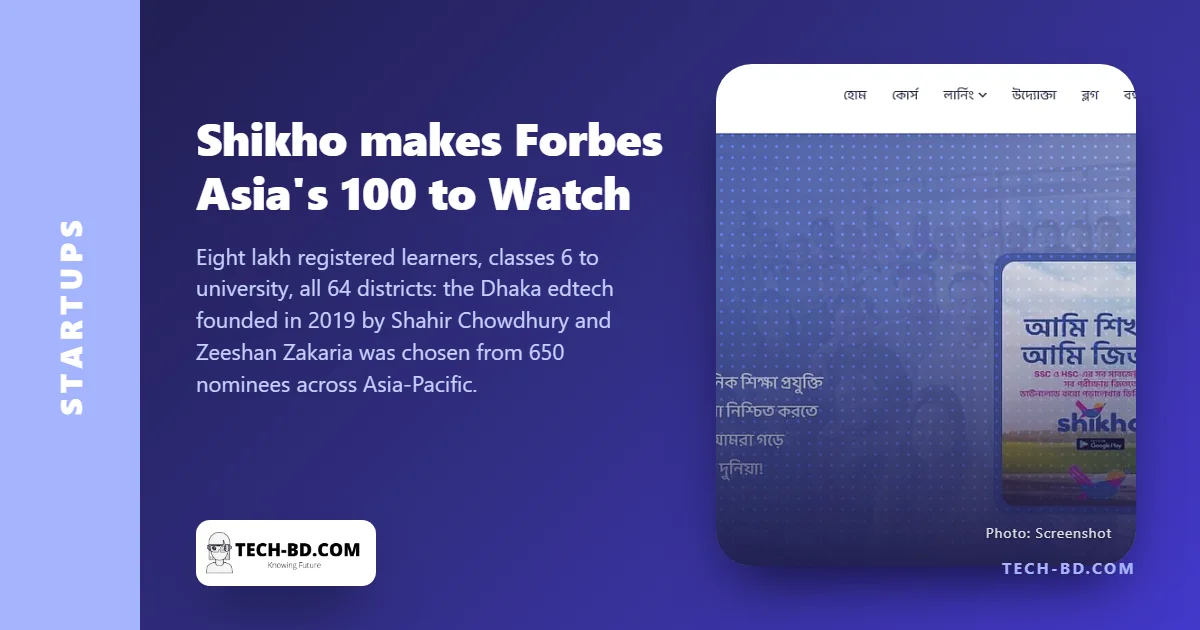
Forbes Asia published its "100 to Watch" list for 2022 on Sunday, 4 September, and among the hundred small companies and startups it thinks are solving real problems across Asia-Pacific, one is from Bangladesh: Shikho, the online-learning platform, listed in the Education and Recruitment category.
What Shikho is
Shikho was founded in 2019 by Shahir Chowdhury, now chief executive, and Zeeshan Zakaria, chief operating officer, to teach the national curriculum online in a way that is cheaper and clearer than the coaching centres most families pay for. It covers students from class 6 to university, with animated lessons in Bangla, practice questions, live classes and, more recently, skills courses in freelancing and admission-test preparation. "We work to teach complex subjects online in simple language," Chowdhury told Prothom Alo. "We now have about eight lakh registered users, from all 64 districts. The recognition will push us to do more."
How the list is made
Forbes Asia's editors and a panel of judges picked the hundred from 650 nominations submitted by companies, venture funds and accelerators across the region. Entries had to be privately held, for-profit, headquartered in Asia-Pacific and generating revenue below $50 million a year, with a demonstrated record and a founder with a plausible path to scale. Singapore has the most entries, 19, and Hong Kong 16; the categories run from e-commerce and fintech to agriculture, biotech and construction.
Why edtech, and why now
The pandemic shut Bangladesh's schools for 18 months, longer than almost anywhere else, and pushed a generation of parents to try online lessons for the first time. Ten Minute School had shown a decade earlier that free Bangla video could reach millions; Shikho's bet is that families who already spend thousands of taka a month on coaching will pay a fraction of that for a structured app. Its investors, including Learn Capital and Anchorless Bangladesh, have put more than $5 million into that bet since 2021.
What it means
A Forbes listing does not change a product, but it changes who returns a founder's e-mail. For a startup ecosystem that has spent a year explaining the Evaly collapse to foreign investors, an education company chosen on merit from 650 peers is a useful counter-example, and a reminder that the most durable Bangladeshi startups tend to sell something families already buy.
What happened to edtech after 2022
The list appeared at the top of the market, not in the middle of it. Online learning had been lifted worldwide by school closures, and investors funded it on the assumption that the habit would outlast the cause. It largely did not: once classrooms reopened, paid completion rates fell across the sector, and the global reckoning that followed took down far larger names than any Bangladeshi company — India’s Byju’s, valued at $22 billion in 2022, collapsed into insolvency proceedings within two years.
That is the context in which to read a list like this one. Being named is a signal about the moment, not a prediction about the company. The edtech businesses that lasted were generally the ones selling something families were already paying for — exam preparation, tutoring, admission coaching — rather than those trying to create a new habit from scratch.