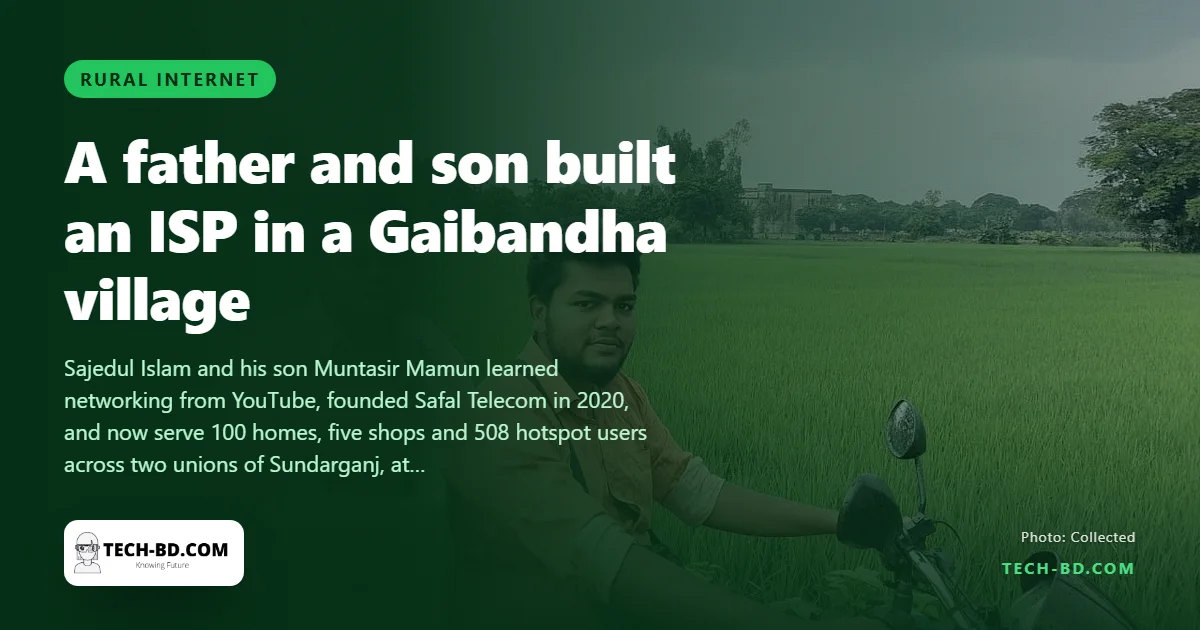
One in the morning or three, if a connection drops in Sarbananda or Bamandanga union, Sajedul Islam and his son get on the motorbike. They are the whole technical staff of Safal Telecom, the broadband provider they founded in 2020 in Sundarganj upazila, Gaibandha, and they have built something the big operators never did: a working internet service for two unions of villages in northern Bangladesh, priced for the people who live there.
How a village ISP works
The government's fibre backbone, the Nationwide Telecommunication Transmission Network, now reaches union level; in Sarbananda the fibre was laid by Fiber@Home. Safal Telecom buys bandwidth from Jadoo Broadband, the licensed ISP, and distributes it: a few kilometres of its own fibre, radio links, and a server room next to a paddy field in Masterpara village that is slowly filling with racks, routers and antennas. Muntasir Mamun, whose nickname Safal gave the company its name, is a third-year management student at Rangpur Model College and learned networking, servers and routing entirely from YouTube tutorials, then went out and did it. His father works days as a computer operator at Bamandanga Abdul Haque College and the rest of the time on the network.
What it serves
- 100 homes with broadband, and five shops in the village bazaar that have become the digital-service counters where people apply for birth registration, TINs, e-passports and school admission and check exam results.
- 25 public Wi-Fi hotspots at road junctions and tea stalls, used by 508 people on their phones for online classes, tutorials, films and Facebook. Access is sold on printed vouchers: Tk 20 for three days unlimited, Tk 60 for seven, Tk 100 for fifteen and Tk 200 for a month, the price of a single day's mobile data pack.
- Freelancers and YouTubers in the surrounding villages who could not work on mobile signal. "There is a tower, but you do not really get internet," said Munir Hossain, a blogger in Bamandanga. "Because of Safal Telecom I can do my work, and whatever the hour, they come."
The business earns about Tk 30,000 a month. During the pandemic it carried online classes and vaccine registrations for villages that would otherwise have had neither.
Why this matters more than a 5G trial
Bangladesh has roughly 2,500 licensed ISPs, most of them one-town operations like this, and they, not the mobile operators, are why "broadband" is reaching villages at all. Their problems are the same everywhere: the price of NTTN bandwidth, unreliable power, and a licensing regime written for Dhaka. Sajedul and Muntasir want to extend to neighbouring villages that still have nothing, and to open a freelancing training centre. Given what they have built with a motorbike and YouTube, it would be unwise to bet against them.