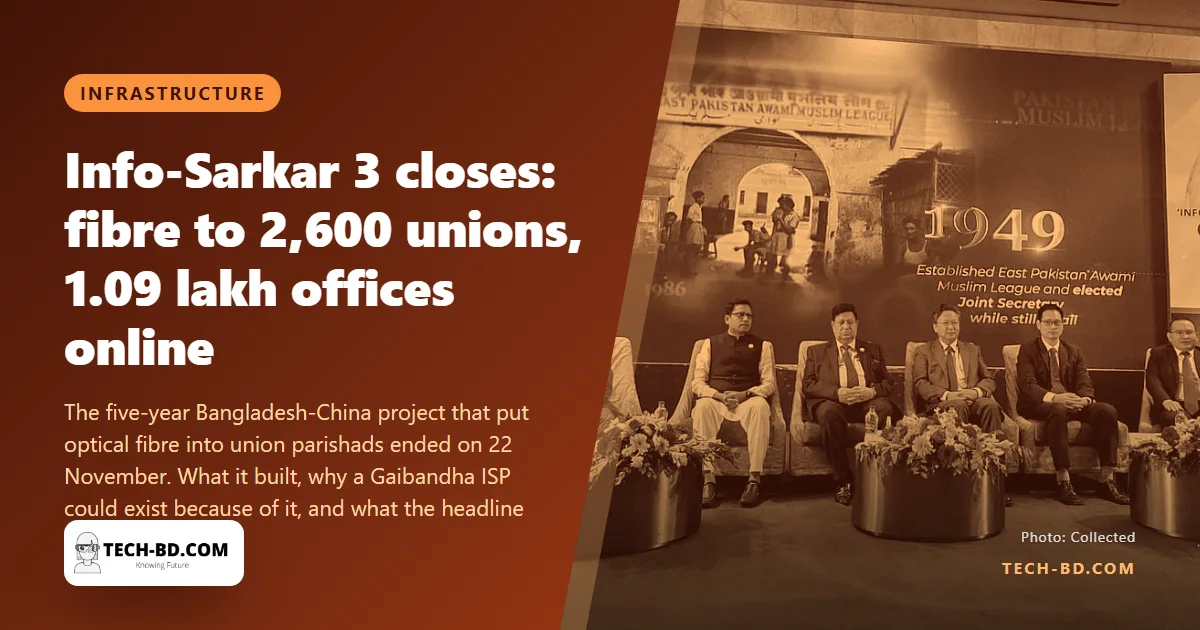
The National ICT Infra-Network for Bangladesh Government Phase III, known as Info-Sarkar 3, held its closing ceremony at a Dhaka hotel on Tuesday, 22 November 2022. Begun in 2017 with joint financing from the governments of Bangladesh and China, the project laid optical fibre to 2,600 union parishads and connected 109,244 government institutions to broadband. Foreign minister A K Abdul Momen, the chief guest, said that as a result "about 10 crore people in the country are now using high-speed internet".
What it built
- Fibre to the union. Before the project, the national fibre backbone stopped at the upazila; Info-Sarkar 3 extended it to the union, the lowest tier of local government, in 2,600 of the country's roughly 4,500 unions.
- Government offices online. Schools, health complexes, land offices and police stations, 1.09 lakh institutions in all, received a broadband connection.
- Union Digital Centres. The entrepreneurs who run the one-stop digital-service counters at each union got 5 Mbps of free bandwidth for four years, which is what let villagers apply for passports, birth certificates and TINs without travelling to the district town.
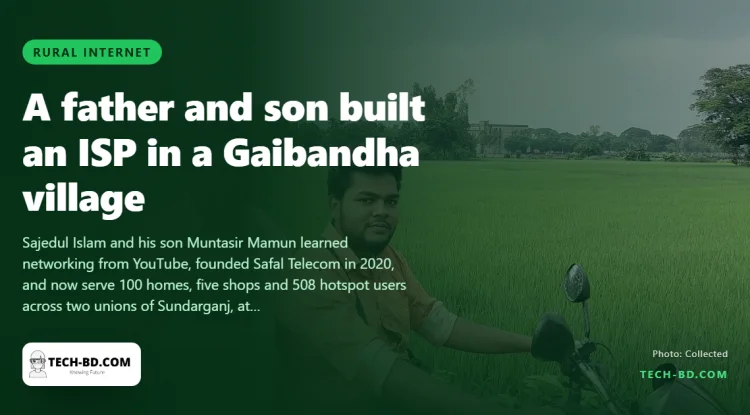
The fibre itself is now managed by the licensed transmission network operators, which is why a father and son in Gaibandha could buy bandwidth and start Safal Telecom, and why the Madhupur freelancers could finally get a connection: the project built the road, private ISPs run the buses.
About that 10 crore
The minister's figure is best read as an aspiration. BTRC's own count of internet subscriptions is around 12.5 crore, but roughly 11 crore of those are mobile data connections, many of them 2G or 3G, and about 1.1 crore are fixed broadband. "High-speed" is not a category the regulator measures, and Ookla's speed tests place Bangladesh's mobile internet among the slowest in the region. What the project verifiably did is bring fibre within a few kilometres of most of the rural population. Turning that into 10 crore fast connections is the job of the ISPs, the operators, and the next project.
What comes next
ICT state minister Zunaid Ahmed Palak, who chaired the closing, framed it under the "villages will become towns" pledge; Chinese ambassador Li Jiming, ICT senior secretary N M Zeaul Alam and PPP Authority chief Md Mushfiqur Rahman also spoke. The remaining unions, the reliability of power at the union level, and the price of last-mile bandwidth are where the gap between fibre in the ground and internet in the home still lies.