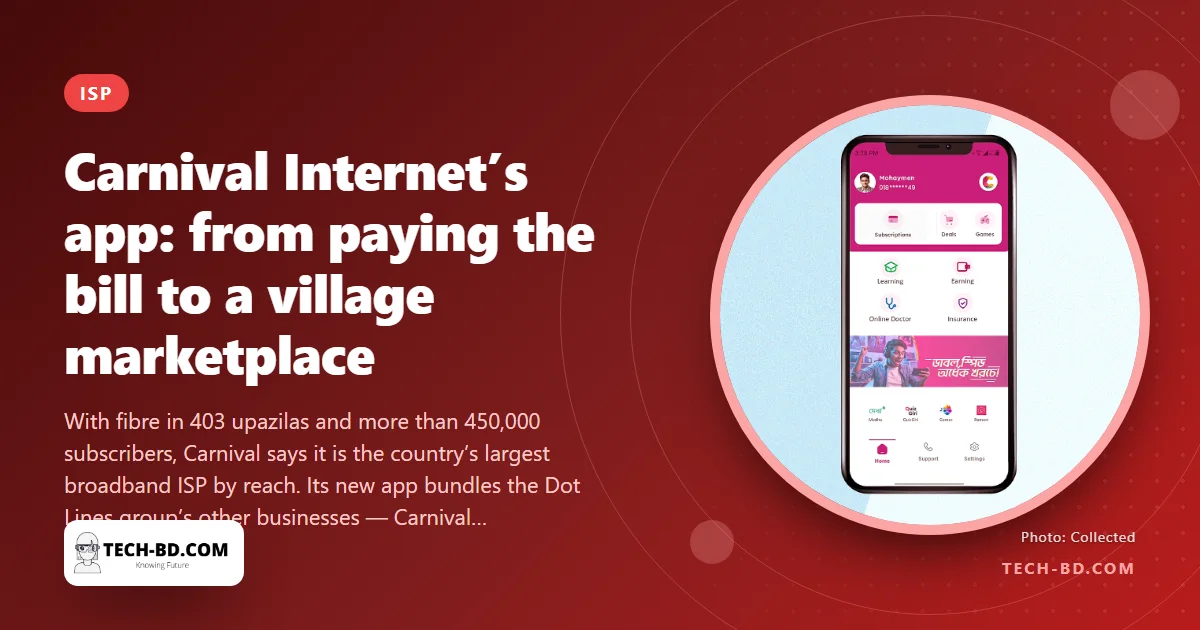
Most people know their internet provider as a monthly bill and a number to call when the line drops. Carnival Internet wants to be more. At its Gulshan office, group chief marketing officer Hasan Mehedi announced an ecosystem marketplace app, due in mid-September, through which subscribers will pay their bill and also consult a doctor, buy small insurance policies, take courses in Bangla and earn money reselling products.
Who Carnival is
Part of the Dot Lines Group, started in 2015, and since then the builder of a fibre broadband network across 403 upazilas, reaching more than 31,000 villages and towns and over 450,000 subscribers — numbers that make it, by geographic reach, the country's largest broadband ISP, a status recognised by the Asia Pacific Network Information Centre. Where mobile operators sell data by the gigabyte, Carnival sells a cable into the house, in places where nobody else has laid one.
What the app will contain
The first version handles bill payment and connection management. Four services follow, each an existing Dot Lines business folded into the same login:
- Carnival Learning — online courses in Bangla, including English through BBC Janala, pitched at young people entering freelancing.
- Carnival Care — telemedicine and health services for remote villages, where a doctor is otherwise a bus ride away.
- Carnival Assure — micro-insurance, bringing several insurers' health and life products into one place at small premiums.
- bSeller — a zero-investment reselling platform where anyone can list and sell products and keep a margin without holding stock.
Why a broadband company, specifically
Super-apps get attempted constantly and mostly fail. Be precise about what Carnival has that the health, insurance and e-learning startups in Dhaka do not, because the advantage is real and narrow.
A recurring payment. The hardest number in consumer internet is the cost of getting someone to install an app and open it again. Carnival's subscribers already open an app every month because they have to — the bill is due. A service added to that screen inherits an audience with an existing habit, at an acquisition cost close to zero. That is a structural advantage no amount of advertising buys, and banks, telcos and utilities keep trying to become platforms for exactly that reason.
A verified relationship. These are not anonymous app installs. They are households with an address, an installation date and a payment history, which is exactly the information an insurer needs and ordinarily cannot get cheaply in a rural market.
Physical presence. A technician has been inside the house. In markets where trust is the binding constraint on selling anything financial, having a person who has physically visited is worth more than any amount of digital credibility.
Where this usually goes wrong
The failure mode is well documented and worth naming, because it is not the one people expect.
It is rarely that the company cannot build five products. It is that trust does not transfer across categories. A customer who believes their ISP can run a cable does not thereby believe it can advise them on a medical symptom, and being asked to take health advice from the broadband company tends to devalue both. The super-apps that work usually solve this by keeping the partner brand visible — the policy is clearly from an insurer, the doctor is clearly from a medical provider, and the app is the counter rather than the practitioner. Carnival's structure, with named insurers and separately branded services, suggests the point is understood.
The second failure is attention. A company whose actual asset is a fibre network in 403 upazilas is a company that must keep spending on that network — capacity, maintenance, the unglamorous work of a line staying up in a storm. Every super-app launch is a bet that the new attention is additional rather than diverted, and subscribers notice the network before they notice the marketplace.
The service that deserves scrutiny
Four of these are ordinary distribution. The fifth needs saying clearly.
"Zero-investment reselling" describes a legitimate and common model: a platform holds stock, a reseller shares a product listing, a sale earns them a margin, and nobody puts money in up front. It also describes, in words almost identical, the pitch of several schemes that cost people a great deal of money in this market within recent memory.
The two are distinguishable, and the test is simple enough to apply before signing up. Ask where the reseller's income comes from. In a genuine reselling platform it comes from customers buying goods — the reseller earns only when a real product reaches a real buyer. In a scheme it comes, in whole or part, from recruitment: a joining fee, a payment for stock the reseller must buy and hold, a commission on signing up other resellers, or earnings presented as a tier that rises with the size of your "team".
So the questions to put to any such platform, including this one: is there any payment required to start? Do I earn anything from bringing in other sellers? Can I see what the customer paid and what I earned on each individual sale? A platform that answers those plainly is probably what it says it is. One that answers them with a presentation about income levels is not.
None of this is an allegation about bSeller, which has not launched. It is the diligence anyone in this market has earned the right to perform, and a company entering the category with a clean structure loses nothing by being asked.
The idea underneath is sound
A regulated point is worth noting too: an ISP selling insurance and telemedicine is touching three different regulators' territory at once, and the licensing questions are the kind that surface after launch rather than before.
But the underlying proposition — that the broadband line is the road and everything else is traffic on it — is the right one for a company whose genuine asset is where its cables go. The reach into places other providers never served is not easily copied, and it is the only part of this that a competitor cannot buy.