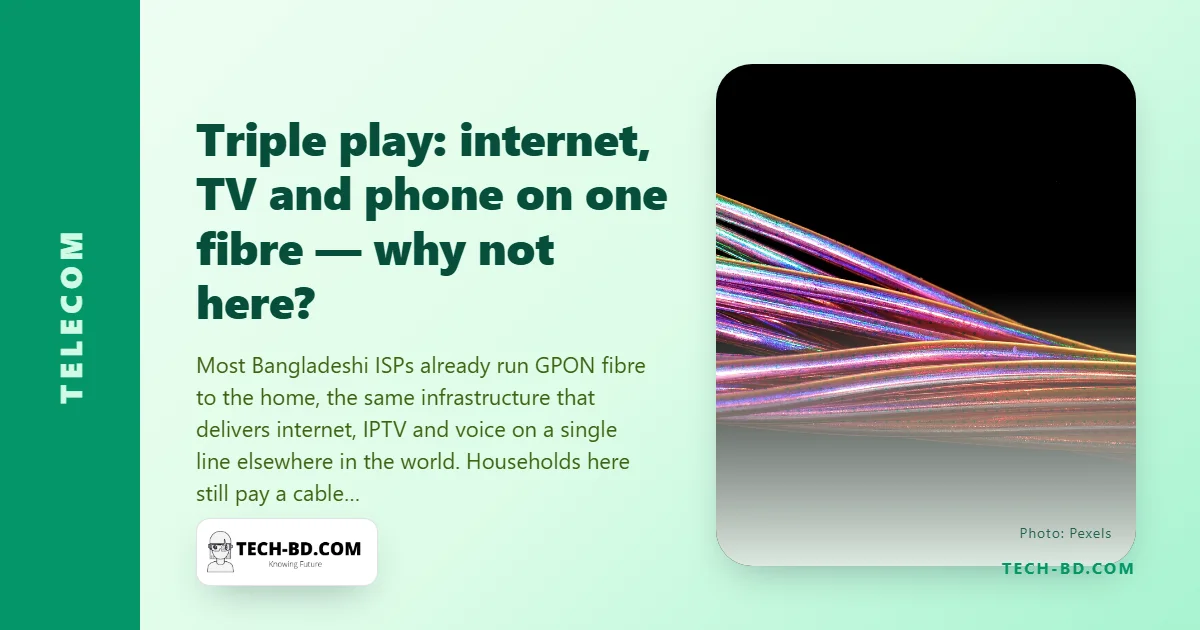
In most homes with a fibre internet connection, a second cable also comes through the wall: the dish line from the local cable operator. The two carry signals that could share one wire. That they do not is a policy and business story rather than an engineering one — and it costs households money every month.
What triple play means
Traditional cable television is one-way. A headend broadcasts channels down a coaxial network, subscribers receive them, and anything interactive needs extra infrastructure bolted on. Modern fibre-to-the-home networks are the opposite: built to carry data, and indifferent to whether that data is a web page, a television stream or a phone call. Running internet, IPTV and voice on the same fibre is what the industry calls triple play, and it has been ordinary in Europe, East Asia and much of the Middle East for well over a decade.
Why the fibre genuinely does not care
The intuition that a dedicated TV cable must be better is wrong and widely held, so here is concretely why television over a data network is not a compromise.
Most ISPs here run GPON — a passive optical network in which one fibre from the exchange is split, with no powered equipment in between, to serve many homes. Everything on it is IP packets. A television channel is a continuous stream of them, and the network has no concept of what they contain.
The piece that makes this work at scale is multicast, and it is the reason IPTV is cheaper to deliver than it looks. When ten thousand subscribers watch a streaming service, the operator sends ten thousand separate copies — that is unicast, and it is how heavy streaming strains a network. When ten thousand subscribers watch the same live channel over IPTV, the operator sends one stream, which is duplicated only at the points in the network where viewers actually diverge. Carrying two hundred live channels costs roughly what carrying two hundred streams costs, regardless of how many people are watching.
That is why an operator's own IPTV service can offer a channel line-up that would be ruinous to deliver over the open internet, and why the fibre already in the house has capacity to spare for it.
Viewing habits have moved too. Households watch on smart TVs, phones and tablets, expect on-demand rather than a schedule, and are drifting to IPTV and OTT platforms anyway.
So what is in the way
- Licensing. Internet service, cable distribution and telephony are licensed separately, under different authorities. An ISP carrying television down its own fibre without a distribution licence is breaking the rules.
- The cable operators. Tens of thousands of local operators built the dish networks of the 1990s and depend on the monthly subscription. Convergence threatens them, and they are organised.
- Content rights. Carrying channels over IP needs agreements the current broadcast-distribution deals do not cover.
Why licence categories become the obstacle
The licensing problem is not unique here and is worth understanding in general terms, because it is the same everywhere convergence has been slow.
Licence categories were written when the networks were physically different things: a telephone network of copper pairs, a television network of coaxial cable, a data network that came later. Separating them was not arbitrary — they required different equipment, different skills and different regulators with different concerns, and a rule about one genuinely did not apply to the others.
A converged network dissolves that distinction. On a fibre carrying IP packets, the difference between a phone call, a television channel and a web page is a matter of what software is reading the packets, and a regulator asking which licence applies is asking a question the technology can no longer answer. The categories do not become wrong so much as meaningless — and meaningless categories are unusually hard to reform, because nobody can point at a clear failure, only at an absence of something that never arrived.
Where other countries moved, the mechanism was almost always the same: a regulator created a unified or converged licence covering carriage regardless of content type, and separated the right to operate a network from the right to distribute particular content. Carriage became one question and rights became another, which is the distinction a converged network actually has.
The operators are a problem with a solution
The cable operators are usually described as the obstacle, which is accurate and incomplete. They hold something a converged future needs and cannot easily replicate.
A local cable operator has a last-mile network along specific streets, the poles and ducts it runs on, the right-of-way arrangements that allowed it, and a billing relationship with households in a defined area. Those are exactly the assets a fibre operator has to spend years and a great deal of money assembling — and in a converged market the coaxial cable becomes worthless while everything around it stays valuable.
Which suggests the shape of a settlement rather than a fight: a licensing path that lets a cable operator become a fibre operator in its own area, carrying licensed television over IP, rather than being competed out of existence by an ISP laying a parallel network down the same street. The thing being defended is a revenue stream, and a transition that preserves it is a different negotiation from one that does not.
What the duplication costs
Two bills for one household, and two networks maintained along the same streets by a country that has to dig up the same roads twice. It also delays services that only exist on a converged network — video on demand integrated with live channels, cloud recording, a landline that costs effectively nothing over fibre already paid for.
One honest cost on the other side: convergence creates a single point of failure. A household with two cables loses television or internet when one fails; a household with one loses both. That is a real trade, usually judged worth making, and worth stating rather than glossing.
A regulatory framework that lets ISPs carry licensed television, and gives cable operators a route to becoming fibre operators rather than obstacles, is the missing piece. The technology arrived years ago. The rules have not.