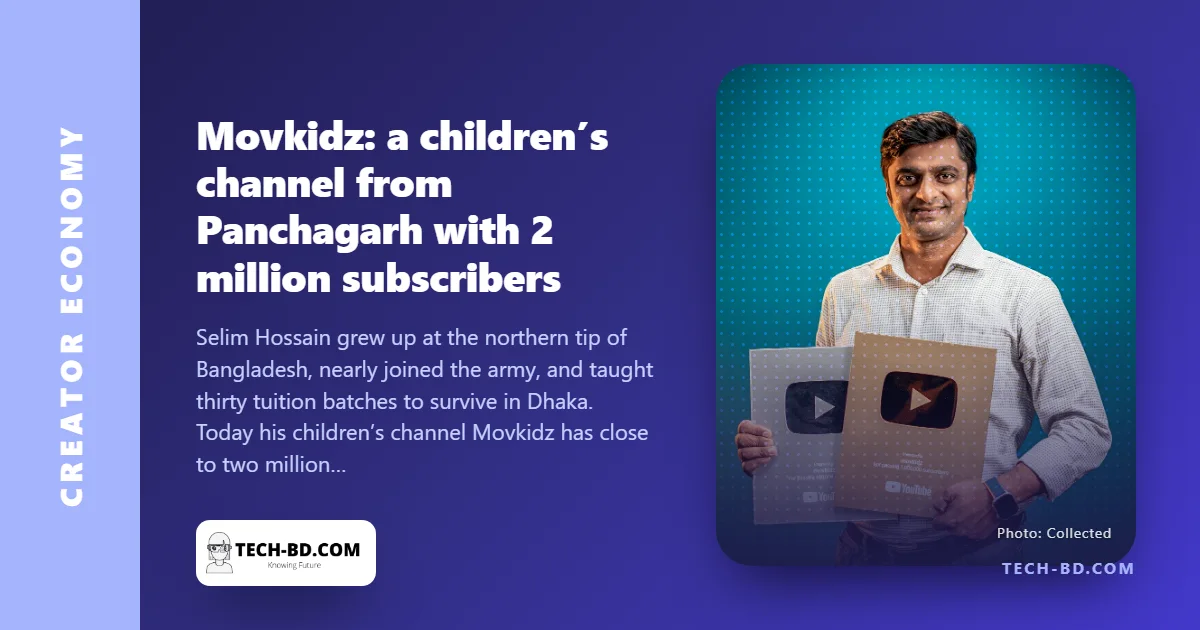
Bangladesh's map ends at Banglabandha, in Panchagarh, where on clear mornings you can watch Kangchenjunga wake up. That is where Selim Hossain grew up, and where a fairly ordinary set of ambitions — go to Dhaka, get a steady job — turned into a children's YouTube channel, Movkidz, closing on two million subscribers and routinely described as Bangladesh's Cocomelon.
The unglamorous middle
The origin story is not a garage and a laptop. Selim's family wanted him in the army, and he got as far as the recruitment door before walking away. He arrived in Dhaka in 2009, missed the university he wanted, enrolled at Government Titumir College under the National University, and paid for it with tuition — more than thirty batches of it. Friends were studying for the BCS and bank jobs.
The turn came through a roommate who worked as a videographer at a private TV channel. Following him on shoots produced an interest in media; watching the edit produced an obsession.
He found Creative IT Institute when it was barely open and its founder still taught classes himself, and enrolled with money his mother had saved, over his family's objections. Then the video-editing batch stalled for lack of students. Rather than lose him, the founder moved him into graphic design first — a detour that, he says, later became the backbone of his editing. Today he heads the institute's Film and Media department, which is a tidy illustration of how small the industry still is.
The number, and why it looks small
Movkidz brings in roughly Tk 2.5 to 3 lakh a month and employs seven people. Set against two million subscribers that can read as underwhelming. It is not, and the reason is a rule rather than a failure.
Since 2020, following a US regulatory settlement over children's privacy, YouTube requires every video to be designated as made for children or not — and on content marked for children it switches off personalised advertising. Ads are served on context alone, with no profile of the viewer behind them.
Personalised ads are where the money is. Removing them cuts the rate advertisers will pay per thousand views to a fraction of what general-audience content earns, and the same designation disables comments, the notification bell, end screens, saving to playlists and live chat — most of the tools other creators use to build an audience and route it to other revenue.
So a children's channel is running a harder business on purpose: the lowest ad rates on the platform, none of the community features, and no realistic path to sponsorship, affiliate links or merchandise aimed at the actual viewer, who is three. Tk 3 lakh a month under those constraints is not a small result. It is a result achieved in the most restricted category YouTube has.
Why nursery rhymes anyway
Three structural advantages pay for those constraints, and together they explain why this format exists in every country.
The audience replaces itself. A video about a phone launch is worthless in two years. A counting song is not — there is always a new three-year-old, and the back catalogue keeps earning indefinitely. The library is the asset, not any individual upload.
It crosses languages. Content built on music, colour and repetition travels with almost no translation, which is why a channel made in Dhaka collects views from markets its producer has never thought about.
Sessions are long. An adult watches one video and leaves. A parent starts a playlist and puts the phone down, so autoplay runs for an hour. That makes production volume matter more than any individual video going viral — which suits a seven-person studio with a schedule far better than it suits a lone creator chasing hits.
The risk nobody puts in the success story
The whole business sits on one platform's policy, and that policy has already changed once in a way that cut revenue across the category overnight. Everyone running a kids channel today is doing so under rules written in 2020 in response to a regulator, and there is no reason to assume those are the last rules.
That is a harder dependency than most creators face, because the usual mitigations are closed off. A technology channel can sell a course, run a newsletter, take sponsorship. A channel whose viewer is three years old has no direct relationship with that viewer and cannot sell them anything. The realistic hedges are the dull ones: distributing the same catalogue to other platforms, licensing it, and keeping the production company capable of making work for clients as well as for itself.
Three lessons for the next Selim
- Pick a niche with global demand and local under-supply. Children's animation in Bangla and English had few serious producers; that gap mattered more than any algorithm trick.
- Skills compound sideways. Graphic design, forced on him by circumstance, is what makes the videos look finished — and in a category where nobody reads your comments, looking finished is most of the competition.
- Treat it as a company early. Seven salaries rather than one hobby is what turns a channel into something that survives a bad month, a policy change, or a founder who wants a holiday.