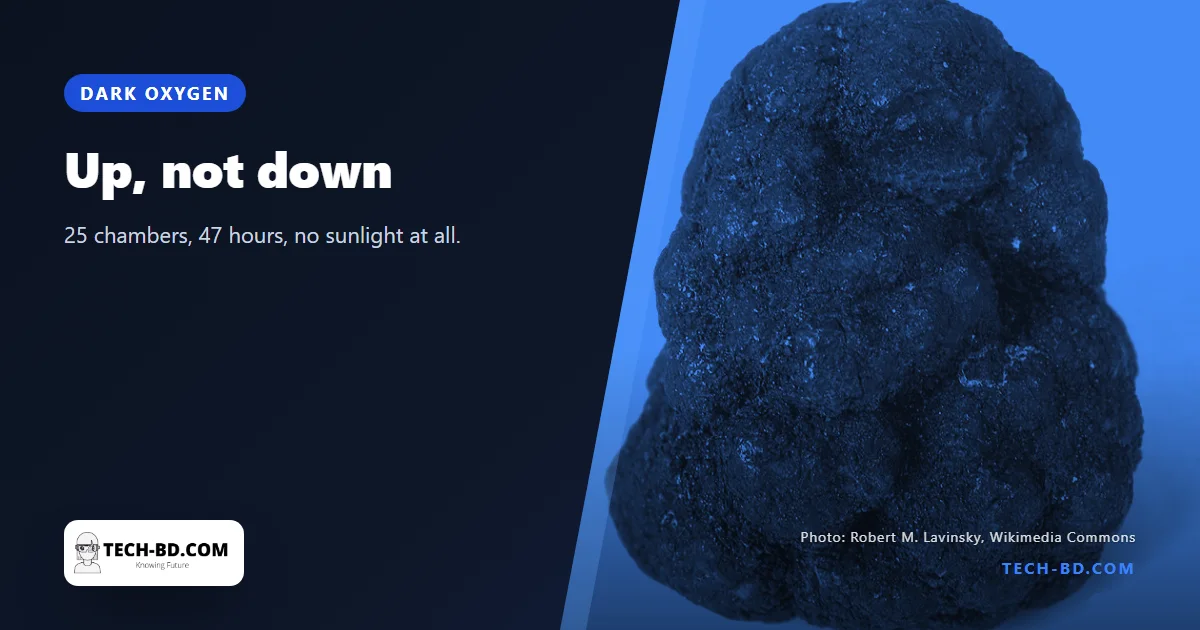
On the floor of the Pacific Ocean, where no sunlight reaches, researchers expected oxygen levels inside sealed experimental chambers to fall. They rose. The results have been published in Nature Geoscience.
What was measured
The team used benthic chambers — containers placed on the seabed that seal off a patch of water and sediment so changes inside can be tracked.
Across 25 chamber incubations, oxygen concentration started at an average of 185.2 micromoles per litre. Over the next 47 hours it climbed to between 201 and 819 micromoles per litre. The implied production of what the researchers call "dark oxygen" was 1.7 to 18 millimoles per square metre per day.
The work was carried out in the Clarion-Clipperton Zone, in the NORI-D licence area — a stretch of seabed where polymetallic nodules, small lumps of metal-rich rock, are scattered across a vast area.
The suspected mechanism
The link researchers found was with those nodules. The hypothesis is that a voltage present on the nodule surfaces splits seawater into hydrogen and oxygen — electrolysis, without a battery and without light.
To test it, the team measured electrical potential at 153 points across 12 nodules. Some readings reached 0.95 volts.
Splitting seawater normally requires an input of about 1.23 volts, plus an additional overpotential. A single nodule at 0.95V is therefore not enough on its own — but the metal-rich layers inside the nodules can create potential differences capable of driving the reaction, which is how the measurement and the mechanism fit together.
Why this is more than a curiosity
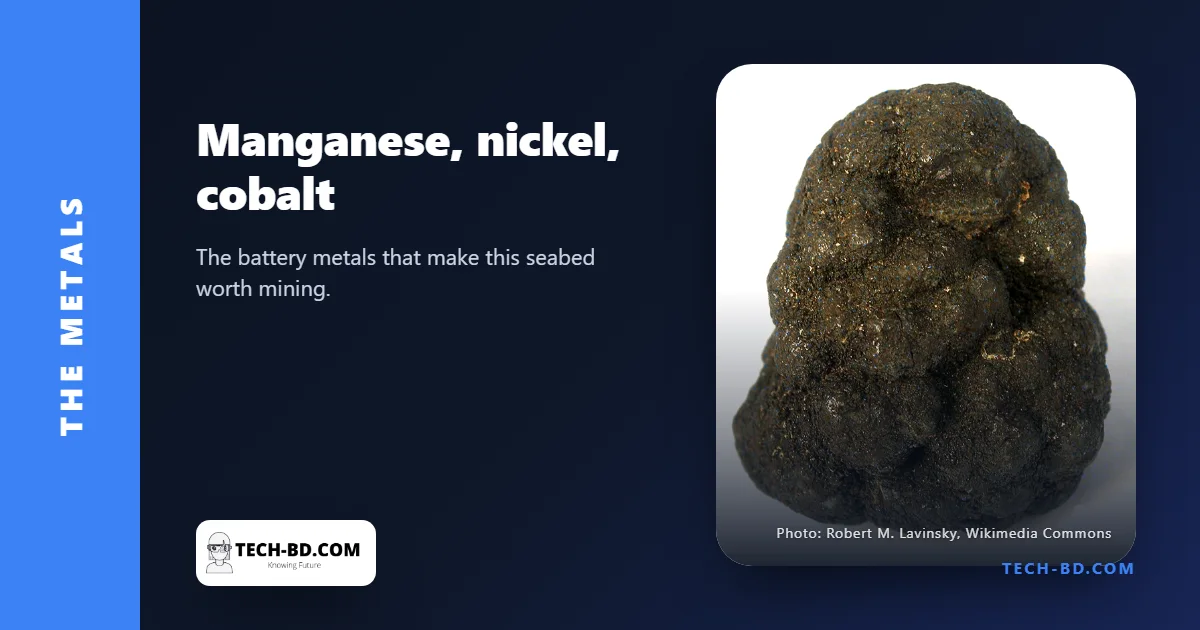
Those nodules are the object of deep-sea mining. They contain manganese, nickel, cobalt and copper — the metals in batteries — and companies have spent years preparing to collect them from exactly this part of the Pacific.
If the nodules are also a source of oxygen for life on the seafloor, then collecting them is not only removing rocks. It is removing whatever is sustaining the organisms around them, in an environment no one has a baseline for.
What is not settled
This is one study in one licence area. The measurements are strong, the mechanism is a hypothesis, and the scale at which it operates across the wider ocean is unknown.
What has changed is the burden of proof. Until now, the argument for mining this seabed rested partly on it being a desert — cold, dark, and largely inert. A seafloor that makes its own oxygen is not a desert, and whoever wants to mine it now has to explain what happens when it stops.
How long the nodules took to get there
One number puts the stakes in order. Polymetallic nodules grow by a few millimetres every million years, accreting metal out of the water around them. The lumps sitting on that seabed are older than the species proposing to collect them, and nothing about the process can be restarted on a human timescale.
That is the real asymmetry in the argument. The metals are genuinely needed — batteries do not get built out of good intentions — and the case for mining them is not frivolous. But a mistake here is not a bad quarter; it is permanent, at a depth where nobody will be watching it happen.