Far more bats are dying in the United States each year than before, and a new study has put a number on the cause.
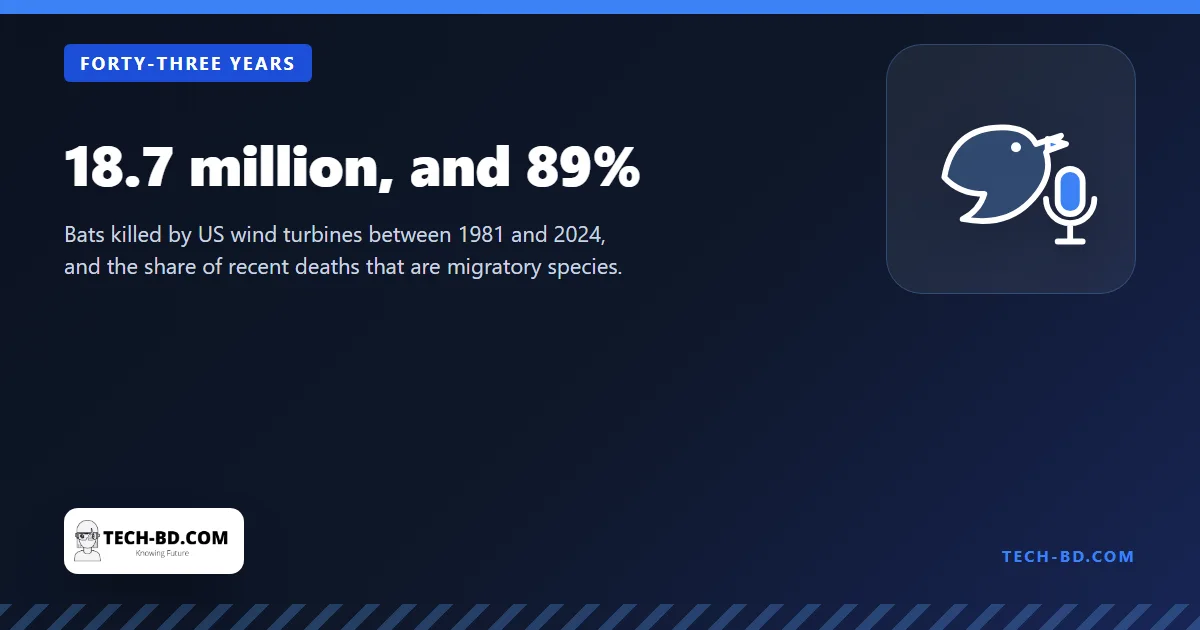
Research published in the journal Proceedings of the National Academy of Sciences estimates that the large turbines at wind power stations killed about 18.7 million bats in the US between 1981 and 2024.
The problem came to scientists’ attention in 2003, after several thousand dead bats were recovered at a new wind farm on a mountain in West Virginia.
The rate is accelerating
Twenty years ago roughly 100,000 bats died this way each year. As the number of wind installations grew, that reached 1.5 million a year by 2021.
Over the four decades, the toll from turbine strikes is close to the damage done by white-nose syndrome, the deadly fungal disease that spread through North America from 2006. Winifred Frick, chief scientist at Bat Conservation International, described the finding as tragic.
Where and why
Bethany Fried, a scientist at the US Geological Survey and senior author of the study, said the Appalachian mountain region has been identified as a major hotspot.
A model built from 499 reports across 277 facilities found that wind farms built near rivers and near the entrances to old mines have the highest death rates. Turbines with larger blades, and blades that rotate closer to the ground, are the most dangerous.
89% of recent deaths are migratory species, the hoary bat prominent among them. A spokesperson for the American Clean Power Association said the industry is aware of the risk to bats and is working to increase conservation measures.
The cost is not only to the bats
Bats eat insects. Where insect-eating bat populations fall, farmers end up using more pesticide, so the loss shows up in agriculture as well as in conservation.
What would work
There is a known fix. A study in the Journal of Applied Ecology, based on data from European wind farms, found that shutting turbines down during the periods when bats are flying could prevent more than 80% of the deaths. Environmental scientists have called for a coordinated national policy in the US to protect bats of all kinds.
The reason this does not simply happen is that the fix has a price: a turbine that is not turning is not earning, and the hours when bats fly are hours the operator would otherwise sell. Which makes this a policy problem rather than a technical one — the engineering answer already exists and is sitting in a journal.
Why bats and not birds
Bats are hit disproportionately, and not only by the blades. Pressure changes in the air around a moving blade tip can injure a bat that never touches it — an effect birds, with differently structured lungs, largely escape.
There is also an attraction problem nobody has fully explained: migratory bats appear to approach turbines rather than simply flying past them. That is consistent with the finding that 89% of recent deaths are migratory species, and it is why the toll concentrates on a small number of species rather than spreading across the population.
What this does and does not say about wind power
It is worth being clear, because a figure like 18.7 million invites misuse. This study is not an argument against wind energy, and nothing in it compares these deaths with the ecological cost of the generation it displaced.
What it is, is a finding that a specific harm has been growing for forty years alongside the industry, that it is now comparable to the worst disease the species faces, and that a known mitigation exists and is not being applied at scale. Those are three separate claims and all three are supportable. Treating the first as a verdict on wind power is the error the data does not license.