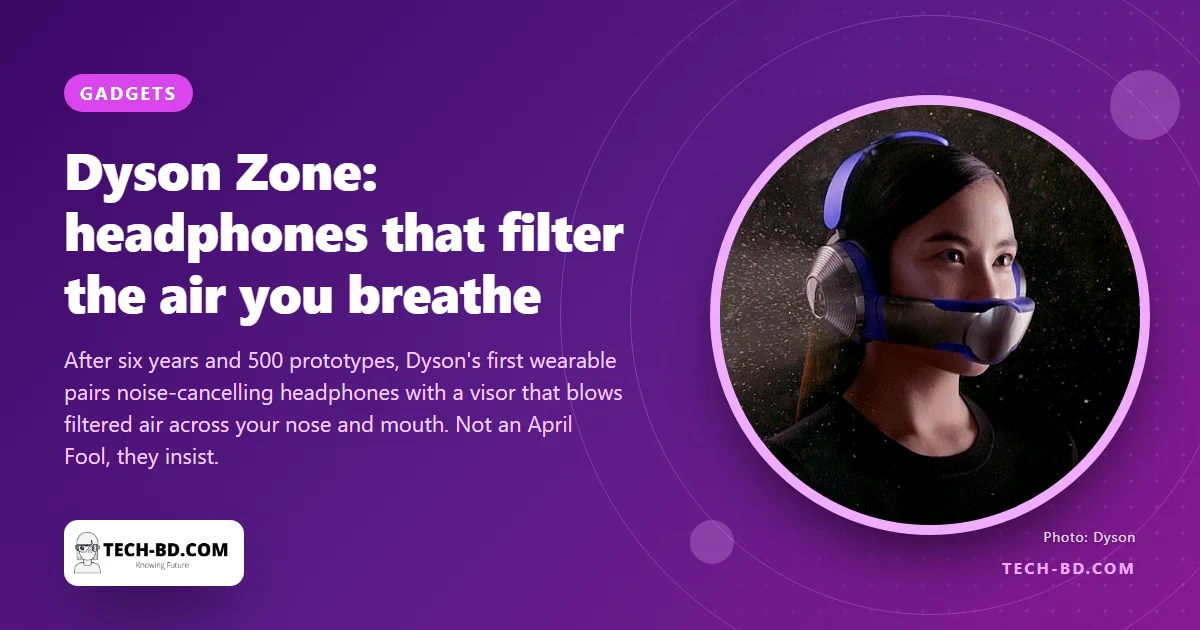
The photograph looked like a joke timed for 1 April: a pair of chunky over-ear headphones with a curved visor hovering in front of the wearer's mouth like a mask that does not touch the face. Dyson, the company that made vacuum cleaners and hair dryers into luxury goods, announced the Dyson Zone on 30 March 2022 and was at pains to say it was real. Six years of development, 500 prototypes, and a product that does two things at once: cancels noise and filters the air.
How it works
Each ear cup hides a small compressor and a two-stage filter. An electrostatic filter catches fine particles, the PM2.5 dust that is the main pollutant in South Asian cities, and a potassium-enriched carbon layer absorbs gases such as nitrogen dioxide and ozone. The purified air is pushed through the magnetic visor and released as a stream in front of the nose and mouth, so the wearer breathes cleaned air without a seal on the skin. The airflow has three speeds, adjusts automatically as you walk faster, and can be switched off indoors; the visor folds down when you take a phone call. Dyson says the filters also trap bacteria. The audio side is conventional: active noise cancelling, large drivers, a companion app that shows local air quality.
Price and date
Dyson said the Zone would go on sale by the end of 2022 and did not give a price. Given that the company's fan-heaters cost more than most phones, nobody expected it to be cheap.
Does it make sense for Dhaka?
Dhaka spent most of the past winter at the top of the global air-quality rankings for the wrong reason, with PM2.5 readings routinely five to ten times the WHO guideline. So a wearable purifier is not a silly idea here; it is arguably more relevant than in London. But three caveats:
- A visor is not a seal. Dyson is careful not to call the Zone a mask. In heavy traffic, a Tk 200 N95 with a proper fit still stops more particles than an open air stream.
- Filters are consumables. They need replacing, and Dyson does not sell them here.
- Battery. Running compressors and noise cancelling together is expected to cut listening time to a few hours.
The more useful take-away is the engineering itself: a compact filter that can be worn. If it works, cheaper copies will follow, and those are the ones that will matter on Mirpur Road.
Update: the Dyson Zone launched in early 2023 at $949, with about four hours of battery when purifying.