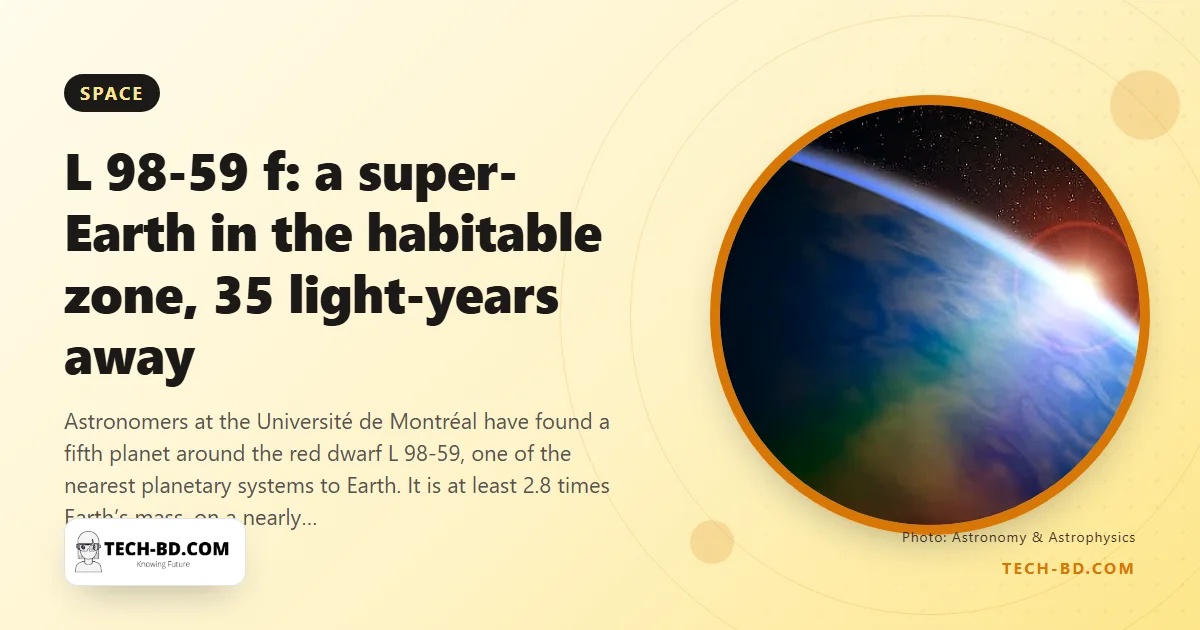
Thirty-five light-years is close by galactic standards, and the small red dwarf L 98-59 has turned out to be an unusually crowded neighbour. A team led by Charles Cadieux at the Université de Montréal’s Trottier Institute for Research on Exoplanets has confirmed a fifth planet there, L 98-59 f, in the region around the star where liquid water could persist on a surface. The paper, in The Astronomical Journal, is a reanalysis rather than a new observation: it pulls together data from NASA’s TESS, the European Southern Observatory’s HARPS and ESPRESSO spectrographs, and the James Webb Space Telescope, and takes the system apart planet by planet.
What was found
L 98-59 f completes an orbit every 23 days. That sounds impossibly close for a temperate world until you remember what kind of star it circles: a red dwarf radiates a small fraction of the Sun’s output, so its habitable zone sits far inward. At 23 days the planet receives roughly the same stellar energy per square metre that Earth receives from the Sun. Its orbit is close to circular, which matters, because an eccentric orbit would swing it through large temperature changes.
Its minimum mass is 2.8 times Earth’s, which places it among the super-Earths — bigger than our planet, smaller than Neptune, absent from our solar system and the most common size of planet in the galaxy.
The word doing the work is “minimum”
The first four planets at L 98-59 were found by transit: from our line of sight they pass in front of the star and dim it, and the depth of that dip gives their diameter. The fifth does not pass in front of the star. It was found the other way — by radial velocity, the small back-and-forth wobble the planet’s gravity imposes on the star, read out of years of HARPS and ESPRESSO measurements.
Radial velocity measures motion along our line of sight only. If an orbit is tilted away from edge-on, part of the planet’s pull is sideways and invisible to us, so the wobble we see is smaller than the wobble that exists. The mass you calculate is therefore the smallest mass that could produce the signal. The true figure is 2.8 Earth masses divided by the sine of an inclination nobody has measured. It could be 3. It could be 6. The other planets in the system being near-coplanar is a reasonable argument that the real number is close to the minimum, but it is an argument, not a measurement.
What this means for Webb, which is not what you would expect
Reports of a potentially habitable planet are usually followed by the line that the Webb telescope will now examine its atmosphere. For L 98-59 f, it cannot — and the reason is the same fact as above.
Webb’s main technique for reading an exoplanet atmosphere is transmission spectroscopy: when a planet crosses its star, a sliver of starlight passes through the planet’s air on the way to us, and the molecules in that air absorb specific wavelengths. No transit, no sliver of filtered starlight, no spectrum. The method requires the planet to get between us and the star, and L 98-59 f never does.
Webb’s work in this system is on the inner planets, which do transit, and that work is the real reason the system matters. L 98-59 is bright and nearby — brighter and closer than TRAPPIST-1, the other multi-planet red dwarf system everyone studies — so its transiting planets are among the best available targets for the question that decides whether red dwarfs matter at all: can a rocky planet orbiting a small, flare-prone star keep an atmosphere? Red dwarfs are the most numerous stars in the galaxy and they erupt violently, especially when young, and a habitable zone pulled in close to the star is a habitable zone inside the blast radius. If atmospheres do not survive there, most of the galaxy’s rocky planets are sterile, and the search narrows sharply. If they do, the number of candidate worlds multiplies.
So the honest summary is narrower than the headline and more interesting. A planet of at least 2.8 Earth masses is receiving about as much light as Earth, 35 light-years away. Nobody knows whether it has air, and from here nobody can find out. What can be found out is whether its siblings kept theirs — and that answer will say more about the galaxy than this one planet ever could.