A recycling centre in Gateshead has had five fires during 2026, every one caused by a lithium-ion battery that somebody threw away.
"We've had four small fires on site and one in the back of a truck which was pretty lively," said Chris Gaffney, manager at GAP Group Recycling. "We were able to contain them safely and are prepared to do so, but they can be very dangerous."
The numbers behind one site's bad year
Figures from the Recycle Your Electricals campaign, run by the not-for-profit Material Focus, put the national picture in proportion.
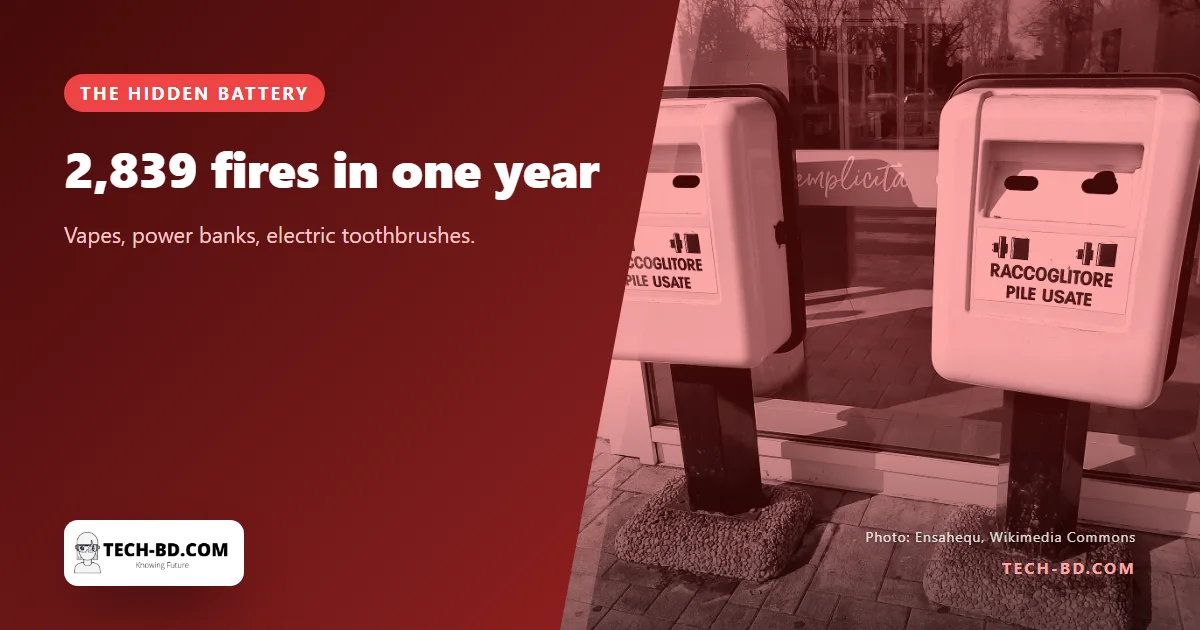
An estimated 2,839 battery fires across the UK in 2025 were caused by items containing hidden batteries.
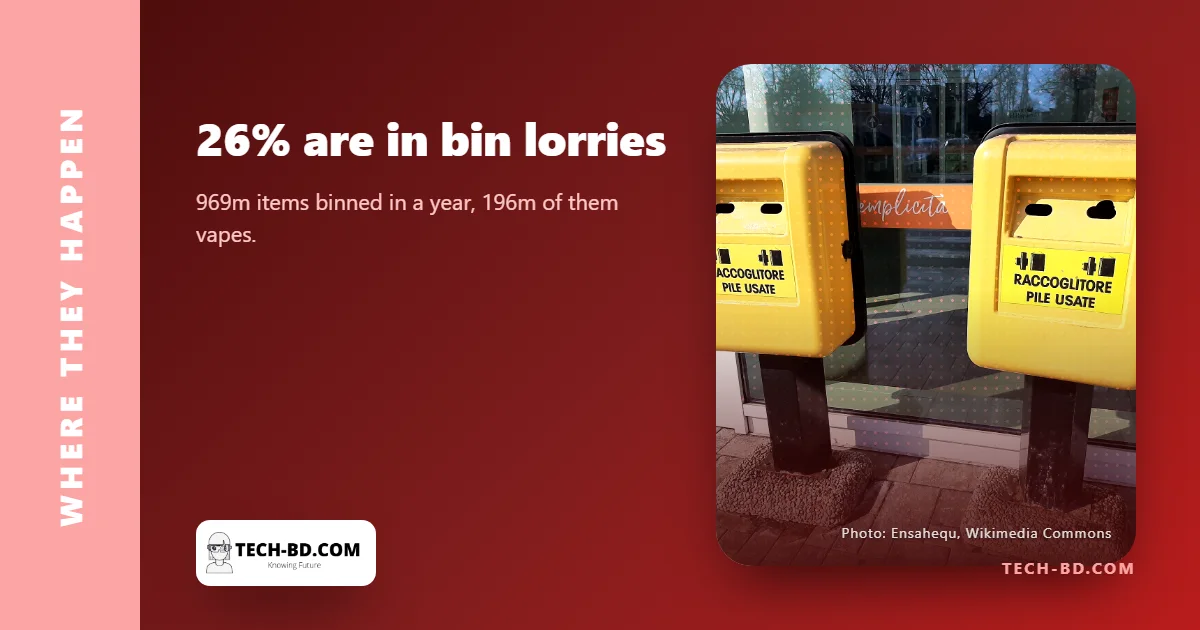
More than one in four fires — 26% — now happen in bin lorries, not at the tip. That is a vehicle with a person in it, moving through a residential street.
And the scale of what gets thrown away: 969 million electrical items and loose batteries were binned over the past year, including more than 196 million vapes.
The items are not the ones you would guess
Nobody puts a laptop in the kitchen bin. The problem is the things people do not think of as electronics at all.
Vapes. Power banks. Electric toothbrushes. Electric razors. Loose household batteries.
Gaffney said staff have to pick through "a lot" of vapes, removing the batteries by hand before anything is recycled.
The mechanism is what makes it dangerous. "The pincer which we use to pick up the material can easily puncture a battery," he said. "Once that happens, it could easily go up and set off another battery and be a big problem."
Lithium-ion cells can ignite within seconds when crushed or damaged, and the resulting fires are notoriously hard to put out — which is the same property we reported when a power bank caught fire in the front row of a Gatwick flight.
Kent has the same problem, with bigger numbers
Kent Fire and Rescue Service is running its own awareness campaign. Councillor Jamie Henderson said incorrectly discarded batteries and small electricals had caused 22 fires at Kent's waste and recycling facilities and 139 at the Allington Energy from Waste plant.
A battery "might seem small", he said, but can have "serious consequences" thrown into a household bin.
Station manager Kev Chapman put the physics plainly: if a battery or rechargeable item "gets wet, damaged or crushed, there is a risk it could overheat and catch alight".
His reason for caring is worth repeating. "By doing so, we can help prevent large fires and protect the lives of our crews and waste operatives." The people at risk are the ones collecting and sorting, not the person who binned it.
What this means here
These are UK figures, and Bangladesh has no equivalent count. But the devices are identical and increasingly common, and the sorting is done far more often by hand.
The practical rule is the same anywhere: anything that charges, or that lights up and was never meant to be opened, does not belong in a household bin. Vapes and power banks are the two worth changing your habit over, because they are the ones people genuinely do not think of as batteries.