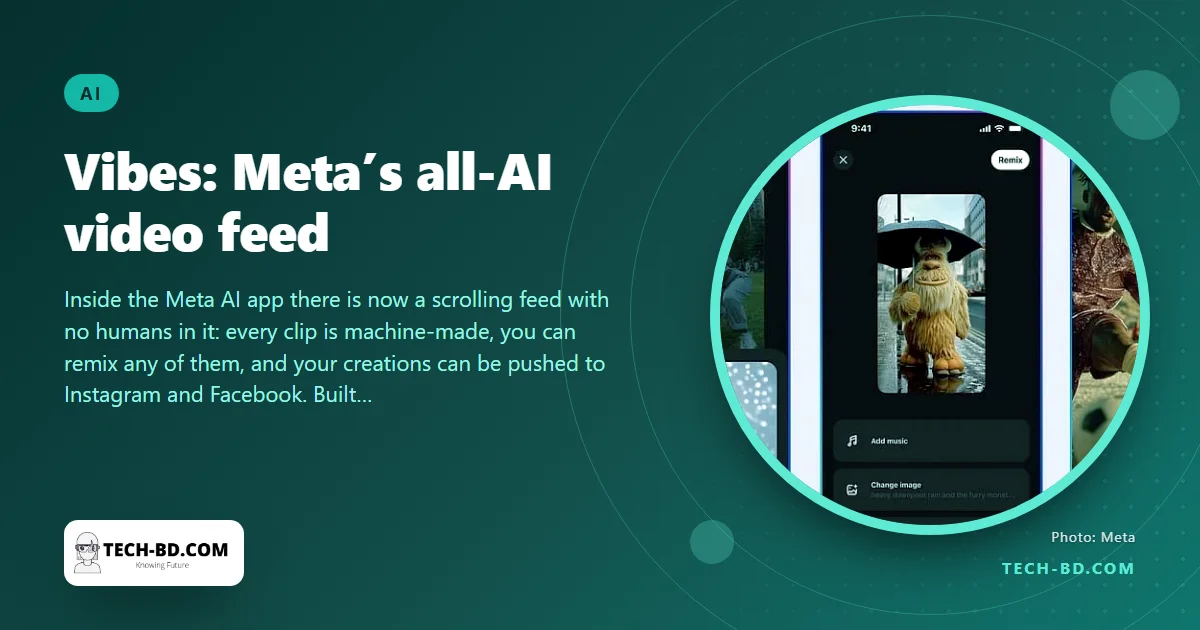
Mark Zuckerberg announced it with a handful of clips: a cat that is also a chef, a city that folds like paper, a woman turning into fireworks. None of it was filmed. Vibes is a feed inside the Meta AI app and on meta.ai where every video has been generated — and the stated point is not to watch but to make.
How it works
Open the feed and scroll, as on TikTok or Reels. Any clip can be remixed: take someone else's video, change the visuals, apply a style, add music, and post the result back to Vibes or push it to Instagram and Facebook Stories and Reels. You can also start from a blank prompt. The recommendation algorithm learns what you linger on, exactly as Meta's other apps do.
Generation currently runs on models from Midjourney and Black Forest Labs; Meta's chief AI officer confirmed that the company's own video model is still being built and will replace them.
Why a platform wants this
The obvious reading is that Meta needs somewhere to justify tens of billions of dollars of AI spending. True, and not the most interesting part.
A social platform's hardest permanent problem is content supply. It needs an enormous volume of new material every day, it does not make any of it, and the people who do make it have to be kept — which is why platforms run creator funds, revenue shares and bonus programmes. That arrangement is expensive, it is a constant negotiation, and creators periodically leave for whoever is paying more.
Generated content changes the terms completely. If material can be produced on demand at near-zero marginal cost, the supply constraint disappears and so does the negotiating position of the people who used to be the supply. A platform that fills its own feed does not need to share revenue with anyone, because there is no longer anyone whose absence would leave a gap.
That is the development worth watching, well beyond this one app. Not whether the videos are good — most will not be — but that the relationship between platforms and the people who fill them has a cheaper alternative for the first time.
Two opposite bets in the same month
Vibes launched as YouTube tightened rules against mass-produced synthetic video that was clogging recommendations and monetisation. The two responses look contradictory and follow from different positions.
YouTube's business is advertising against content people chose to watch, and its risk is that recommendations fill with cheap synthetic material that viewers do not want, which degrades the product and the ad inventory with it. So YouTube restricts.
Meta has concluded that if short video is going to be flooded with synthetic content regardless, it would rather own the flood — and that the way to make it tolerable is to put it in a separate feed, labelled by construction, that people opt into. Quarantine rather than prohibition.
Which is right depends on an empirical question nobody has answered: whether people actually want this. The honest case for Meta's position is that the enormously popular formats of the last decade — remixing a sound, replying to a video, editing a meme — suggest participation beats passive consumption, and a feed built for making rather than watching is at least pointed at something real. The case against is that the output is interchangeable by nature, and a feed of interchangeable things is a feed nobody misses when they stop opening it.
Labelling, and why it leaks
Meta's defence is that content made in Vibes carries a watermark and is identifiable when it reaches the main feed. Worth understanding how that actually works, because there are two mechanisms and they fail differently.
The industry's technical approach attaches provenance metadata to a file: a signed record of what made it and what was done to it afterwards. It is robust while the file stays a file — and it is destroyed by the most common thing that happens to any interesting video. Screenshot it, screen-record it, re-upload it to another platform that re-encodes it, and the metadata is gone. What survives is the pixels.
That is why a visible watermark does more work than the sophisticated invisible one. It is also croppable, and it is routinely cropped.
So labelling helps in the case where content moves through cooperating systems and does very little in the case that matters: a clip stripped of its origin and reposted as though real. That has been the open question since synthetic media arrived, and no announcement has closed it.
The part that is already a problem
Feeds in many countries are already thick with AI-generated clips — captioned "historical" scenes, fabricated product demonstrations, sermons over generated visuals — most of it unlabelled and some of it used to sell things that do not exist. A tool that makes such clips easier to produce makes that worse before any labelling makes it better, because the people producing them for fraud are exactly the people who will remove the label.
What a viewer can actually do is unglamorous and works without any platform cooperation. Treat a video that shows a product doing something remarkable as an advertisement until proven otherwise. Check whether anyone other than the account posting it has reported the same thing. Be most suspicious of footage that is emotionally effective and has no identifiable source — that combination is the signature, far more than any visual artefact, because the artefacts get better every year and the sourcing does not.
For now the feed is rolling out in the United States and a few other countries, arriving elsewhere when the Meta AI app does.