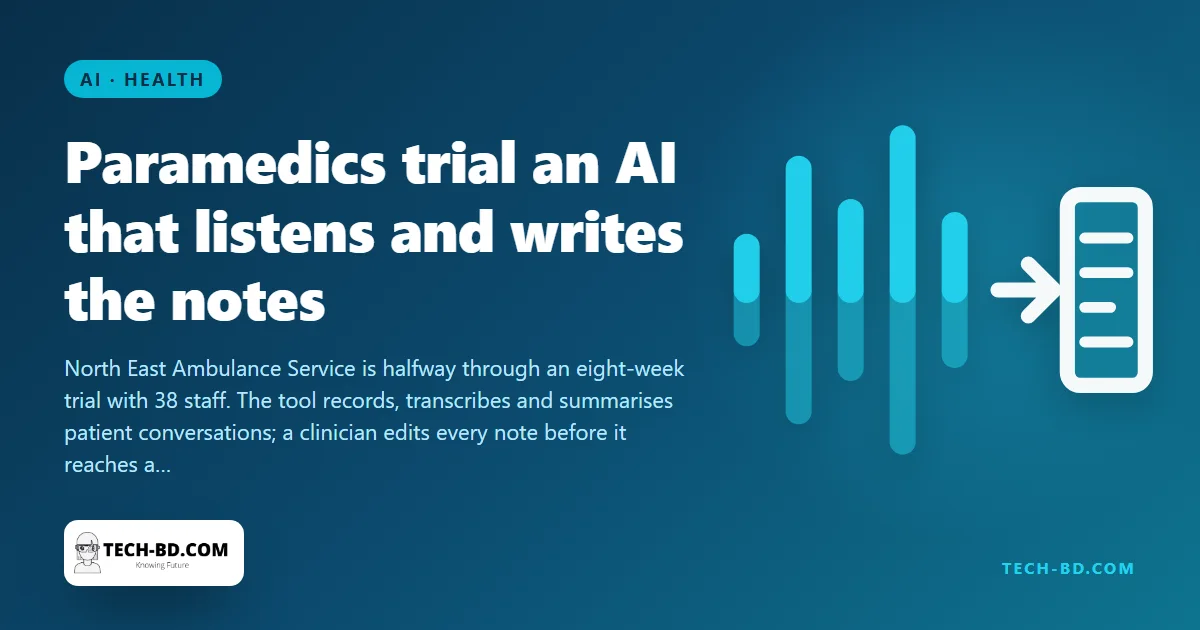
Paramedics in the north-east of England are testing an AI assistant that listens to their conversations with patients and writes the notes.
North East Ambulance Service (NEAS) says it is halfway through an eight-week trial of technology that records, transcribes and summarises patient conversations, with 38 people taking part — paramedics and operational staff. The trial ends in November, and a decision on the tool's future follows.
How it works
The software uses the built-in microphones of the iPads ambulance staff already carry, and is being used in real interactions with patients rather than in simulation.
The safeguard is the part worth noting: all notes generated by the ambient voice technology are reviewed and edited by a clinician before they are added to a patient's record.
Georgina Campbell, the service's digital clinical lead, said the trial would help the team understand how emerging technology could be used "safely and effectively, while maintaining the high standards of care and record keeping that our patients and communities expect".
NEAS says it hopes the tool may reduce staff workload and improve the consistency and accuracy of record-keeping.
Why this is a better design than most
Three choices here are worth separating from the general noise about AI in healthcare.
It is small and bounded: eight weeks, 38 people, one task. It is honest about the task — transcription and summary, not diagnosis or triage. And the human review is before the record is written, not after a complaint.
That last point is the one that usually goes wrong. A system where the clinician signs off afterwards becomes a system where the clinician signs off without reading, because the note is already in the file and reading it is extra work. Putting the review in the path makes it the only way the note gets saved.
The open question the trial has to answer is not accuracy. It is whether the time saved on typing is larger than the time spent correcting — and whether tired staff at the end of a shift correct as carefully as fresh ones at the start.
What it means in Bangladesh
Ambient note-taking is one of the few AI health applications that could transfer here without a regulatory apparatus, because it does not make a clinical decision. It writes down what was said.
But it transfers only if it works in Bangla, and that is not a small caveat. Transcription in Bangla is substantially behind English, worse again with regional accents, and a Dhaka ambulance is a loud environment. An English-trained tool in a Bangladeshi ambulance would not produce a slightly worse note; it would produce an unusable one.
The more realistic near-term use is the quieter setting — an outpatient consultation room in a district hospital, where a single doctor may see a hundred patients in a day and the written record is whatever can be managed between them. That is a documentation problem long before it is an AI problem, and it is the place where even imperfect transcription would be an improvement on nothing.
Source: BBC News, North East and Cumbria.