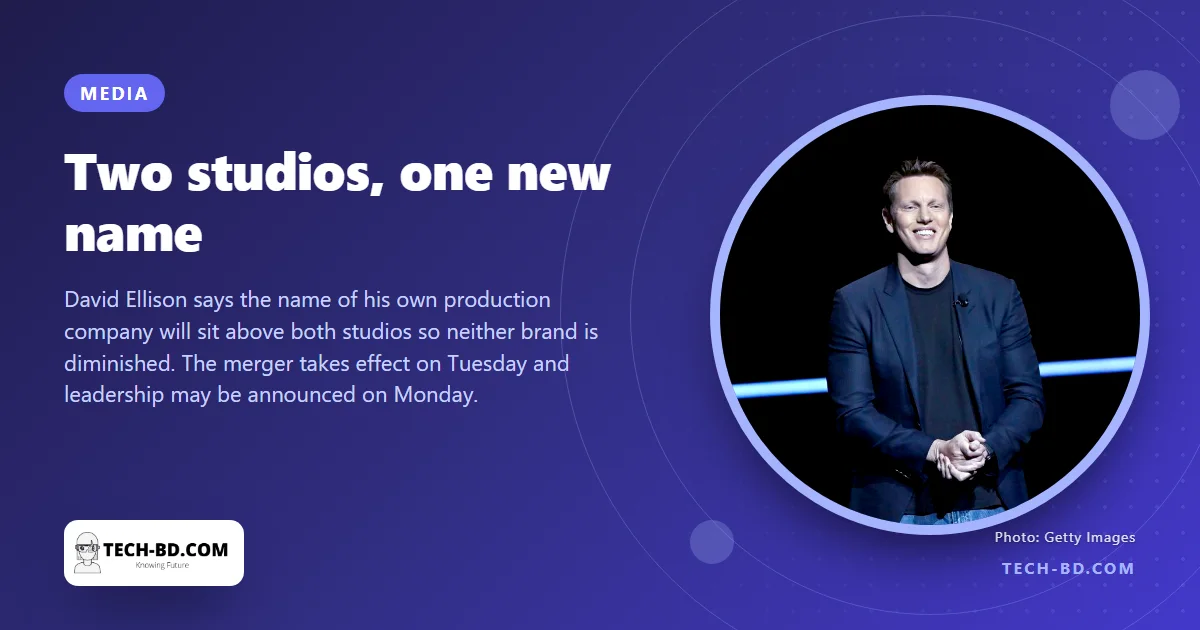
The combined Paramount–Warner Bros. Discovery will be named Skydance, chief executive David Ellison announced on Friday, days before the merger completes.
The name
Skydance was the production company Ellison founded in 2006; the name came from his love of aviation and an aerobatic manoeuvre. When he took control of Paramount in 2025 he renamed it Paramount Skydance.
"As we bring Paramount and Warner Bros. together, we wanted to preserve what has made each of these studios iconic," Ellison wrote. "We never wanted a new corporate identity to diminish, alter or overshadow either one."
The merger is expected to take effect on Tuesday. Ellison may name the leadership team on Monday, people familiar with the planning told CNN.
What it means in Bangladesh
Paramount and Warner Bros. are two of the handful of studios whose libraries make up most of what a Bangladeshi household watches when it watches anything foreign. Putting them under one owner reduces the number of entities that decide what reaches this market, and on what terms.
The practical consequence runs through licensing. Netflix, Amazon and the local platforms — Hoichoi, Bongo, Chorki, Toffee — buy from a catalogue, and catalogue owners that merge gain pricing power over everyone who buys. A single negotiation now covers what used to be two. For a market that pays in taka and is never anyone's priority, that matters more than the branding.
The second consequence is the one worth watching. Consolidated studios increasingly want their own direct subscription relationship rather than a licensing fee. Every title pulled back into an owner's own service is a title the Bangladeshi platforms cannot carry, in a country where the realistic subscription budget is one service, not four.
There is a more hopeful reading, and it is not naive. Studio consolidation has historically coincided with studios losing interest in mid-budget local-language production — which is precisely the space Bangladeshi and Bengali-language producers occupy. Chorki and Hoichoi did not grow because they outbid anyone. They grew because they made things nobody in Los Angeles was going to make.
On the name itself, the honest assessment is that it is a reasonable solve for a real problem. Two hundred-year-old brands cannot be ranked without insulting one, so you put something neutral above both. Whether "Skydance" means anything to anyone outside the company is a different question.