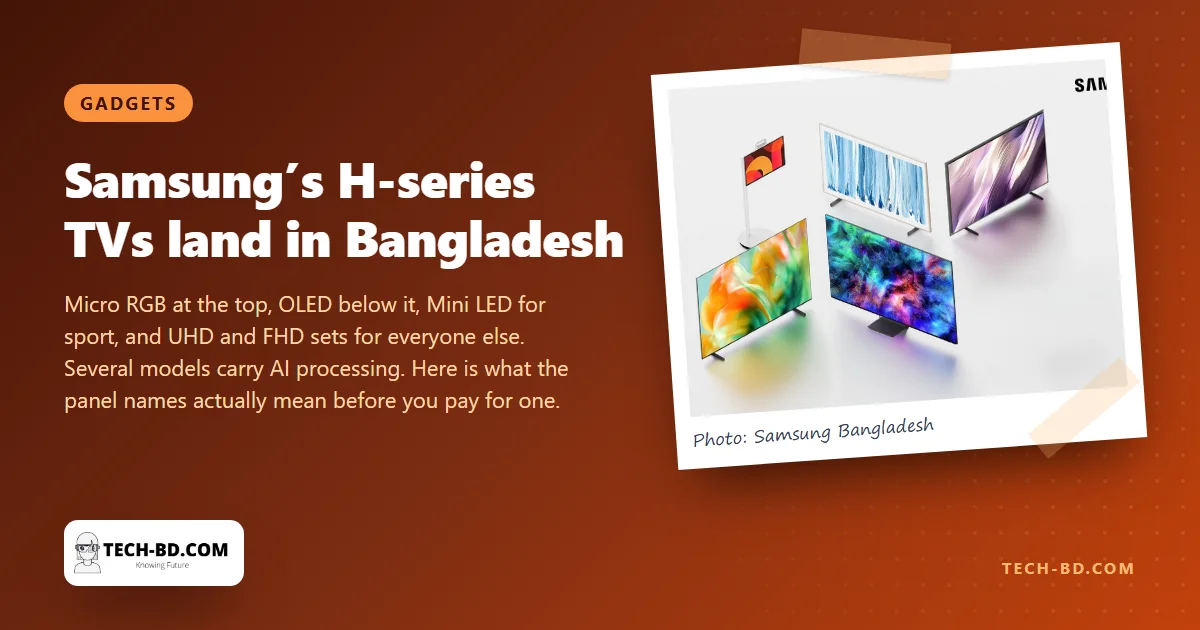
Samsung Bangladesh has brought its new H-series televisions to the local market, spanning several display technologies, with AI processing in several of the models.
The line-up
At the top sits the R95H, built on Samsung's Micro RGB technology. Below it are two OLED sets, the S95H and S85H, which the company positions on precise contrast and an ultra-fast refresh rate for films and gaming.
For sport there is the Mini LED M70H, with a dynamic sound pack meant to give a stadium feel indoors. For everyday viewing there are the UHD U8500H and U9000H, and the FHD/HD F6000F and F5000F series.
The headline technology is Micro RGB: an advanced AI engine combined with red, green and blue light chips described as smaller than a snowflake, producing brighter images, precise contrast and more vivid colour. The sets also use a glare-free screen coating, so room light and daylight do not reflect off the panel — genuinely useful in Bangladeshi living rooms, which are rarely dark.
What the names actually mean
Panel marketing is confusing by design, so here is the short version before anyone spends.
OLED lights each pixel individually, so black is truly black. It is the best picture in a dark room and the usual choice for films. Mini LED uses a backlight divided into many small zones — not as precise as OLED in the dark, but much brighter, which matters more in a bright room. Micro RGB is a further step in backlight control, using separate coloured light sources for finer colour. UHD is a resolution, not a panel technology, and an inexpensive UHD set and an expensive one can look very different.
The practical rule: buy for the room, not the spec sheet. A bright drawing room with windows rewards brightness and anti-glare over perfect black levels.
What it means in Bangladesh
Prices have not been announced, and that is the whole question here. Imported electronics carry duty and VAT that shift the effective price well above the international sticker, and a premium panel is exactly where that gap is widest.
Two things are worth checking before buying at this end of the market. First, warranty and panel service: a Micro RGB or OLED panel is not repairable at a local shop, so the value of the official warranty and the availability of parts in-country is a real part of the price. Second, what you will actually feed it. Most viewing here is broadcast, cable and streaming at bitrates that will not reveal the difference between a good UHD set and a flagship. The upgrade that most often improves picture is a better source, not a better panel.
There is also a timing point. Component prices have been moving — we wrote about memory prices rising again in Dhaka this month — and display panels sit in the same import-and-currency squeeze. A launch price announced now is not a price that necessarily holds.