
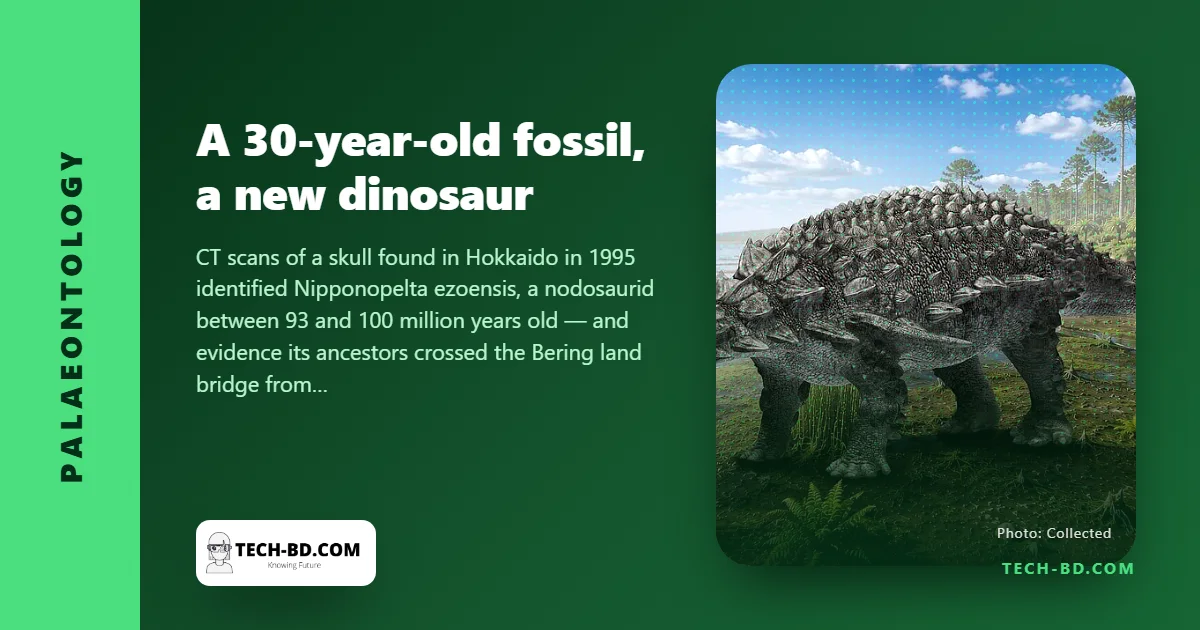
A dinosaur fossil found in Japan about 30 years ago has been re-examined and identified as a new species of armoured dinosaur — and in the process has helped explain how dinosaurs moved between continents. The work is published in Cretaceous Research.
The animal
The new species is named Nipponopelta ezoensis. Nippon means Japan, pelta means shield, and Ezo is the traditional name for Hokkaido. The fossil was recovered in 1995 from marine sediment on Hokkaido, Japan's northernmost island.
What changed is the technology. Researchers used CT scanning to analyse the back of the skull, parts of the jaw and the teeth — detail that was not accessible when the fossil was first found. It is between 93 and 100 million years old.
Victoria Arbour of Canada's Royal BC Museum made the general point: analysing fossils with new technology is bringing a great deal of previously unknown history to the surface. The animal belongs to the nodosaurid family — four-legged plant-eaters covered in bony armour plates, living in coastal areas.
The migration story
Here is why it matters beyond one skeleton. Nodosaurid fossils are abundant in North America and Europe and extremely rare in Asia. This specimen's physical similarity to North American dinosaurs, combined with that scarcity, points to a route.
The researchers conclude that this dinosaur's ancestors crossed from North America into Asia 110 to 100 million years ago, over the Bering land bridge — the ancient land connection where Alaska and Russia now face each other. Darla Zelenitsky, a dinosaur palaeobiologist at the University of Calgary, notes that because these animals lived in coastal regions, migrating that way would have been comparatively easy.
The fossil coming out of marine sediment suggests the body was washed down a river and out to sea after death.
Why Asia has so few
Jordan Mallon of the Canadian Museum of Nature offers the caution that keeps this honest: the fossil record is often incomplete, because erosion on higher ground means fossils are not easily preserved. So Asia's scarcity of nodosaurids may reflect the limits of the rock record rather than a genuine lack of these dinosaurs. Further excavation should settle it.
What it means in Bangladesh
The transferable lesson is about collections, not digs. This discovery required no new expedition — the fossil had been in hand since 1995. What was needed was a CT scanner and someone willing to look again.
Bangladesh has museum and university collections that have been catalogued once and rarely revisited, and it now has CT capacity in hospitals in every divisional city. Re-examining existing holdings is the cheapest research a poorly funded department can do, and it does not depend on a field season or a foreign grant.
There is a geological point too. Bangladesh is a delta — kilometres of young sediment over anything older — so it will never be a dinosaur country. But the same marine and fluvial deposits that buried this nodosaurid are the country's entire surface geology, and they hold a record of far more recent change: sea levels, river courses, climate. That record is directly relevant to a country arguing about its own coastline, and reading it requires the same patient work.