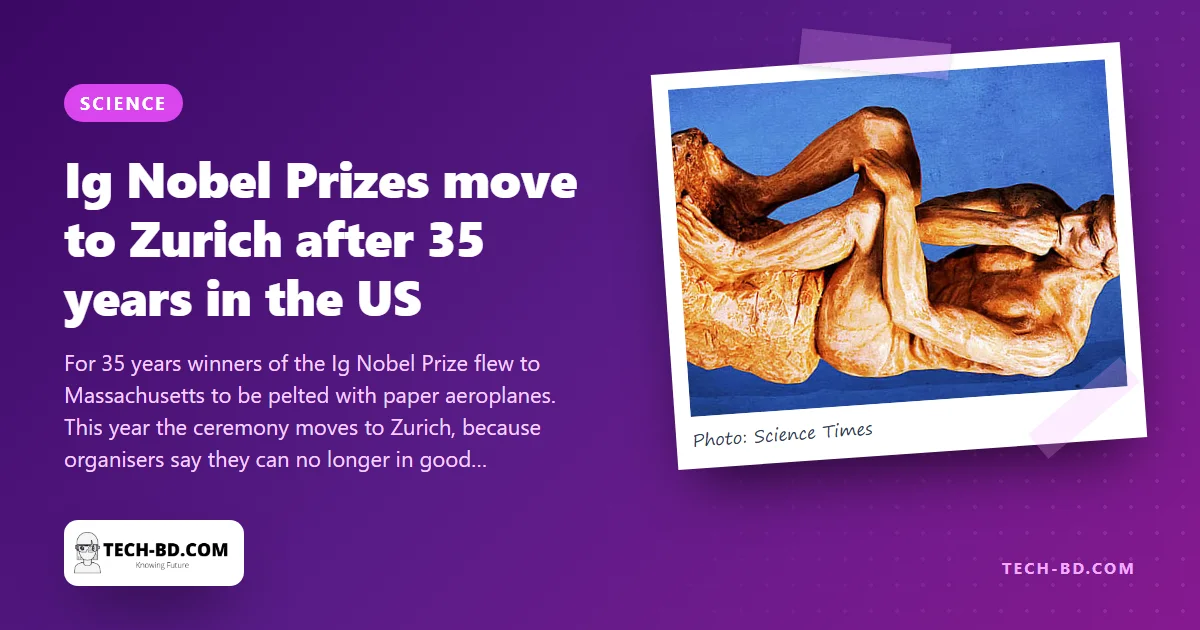
The Ig Nobel Prizes honour research that "first makes people laugh, then makes them think" — studies on whether cows named individually give more milk, or how quickly a wombat produces cube-shaped droppings. For 35 years the ceremony has been an American institution, held each September shortly before the real Nobels, with laureates accepting their awards under a hail of paper aeroplanes thrown by the audience. This year, for the first time, it will not happen in the United States.
What is changing
The 36th ceremony, organised by the magazine Annals of Improbable Research, will be held in Zurich, in partnership with the University of Zurich and ETH, the Swiss Federal Institute of Technology. Organisers say it will return to Zurich every second year, with other European cities hosting in between.
Why
The stated reason is blunt. Marc Abrahams, the magazine's editor and the ceremony's master of ceremonies, told The Guardian that over the past year travelling to the US had become unsafe for the event's guests, and that organisers could not in good conscience invite this year's winners or international journalists to make the trip. The problem is practical as much as political: growing difficulty and uncertainty in obtaining US visas. The trend was visible already — four of the ten laureates did not come to Boston for the previous main ceremony.
The laureate who won both
The case for taking a joke prize seriously is best made by one person.
In 2000 the Ig Nobel for physics went to Andre Geim, for levitating a live frog using magnets. It is exactly the kind of result the prize exists for: funny, apparently pointless, and widely treated as a stunt. It was also a real demonstration of diamagnetism — the fact that ordinary matter, including water and therefore frogs, is very weakly repelled by a magnetic field, strongly enough to float if the field is strong enough.
Ten years later Geim won the Nobel Prize in Physics for graphene, isolated in his lab using adhesive tape to peel layers off graphite. He remains the only person to hold both prizes, and his two awards share a method rather than a subject: trying the obviously silly experiment to see what happens.
That is the serious content of a comic award. Research that sounds absurd in a one-line summary is not a separate category from research that matters — frequently it is the same work described before anyone knows which it will turn out to be. The 2006 physics Ig Nobel, for why dry spaghetti snaps into more than two pieces, is now a standard teaching illustration in fracture mechanics. The prize's real function is to notice work at the stage when it still sounds ridiculous.
What a conference actually does
A ceremony relocating because guests cannot reliably get visas sounds like an inconvenience. What is lost deserves spelling out, because the mechanism is not obvious from outside academia.
Papers can be read anywhere, and increasingly are. What a conference provides is everything that does not go in a paper: the conversation after a talk that becomes a collaboration, the senior researcher who meets a PhD student and remembers the name two years later when a position opens, the corridor exchange that saves somebody a year of work because it turns out two groups are solving the same problem.
Those are disproportionately valuable early in a career and to people without an established network — which is to say, exactly the researchers for whom a visa is hardest to obtain. The friction is not distributed randomly. It falls on applicants from particular passports, and it compounds: a researcher who misses three conferences in their first five years has a measurably smaller network than one who attended, and the gap does not close later.
A hybrid session is better than nothing and is not a substitute. Nobody has ever started a collaboration in a video call they were not already invited to.
The wider pattern
Scientific conferences have been quietly relocating for some time, choosing venues where attendees from Asia, Africa and the Middle East can actually get in. Organisers increasingly treat visa accessibility as a selection criterion alongside cost and facilities, which is a change in how the infrastructure of science gets planned.
For researchers in Bangladesh, who routinely lose weeks to appointment queues and occasionally lose the trip entirely, a Europe-based Ig Nobel is marginally easier to reach. Schengen visas remain a hurdle, but a more predictable one — and predictability is most of what matters when a conference date is fixed and an appointment slot is not.
The practical advice for anyone presenting abroad is unglamorous and widely ignored: start the visa process the day the paper is accepted rather than when the travel is booked, because the binding constraint is almost never the decision — it is the wait for an appointment to be seen at all.
Whether the move is temporary or the start of a permanent European home, the organisers have made their point: the paper aeroplanes will fly wherever the scientists can.