
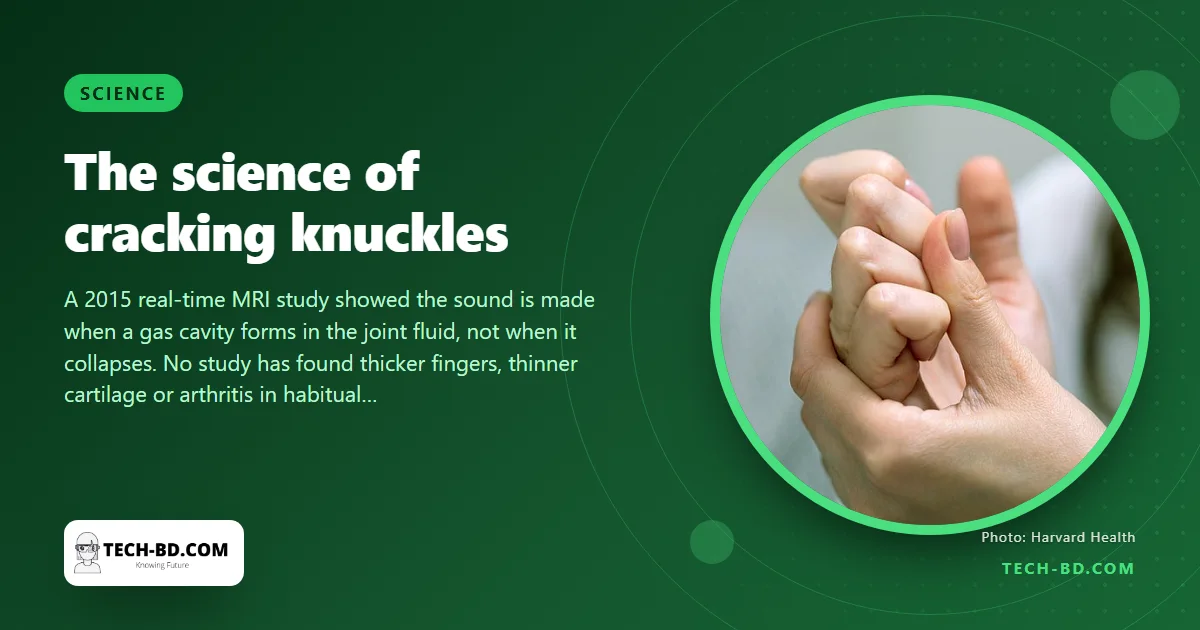
Everyone who cracks their knuckles has heard the same warnings: the fingers will thicken, the joints will wear, arthritis is coming. The warnings are decades old. So is the research that answers them, and it is more interesting than the warnings — partly because one of the answers is not the clean "it is completely harmless" that gets repeated.
What makes the sound
A finger joint is sealed inside a capsule of synovial fluid, a slippery liquid that lets the bone ends glide. Pull or bend the joint hard and the two surfaces separate; the space between them expands faster than the fluid can flow in to fill it. Pressure drops sharply, dissolved gas comes out of solution, and a cavity appears in an instant.
The process is called tribonucleation, and in 2015 a team led by Greg Kawchuk at the University of Alberta watched it happen. They put a volunteer's finger in an MRI scanner running in real time at three frames a second, attached a cable, and pulled. The paper, in PLOS ONE, is titled "Real-Time Visualization of Joint Cavitation", and the images show a dark void appearing in the joint at the same moment as the sound, and still sitting there afterwards.
That mattered because it contradicted the standard explanation. Since a 1971 study the accepted account had been that the noise came from a bubble collapsing. The MRI showed the bubble being born, not dying.
The part usually reported as settled, which is not
Three years later a mathematical model published in Scientific Reports argued that a partial collapse of the newly formed bubble could reproduce the recorded acoustic signature, and that the observed cavity persisting afterwards is compatible with that. So the question is not closed. What the MRI definitively established is that a bubble forms at the moment of the crack; whether the sound comes from the formation or from a partial collapse immediately after is still argued over.
This is worth stating plainly because it is a good small example of how science gets reported. The 2015 study was widely written up as having settled a century-old mystery. It did settle something — the gas cavity is real and visible and it appears rather than vanishes — and it left something open.
Why you cannot crack the same knuckle twice
The cavity does not disappear at once. The gas takes roughly twenty minutes to dissolve back into the fluid, and until it has, the joint cannot form a new one — which is why a knuckle just cracked will not crack again however hard you try. Nothing is healing. Gas is redissolving.
The fifty-year experiment, and why it is not the evidence
Donald Unger, an American physician, cracked the knuckles of his left hand at least twice a day for fifty years and deliberately left the right hand alone. He published the comparison in a letter to a rheumatology journal in 1998: no arthritis in either hand, no difference between them. In 2009 he received the Ig Nobel Prize in medicine, the parody award for research that makes people laugh and then think.
It is a wonderful story and it is not proof of anything. One subject, unblinded, assessing his own hands, with no control for the thousand other ways two hands differ. If the result had gone the other way nobody should have believed that either.
The actual evidence is duller and much stronger. DeWeber and colleagues (2011), in the Journal of the American Board of Family Medicine, compared people with and without a knuckle-cracking habit and found no association with hand osteoarthritis — and, importantly, none with total duration or cumulative lifetime exposure either, which is what you would expect to see if the damage were accumulating.
The one finding that is not reassuring
Coverage of the subject tends to leave it out. Castellanos and Axelrod (1990), in the Annals of the Rheumatic Diseases, examined 300 consecutive patients aged 45 and over — 74 habitual crackers and 226 non-crackers. On arthritis they found what everyone else found: no difference. But the habitual crackers were more likely to have hand swelling and lower grip strength.
That is a single study, it is observational, and it cannot tell you the direction of cause: people with weaker, more swollen hands may simply be more inclined to crack them. It is not a reason to stop. It is a reason to be accurate, because "completely harmless" is a stronger claim than the literature supports, and a debunking is only useful if it survives being checked.
So, the honest summary
Cracking your knuckles does not cause arthritis. The evidence on that is consistent across decades and across study designs, and the fear can be retired. The sound is gas, not grinding, and it is not a signal of damage. One study found an association with swelling and grip strength that nobody has since explained, so "no known link to arthritis" is more defensible than "no effect at all".
And the normal caveat holds, as always: a joint that hurts, swells or loses movement after cracking is not doing what a healthy joint does, and that is a question for a doctor rather than for an article.