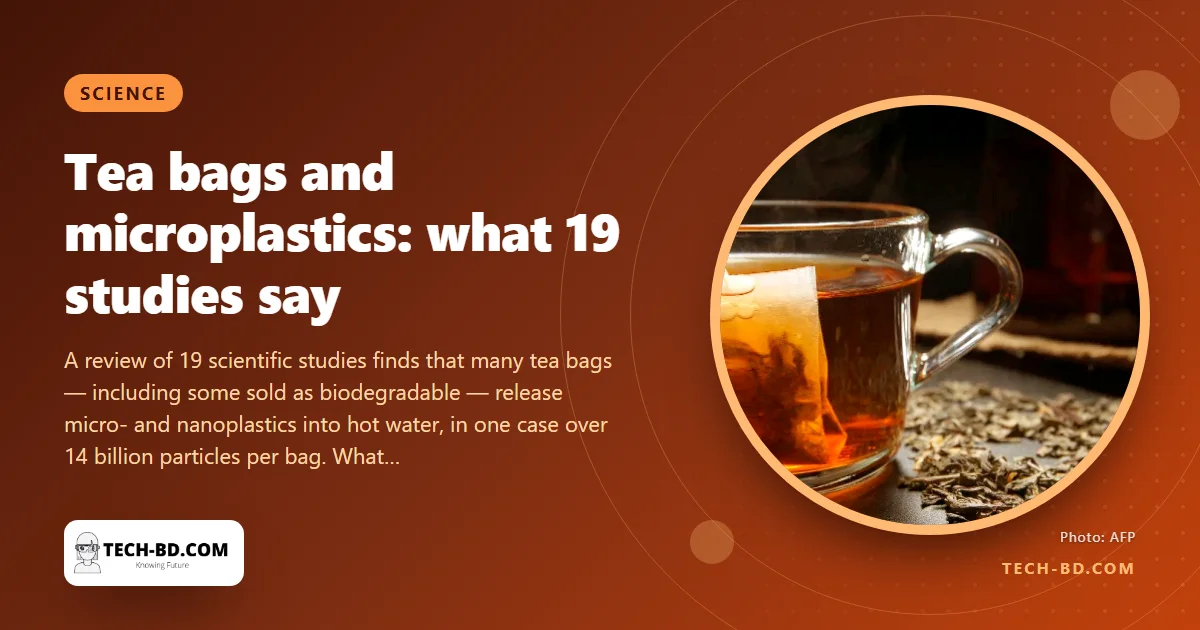
Research from the Mutagenesis Group in the Department of Genetics and Microbiology at the Universitat Autònoma de Barcelona measured what commercial tea bags release into the cup during brewing. The numbers are large, but they are not the part of the study that matters most.
What each material released
The team tested three bag materials and counted particles per millilitre of brewed liquid:
- Polypropylene — about 1.2 billion particles per millilitre, averaging 136.7 nanometres.
- Cellulose — about 135 million particles per millilitre, averaging 244 nanometres.
- Nylon-6 — about 8.18 million particles per millilitre, averaging 138.4 nanometres.
Particle counts were established using scanning and transmission electron microscopy, infrared spectroscopy, dynamic light scattering, laser Doppler velocimetry and nanoparticle tracking analysis — a range of methods that matters, because counting objects a hundred nanometres across is where this kind of research usually goes wrong.
The result that was actually new
Measuring shedding is not novel; several groups had done it. What this study added was the next step: exposing human intestinal cells to the particles and watching what happened.
The cells absorbed them. Mucus-producing intestinal cells took up the most, and particles were found to have entered the cell nucleus — the compartment holding the cell's DNA.
That is the finding worth reporting, and it is a different claim from "there are particles in your tea". It establishes a route from cup to cell, which is the step every previous study had to assume.
The part that overturns the obvious response
The intuitive reaction to "plastic in tea bags" is to buy the plastic-free kind. The data complicates that.
Cellulose is the plant-based material used in bags marketed as plastic-free or biodegradable. It released 135 million particles per millilitre — sixteen times more than nylon-6, and with the largest average particle size of the three.
So the choice is not between a shedding bag and a clean one. All three materials shed; they differ in how much and at what size. Anyone switching to paper or cornstarch bags on the assumption that this solves the problem has made a smaller improvement than the packaging implies.
What this does not establish
Three limits, and they should sit alongside the headline figures.
Cell cultures are not people. Intestinal cells in a dish exposed directly to a particle suspension are a reasonable model of absorption and a poor model of a digestive system, which has mucus layers, transit times and an immune response that a culture does not.
Absorption is not harm. The study shows particles crossing into cells and reaching the nucleus. It does not show what they do there. The honest position is that a plausible route to harm has been demonstrated and the harm has not.
"Billions per millilitre" needs scale. The number is arresting because nanoparticles are small — a billion particles 137 nanometres across is a very small total mass. That does not make it harmless; it means the count alone cannot tell you whether it is.
The one change that follows from the evidence
If you want to reduce exposure without waiting for the toxicology, the answer is not a different bag. It is loose-leaf tea and an infuser, which removes the bag from the equation entirely and costs very little.
Beyond that, the sensible posture is the one the researchers themselves take: this is a reason for regulators to require disclosure of food-contact materials and for the field to run proper exposure studies — not a reason to stop drinking tea.
Sources: the Universitat Autònoma de Barcelona study and its EurekAlert release; Food Safety Magazine; Earth.com; Fortune Well; and Prothom Alo's original report.