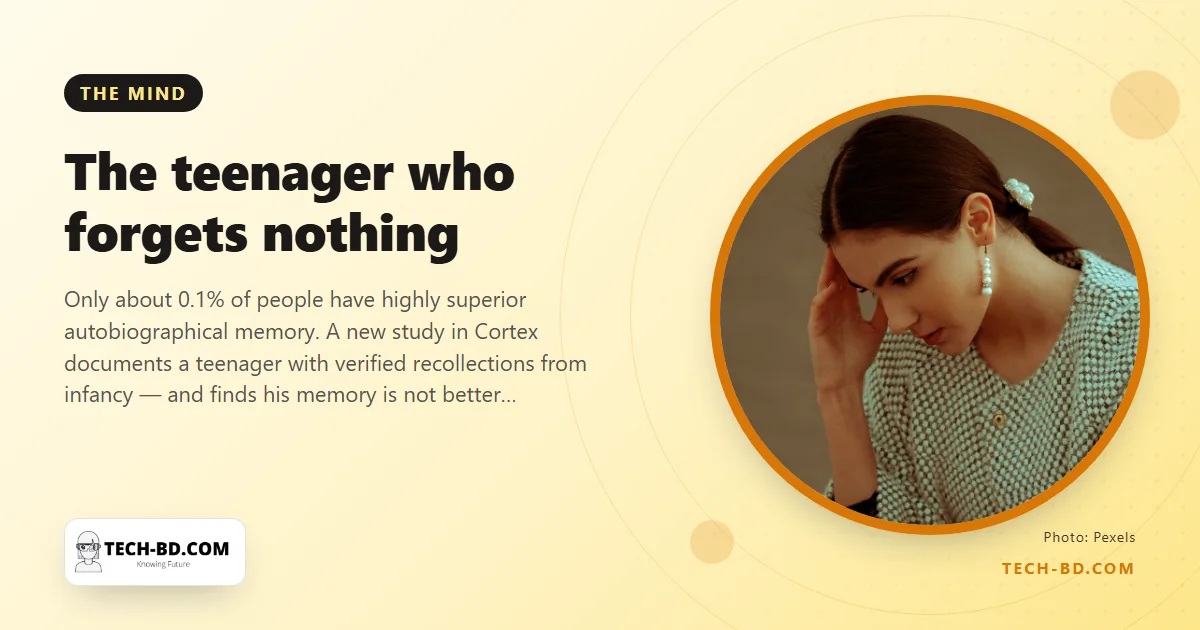
Human memory is fragile and fades with time. But a very small number of people can recall the ordinary days of their past in precise detail — and researchers have now documented that ability in a 16-year-old boy.
The study, published in Cortex, keeps his identity private and refers to him as KCL. Researchers say he has hyperthymesia, also called highly superior autobiographical memory (HSAM).
What he can do
KCL has an extraordinary ability to recall his own childhood with unusual precision and clarity, including events from when he was just three months old. His parents confirmed the accuracy of those early memories, and said his conscious recall became stronger from the age of three.
According to them, a particular smell, a song or a short sentence can bring a memory into his mind unbidden.
Researcher Christian Bergikovsky and colleagues at Grenoble Alpes University in France analysed this involuntary recall in depth. Compared with ordinary people, KCL's ability to retrieve past memories was far greater. His mental capacity for planning ahead and for other kinds of thinking was normal.
The finding that matters
The researchers are careful about what this is. It is not generally superior memory. It is a change in the dynamics of how the brain retrieves information.
That distinction is the whole result. People with HSAM learn everyday information at about the same rate as everyone else — they are not better students, they do not absorb facts faster. What differs is the route back to autobiographical experience: for most of us that path degrades, and for them it stays open.
The team confirmed the diagnosis through remote testing. They estimate only about 0.1% of the population has this kind of memory, and note that such people otherwise behave much like anyone else.
What it means in Bangladesh
Two things are worth drawing out, and neither is about prodigies.
The first is how easily this is misread. A child who recalls early events in vivid detail is likely to be treated here as either gifted or as making it up, and both readings are wrong. HSAM is a retrieval difference, not intelligence, and it does not predict academic performance — a distinction worth knowing in a school culture that rewards memorisation and tends to confuse it with understanding. A student who cannot recite a chapter is not failing to remember; they are being asked for the kind of recall that this study shows is a separate faculty altogether.
The second is the method. This diagnosis was confirmed remotely — the team tested KCL at a distance. Bangladesh has very few clinical neuropsychologists and almost all of them are in Dhaka, which puts assessment out of reach for most families. Remote cognitive testing is a route around that, and this study is a demonstration that it produces publishable results. The same argument applies to diagnosis more broadly, as we found when a family reached a rare-disease diagnosis that the system around them had missed.