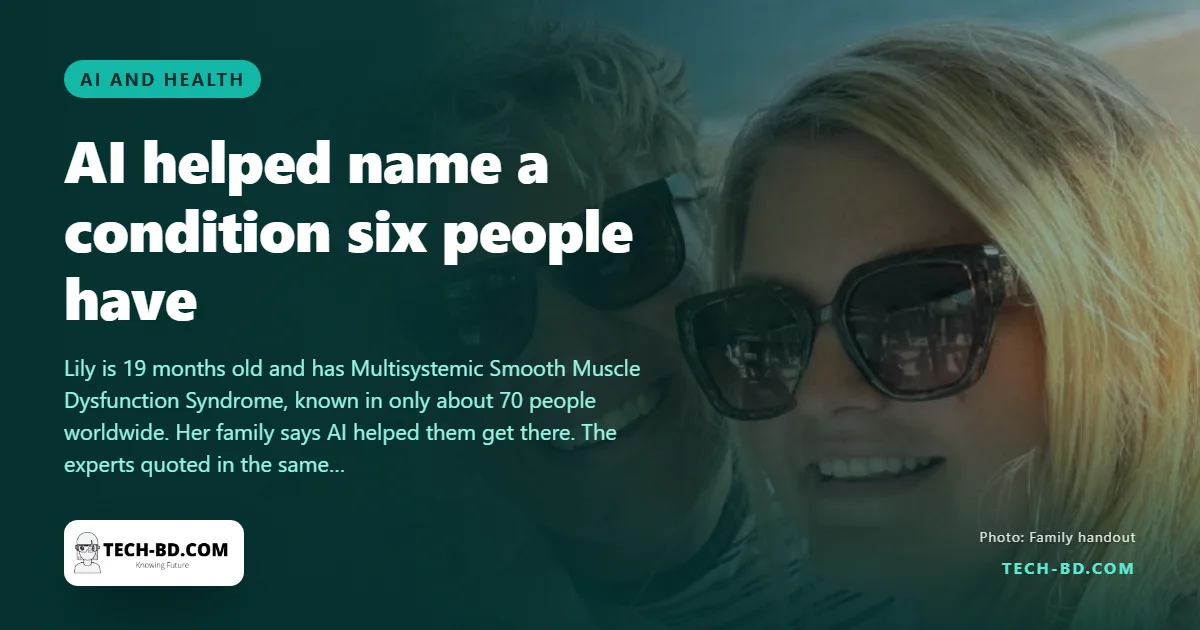
Lily, from Bath, is 19 months old. At four months she had surgery for a heart condition nobody could name. In January, tests finally identified it: Multisystemic Smooth Muscle Dysfunction Syndrome, or MSMDS, caused by a specific change in the ACTA2 gene, which affects organs including the heart and the kidneys. Roughly 70 people worldwide are known to have it, and only six in the UK.
Her family told the BBC that AI helped them get to the answer. Her mother Rosie put her daughter's symptoms into ChatGPT — the heart condition, and the detail that Lily's pupils were permanently dilated, which is why she now wears sunglasses outdoors.
Why this worked, and why it usually will not
The instinct is to read this as a story about AI beating doctors. It is not. It is a story about a specific failure mode of rare disease: the individual symptoms are each unremarkable, they present to different specialists who do not meet, and the pattern only becomes visible when somebody puts them in one place. A language model is unusually good at that one task, because it has read case reports no single clinician has time to.
The experts in the same report are careful about this. Nick Meade, chief executive of Genetic Alliance UK, said he would urge caution, and stressed that his organisation is not aware of many diagnoses being made this way. His technical objection is the important one: machine learning models learn mainly from whatever appears most often in their training data — which is the exact opposite of what a rare disease is.
Research from the University of Oxford this year points the same way. Dr Rebecca Payne, a GP who co-authored the study, has said that despite the hype, "AI just isn't ready to take on the role of the physician", and warned that asking a model about symptoms can be dangerous, producing wrong diagnoses and failing to recognise when urgent help is needed.
Both things are true at once. Lily's case is real, and so is the far larger number of people who will type symptoms into a chatbot, receive a confident wrong answer, and wait.
What the family is doing now
Lily is under Great Ormond Street Hospital and Bristol Royal Hospital for Children. Her parents, Rosie and Jonny, have set up a charity, ACTA2 Alliance UK, to fund research. International work on treatments is being led from Boston, with other approaches explored in the UK; the family is raising £30,000 towards a proof of concept in England. This week they held a move-a-thon, asking people to log every mile they walk, run, swim or dance until the total covers the 3,300 miles from Bath to Boston. Lily's grandfather Andy said they also want to find other patients, to build up data — and described the family as being on a ticking clock, because the condition is progressive.
What it means in Bangladesh
The diagnostic gap this story turns on is far wider here. Bangladesh has very few clinical geneticists, genetic testing usually means sending samples abroad at a cost most families cannot meet, and there is no national rare-disease registry — so a child with a condition like Lily's would, in most districts, simply be treated symptom by symptom for years. That is exactly the vacuum a chatbot fills, and exactly why the caution matters more here, not less: a confident wrong answer is more dangerous where there is no specialist to correct it.
The usable version of this is narrow and worth stating precisely. Use a model to organise, not to decide — to assemble a single written timeline of every symptom, age of onset, test and result, in one document, and to generate the questions worth asking. Then take that document to a paediatrician. A well-organised history is the single most useful thing a family can carry into a consultation, and it is the one part of this that AI is genuinely good at. Treat any named diagnosis it offers as a lead to check, never as a finding. We set out the same boundary when we looked at children and AI by age.