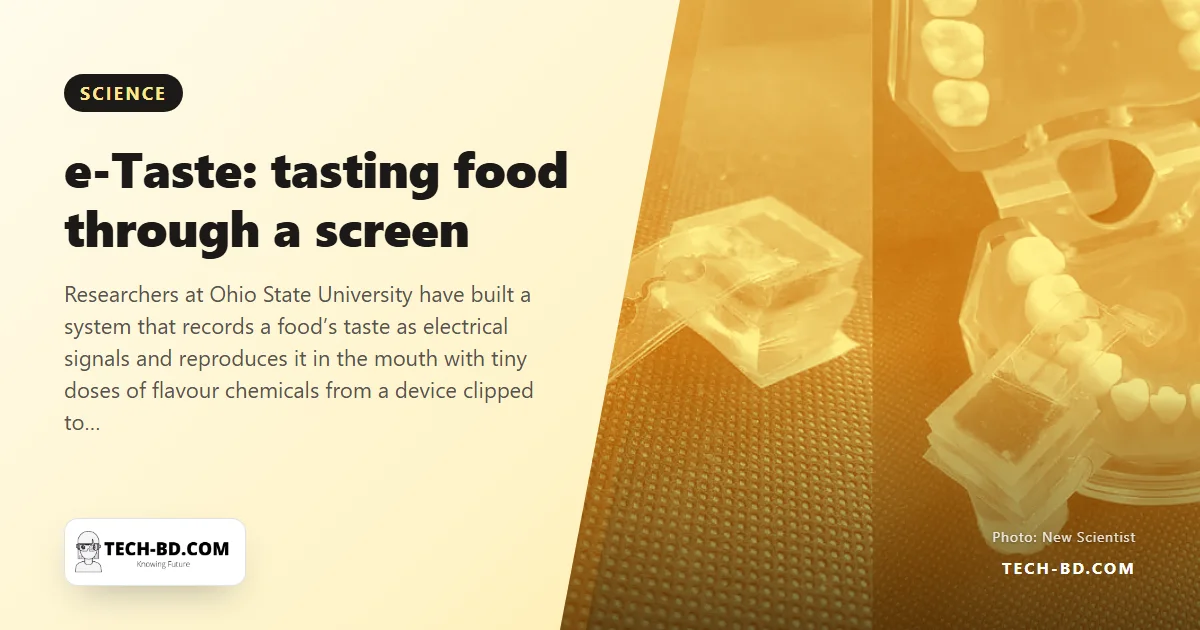
Researchers at Ohio State University, publishing in Science Advances, built a system they call e-Taste that captures a taste in one place and reproduces it in another. It was demonstrated at a distance of roughly 3,000 kilometres, from Ohio to California.
Almost every report framed this as "taste in virtual reality". The mechanism is more specific than that, and so are the limits.
How it works
The system has two halves, and neither involves stimulating the tongue electrically — which is how most previous attempts at this worked.
Capture. Sensors detect specific molecules — glucose and glutamate among them — chosen because they stand in for the five basic tastes: sweet, sour, salty, bitter and umami. The readings become an electrical signal.
Reproduction. That signal travels wirelessly to a remote device holding a small electromagnetic pump connected to a channel of chemicals. Mixed in the right ratios, those chemicals approximate the original taste.
So this is chemical reproduction rather than neural stimulation: the remote end genuinely delivers a tasting liquid, mixed to a recipe transmitted over a network. The device is closer to a very small automated bartender than to a brain interface, and that is why it works at all.
What was actually tested
The study used two groups of human subjects — one of ten people and one of six. They tested reproductions of lemonade, cake, fried egg, fish soup and coffee.
The headline accuracy figure is about 70%, and what it refers to needs stating precisely: participants distinguishing between different sour intensities in liquids the system generated. That is one dimension, of one taste, among sixteen people.
It is a reasonable early result and it is not a claim that the system reproduces flavours convincingly.
What it leaves out
The gap between this and "tasting food remotely" is mostly anatomy.
Most of flavour is smell. Retronasal olfaction — aroma reaching the nose from the back of the mouth while eating — accounts for a large part of what people call taste. A system reproducing five basic tastes chemically addresses the minority of the experience. This is the same reason food is bland with a blocked nose, despite the tongue working normally.
Texture and temperature are missing. Both change perceived flavour substantially, and neither is transmitted.
It consumes chemicals. The remote device dispenses physical substances from a cartridge. Unlike a screen or a speaker, it runs out — which places a hard practical limit on any consumer application that the VR framing tends to skip.
Where it could actually matter
Not in entertainment, where the smell problem makes it a partial experience at best.
The more plausible uses are clinical and industrial. Taste loss after illness or treatment is poorly measured, and a system that produces calibrated, repeatable taste stimuli is a diagnostic instrument before it is a consumer product. Food quality control is another: an objective, transmissible chemical signature of a product is useful to an industry that currently relies on trained human panels that disagree with each other.
Both are unglamorous next to the virtual-reality framing, and both are reachable from what the paper demonstrates.
Sources: the Science Advances paper; Ohio State University; Popular Science; The Brighter Side; and Prothom Alo's original report.