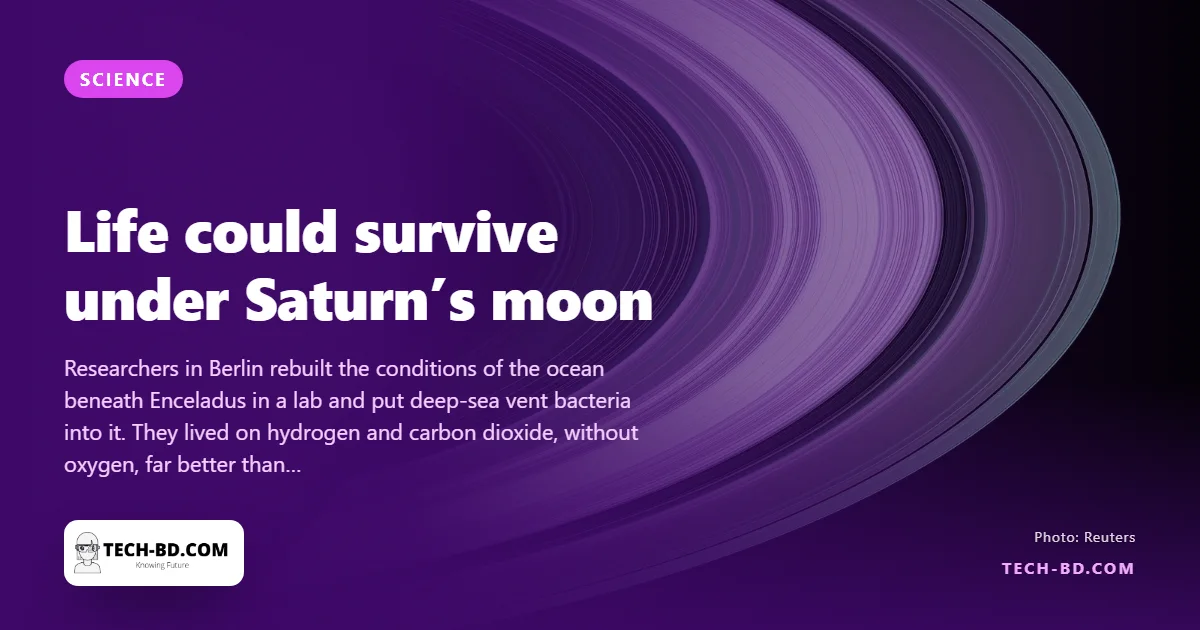
Scientists at the Free University of Berlin have found that microbes could survive in the ocean beneath Enceladus, the ice-covered moon of Saturn — a result that has renewed hope among space scientists and is expected to sharpen the search for life beyond Earth.
How they tested it
Rather than waiting for a spacecraft, the team built an artificial version of the Enceladus subsurface ocean in the laboratory. Into it they put a particular kind of bacteria found at hydrothermal vents on the deep ocean floor.
The bacteria lived without oxygen, running their metabolism on hydrogen and carbon dioxide. They survived the extremely harsh simulated conditions far better than expected.
Scientist Nozair Khawaja said the result was surprising. Enceladus is about 500km across and its surface temperature drops below minus 201 degrees Celsius — yet geothermal processes in its rocky core keep a vast liquid water ocean beneath the ice.
Why Enceladus keeps coming up
There are cracks at the moon's south pole, and through them water and ice particles from the buried ocean jet hundreds of miles into space. That is what makes Enceladus unusually testable: NASA's Cassini spacecraft flew through those plumes and collected the chemistry directly, without ever landing.
Frank Postberg made the point that anchors the whole result: ancient Earth had no oxygen either, and these microbes evolved in exactly that kind of environment. The bacteria are not being asked to do anything exotic — they are being asked to do what life on Earth already did once.
The careful framing matters. It is still not known whether there is life on Enceladus. What this study shows is that the conditions there are suitable for life to survive.
What it means in Bangladesh
There is no Bangladeshi mission to Enceladus, and there will not be one. What is worth taking from this is the method, because it is the cheap part of space science and the part a country without a launch programme can actually do.
This result did not come from a spacecraft. It came from a laboratory, a well-chosen organism and a careful simulation of somewhere else. That is university-scale work — microbiology, extremophile culture, geochemistry — and Bangladesh has the biology departments to do versions of it. The country's own extreme environments are underexamined: the anoxic sediments of the Sundarbans, the arsenic-bearing aquifers, hypersaline coastal soils. Organisms that survive those are of genuine international interest, and characterising them costs a fraction of a telescope.
It also matters for how science is taught here. Astrobiology is one of the few fields where a question a schoolchild can ask — is there life out there — leads directly to real laboratory work. A student who grasps why hydrogen and carbon dioxide matter on Enceladus has understood metabolism better than most syllabuses manage to teach it.