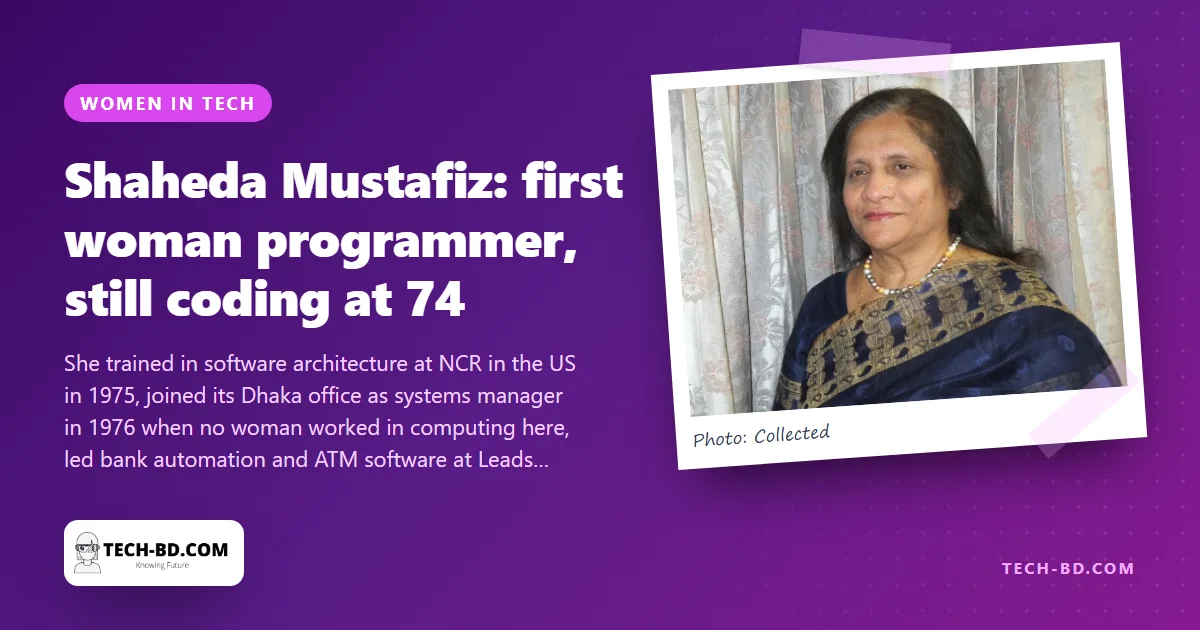
“I am very well, and the reason I am well is my work.” Shaheda Mustafiz is 74, and the work in question is Right Health, a health-records app she is building at her son’s company. “We have come a long way. With more people I could finish it faster.” She was speaking on Monday, two days before International Women’s Day, about a career that began 47 years ago, when she became the first woman in Bangladesh to write software for a living.
1976
In the mid-1970s a handful of firms in Dhaka wrote software for export, and every one of their employees was a man. No university in the country taught computer science. Mustafiz, an economics graduate, went to the United States for a year’s training in software architecture at NCR Corporation, and in 1976 joined NCR’s Bangladesh office as systems manager. When Leads Corporation, one of the country’s first software houses, bought NCR’s Bangladesh business, she went with it and led the work that mattered most in that decade: bank automation, the software that moved Bangladeshi banks off ledgers, and the programming of the systems that ran the country’s first automated teller machines.
The company, and the companies
She spent 22 years at NCR and Leads, resigned in 1998, and founded Probiti Systems, which she ran as managing director and which exported software abroad. She has also been managing director of the Bangladesh branch of Canada’s Twenty-Twenty Technologies and executive vice-president of the Bangladesh branch of e-Techlogics of the United States, and she ran computer training centres for children and, especially, for women. Today she oversees the software division of Right Solution, her son Ridwan Mustafiz’s firm, whose health-care and accounting systems are in use at several institutions. “Building software to automate hospitals — the time passes well,” she says. Born in 1949, she is the mother of four daughters and a son; her late husband, Mustafizur Rahman, was a banker.
“Can this girl do it?”
The story she tells about the 1970s is about hiring. “No woman worked in the computer sector then. I brought in a girl and gave her a job. The male staff said, ‘Madam, will this girl be able to do software work?’ I said, I will be the judge of that. A few days later the same men came to me and said, ‘Madam, it would be good to hire a few more girls — the work is going very well.’ Today many women work on my team. They do excellent work.”
On women in tech now
This year’s Women’s Day theme is digital technology for gender equality, so the question was put to her. “It makes me very happy to see women contributing to IT. But the whole responsibility for children and household is still the woman’s alone. We have to balance working life and family life — and programming demands long stretches of time spent only on programming. In our society that is not always possible for everyone. Fewer women come into programming, it is true. But those who come do very good work.”