SpaceX disclosed in a regulatory filing on Monday that it has a binding commitment for roughly $40bn in financing for AI chips and related data-centre equipment. The company called it the “largest committed GPU financing”.
The number is large. The structure is the more interesting part.
Who owns the chips
An entity managed by Apollo Global Management, the New York private equity firm, will buy the GPUs and server hardware and lease them to SpaceX. The leases run about five to five and a quarter years, and each one starts when its tranche of equipment is delivered.
SpaceX expects the deal to close by the end of the year, subject to conditions, with leases beginning in the first half of 2027 as hardware arrives. Apollo said the financing will help deliver Nvidia’s next-generation Vera Rubin chips for what it called SpaceX’s “terrestrial compute buildout”.
A sale-and-leaseback on hardware that depreciates quickly does two things at once. It moves the purchase off SpaceX’s own capital account, and it transfers the risk of the chips being obsolete in four years to whoever holds the title — here, Apollo. SpaceX pays for access to compute and hands back the question of what a 2027 GPU is worth in 2032.
Why a rocket company needed this
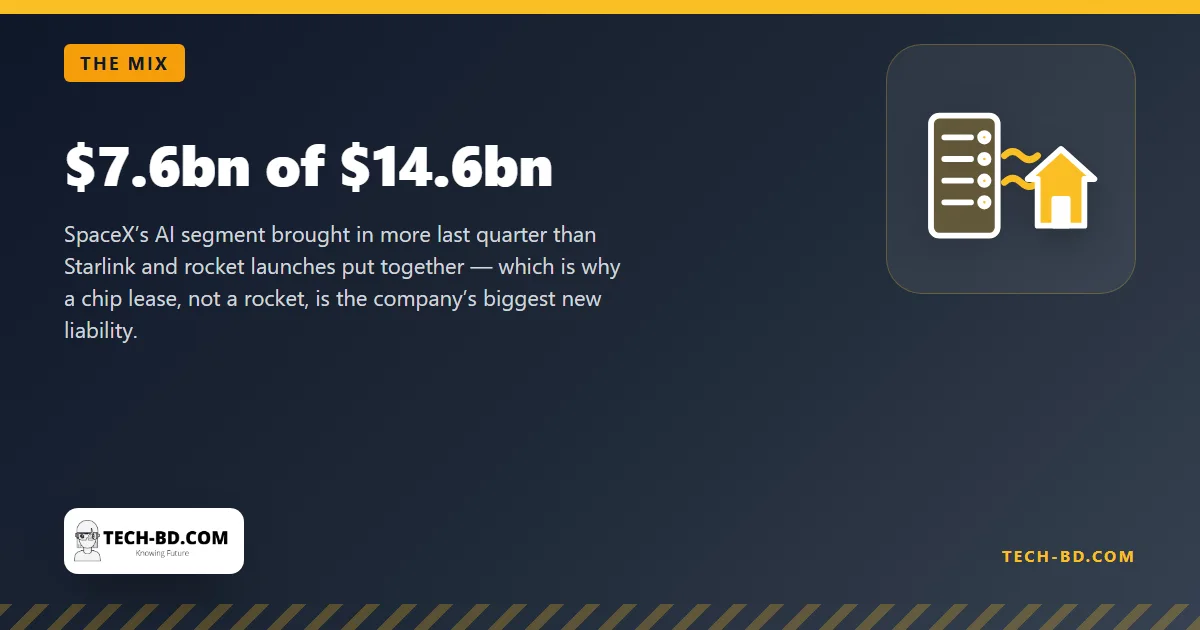
Because it is no longer mainly a rocket company, by revenue. On the 20 October earnings call SpaceX reported that its AI segment — which includes the Grok chatbot, the Cursor coding tool and cloud compute — brought in $7.6bn of the quarter’s $14.6bn in revenue. That is more than Starlink and rocket launches put together.
Capital expenditure reached nearly $20bn, up from $6.9bn a year earlier. Chief financial officer Bret Johnsen said the company expects to spend $35bn to $40bn in the fourth quarter alone.
Johnsen said the lease “diversifies our funding sources” and covers a notable share of the funding SpaceX needs for its growth plans. He also made a claim worth marking down for later checking: that SpaceX sees “less than one-year payback periods” on its AI infrastructure investments as it scales compute for Grok and its cloud services. A sub-twelve-month payback on data-centre hardware would be remarkable, and it is the assumption the whole structure rests on.
This also puts a figure behind something we covered last week: Musk’s consideration of a Tesla–SpaceX merger turned substantially on SpaceX’s compute buildout.
Musk’s prediction about everyone else
In a post on X on Sunday, Musk pointed to SpaceX’s investment-grade status and the steady cash flow from Starlink and launches, and argued that debt markets have largely shut out companies without major revenue outside AI data centres.
Then he forecast what happens to them. He predicted “guppy-level death and consolidation” among the more than 200 neocloud companies that rent out GPUs for AI workloads, adding: “Some will make it through, but not many.”
Read it alongside the deal and the self-interest is plain. Musk is describing a credit market that lends to companies with non-AI cash flow — which is to say, to SpaceX — and closes to those without it. That is both a reasonable description of how lenders behave in a nervous market and an argument for why his own financing should be read as strength rather than leverage.
What to watch
TechCrunch notes this lands in a turbulent period for AI-linked debt, with investors increasingly wary of heavy capital spending set against limited profits. SpaceX has had no difficulty raising money; that is the contrast.
Three things will tell you whether the structure worked. Whether the deal closes on schedule by year-end. Whether the leases actually begin in the first half of 2027, or slip with Vera Rubin deliveries. And whether anything resembling a one-year payback shows up in the segment numbers once lease payments start, rather than only in the quarters before they do.
For anyone in this region buying AI capacity: the lesson in the deal structure is the useful part. Compute is increasingly rented, not owned, and the party carrying the depreciation risk is the one to identify before signing.