Elon Musk says he is actively considering merging Tesla and SpaceX, his two largest companies. “Do I think it would be a good idea? Yes,” he told financial analysts on a call about SpaceX’s latest results on Tuesday.
Where it stands
Special committees have been formed within both companies to examine the move. “The special committees have not reached agreement on terms of any transaction and there’s no guarantee that they will,” Musk said. “But I do think there is a lot of merit to merging and a lot to be gained.”
With Tesla valued at roughly $1.5tn and SpaceX at $2tn, a combination would be among the largest mergers in history. Musk is not on either committee and described himself as a “conflicted party”, being chief executive of both. He compared even discussing it to “tap dancing through a minefield”.
Shareholders decide. At least 50 per cent of Tesla’s would need to approve, which Musk called “quite a high hurdle”. They have backed him before: last year a majority approved a compensation package valued at around $1tn.
The number worth more than the headline
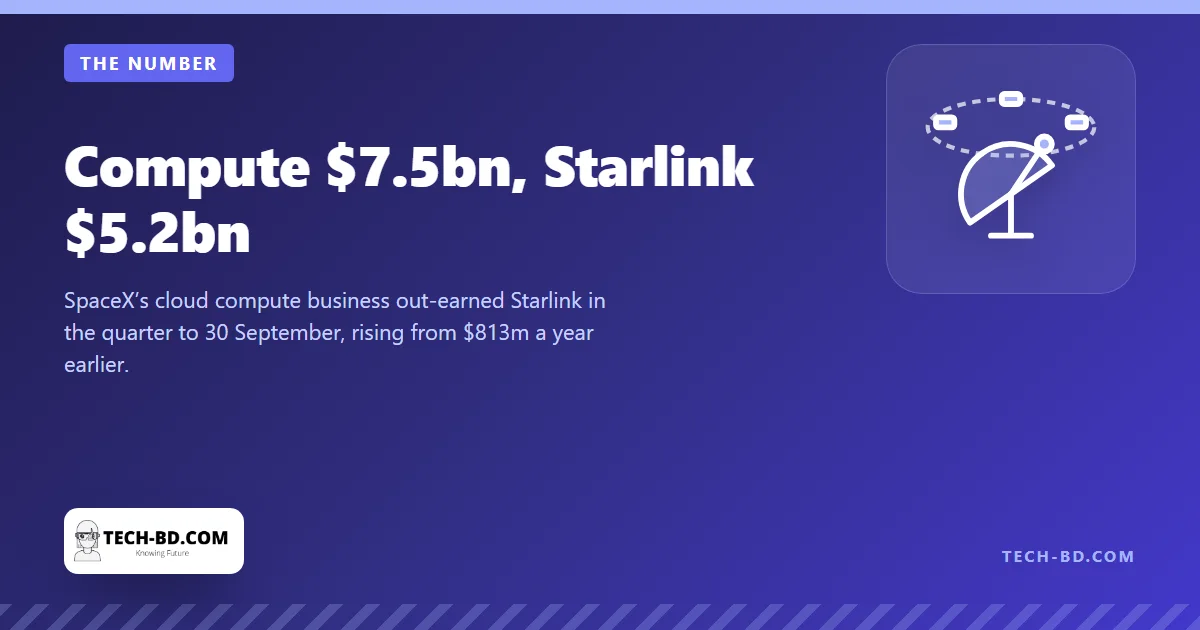
Buried in the same results is a figure that says more about what SpaceX has become. Starlink revenue rose to $5.2bn in the three months to 30 September, from $3bn a year earlier — strong growth. But SpaceX’s business selling cloud compute capacity to other technology companies, including Anthropic and Google, generated $7.5bn over the same three months, against $813m a year ago.
A rocket company’s largest single line is now renting computation. That is a nine-fold increase in a year, and it makes the merger logic clearer than any statement about synergies: the AI build-out needs power and space, and a company that launches things and runs satellites has unusual access to both.
The part under scrutiny
SpaceX also runs Starshield, a secured satellite network for governments including the US. That business is facing scrutiny over claims Ukraine’s access to the network was limited, leaving it vulnerable to deadly Russian strikes. President Trump has denied that either he or Musk ordered any slowdown; Musk has suggested the US government may have been behind the restrictions.
Why Bangladesh should pay attention
Because the satellite network above Bangladesh would change owners. Banglalink is launching Starlink direct-to-cell here, which means a Bangladeshi operator’s coverage promise now depends on a foreign company’s corporate structure. A merger does not change the satellites, but it changes who controls them, what the combined company’s priorities are, and which business unit absorbs losses when a market is small.
The Ukraine dispute is the uncomfortable precedent. Whatever its facts turn out to be, the allegation itself establishes the question any country relying on one satellite provider has to ask: what happens to our access if the provider’s owner has a reason — commercial or political — to change it? That is an argument for licensing more than one satellite operator, not for refusing them.
Why a merger is being discussed at all
The strategic logic is not hard to see. Tesla has manufacturing scale, battery expertise and a cash-generating car business; SpaceX has launch capability, orbital infrastructure and, now, a fast-growing compute business that needs enormous amounts of power and hardware. Combining them puts the energy storage, the manufacturing and the data-centre demand inside one balance sheet.
The counter-argument is governance. Tesla is a public company with ordinary shareholders; SpaceX has a far more concentrated register. Merging them means Tesla investors taking on a business whose largest customer relationships are governmental and whose risks include foreign policy. That is the reason for special committees, and the reason Musk is not sitting on either.