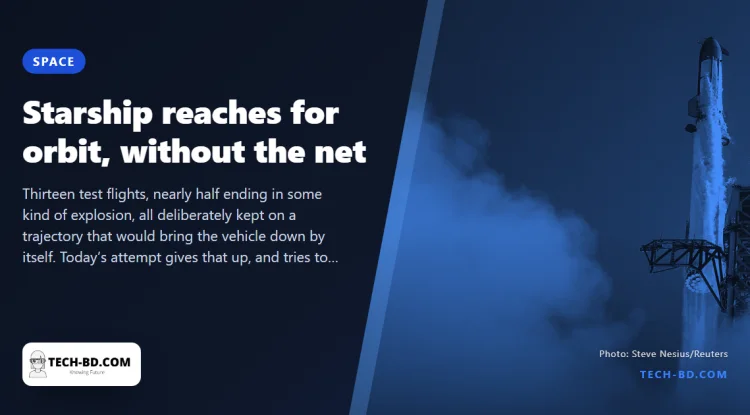
SpaceX has successfully caught the top part of its Starship rocket for the first time, after a flight lasting twenty-two and a half hours.
The stage returned to Earth, hovered beside its launch tower, and the mechanical arms — nicknamed chopsticks — secured it. There were loud cheers from SpaceX staff watching at the Starbase launchpad in Boca Chica, Texas.
This completes a story we left open
We reported yesterday that the attempt to catch the bottom part — the Super Heavy booster — had been aborted a few minutes after Friday's launch, with the booster diverted into the ocean, and that the decision on the upper stage had not yet been taken.
It was taken, and it worked. So the first attempt to fully recover both halves of Starship ended one for two.
The numbers
The 124-metre (407ft) rocket lifted off at 16:47 local time on Friday. The booster was due back at the tower six and a half minutes later; that is the catch that was called off. The upper stage stayed up for nearly a day before returning.
This was the 15th test of Starship, and the first intended to recover both sections.
Why the half that worked is the harder half
It would be easy to read this as the consolation prize. It is closer to the opposite.
The booster separates early, never leaves the atmosphere properly, and comes back within minutes on a short, well-understood arc. The upper stage goes to space, spends hours in orbit, and returns at orbital speed — which means it has to survive re-entry heating, bleed off enormous energy, and then arrive at a specific point beside a tower with enough control left to hover.
Catching that, on the first attempt, after twenty-two and a half hours away, is the more demanding of the two manoeuvres by a wide margin.
What is still unproven
One catch is not reusability. The thing SpaceX needs is for both halves to come back reliably, and then to fly again without a rebuild between flights. Friday showed the booster catch can be waved off; Saturday showed the upper-stage catch can work once.
Neither tells you the rate. The figure that matters, and that nobody has yet, is how often this succeeds across many flights — and how much work each returned vehicle needs before the next launch.
Why it matters beyond SpaceX
The economics only work at a repetition rate nobody has demonstrated yet. A vehicle brought home once is a trophy; one brought home ninety times in a year is an airline. Every claim made about future launch pricing rests on the second, and Saturday produced the first data point towards it.
For a country that buys satellite capacity rather than launching anything, Bangladesh included, the effect is indirect and slow. It shows up as more operators able to afford a constellation at all — and therefore more bidders competing for contracts that today attract very few.
Why catching beats landing on legs
One design point is worth drawing out, because it explains why SpaceX accepts the risk of bringing a rocket down beside its own launch tower. Landing legs have to be carried all the way up and back, and every kilogram of landing hardware is a kilogram of payload not flown. Catching moves that structure to the ground, where weight costs nothing. It is the reason the manoeuvre looks reckless and is actually an efficiency decision.