SpaceX aborted its attempt to catch the bottom half of its Starship rocket during the vehicle's latest test flight.
The plan was to catch the booster with the mechanical arms — nicknamed chopsticks — on the launch tower as it returned to Earth. Instead it was diverted to the ocean, bursting into flames as it came down.
What was being attempted
This was the company's first attempt to fully recover its rocket: catching both the booster and the upper stage, which is what would make Starship fully reusable and bring the cost of each flight down.
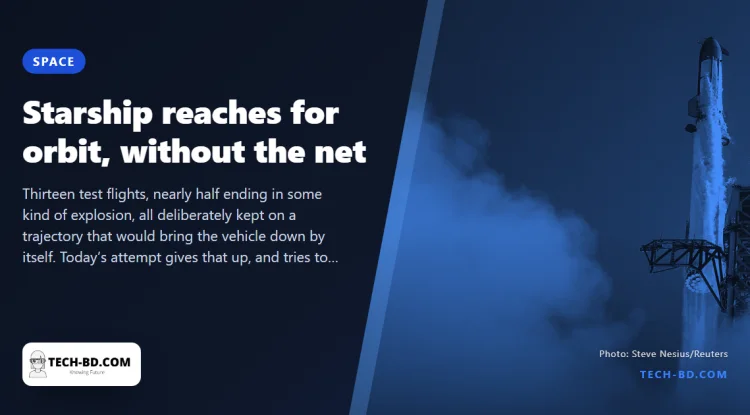
The 124-metre rocket lifted off from the Starbase launchpad at Boca Chica, Texas at 16:45 local time (22:45 GMT) on Friday. The Super Heavy booster was due to return to the launch tower six and a half minutes later. It did not.
The upper stage continued to space. SpaceX was to decide whether to attempt catching that stage at about 15:15 local time (21:15 GMT) on Saturday — which is after this post publishes, so the second half of the test remains open.
What SpaceX said
During the launch stream a SpaceX spokesperson said: "Safety is always the number one priority, and we're still testing out things that we haven't done before on these vehicles, and so we are prioritising making sure that we can perform each maneuver safely."
Why an abort is not the same as a failure
It is worth being clear about what happened, because "aborted" reads as a setback and the engineering reading is more interesting than that.
A tower catch is the one manoeuvre in the sequence with no margin. The booster comes down beside a structure that is needed for every future launch, and if anything is off — the approach, the engine relight, the vehicle's own health signals — the damage is not a lost booster but a destroyed launch site. So the system is built to divert to water unless every condition is met.
Diverting means the checks ran and one of them said no. That is the mechanism performing exactly as designed. A caught booster with a marginal approach would have been the worse outcome, and far more dangerous to the programme.
Why reusability is the whole point
Expendable rockets throw away their most expensive component on every flight. Catching the booster at the tower — rather than landing it on legs, on a pad or a barge — removes the landing hardware from the vehicle entirely and puts it on the ground, where weight does not cost fuel.
If Starship becomes genuinely reusable at this scale, the price of putting mass into orbit falls far enough to change what is worth launching at all: larger satellite constellations, cheaper internet coverage over countries that are expensive to reach by cable, and science missions that currently cannot be afforded. That is what is being tested when a booster is dropped in the sea on a Friday night.
What to look for in the next attempt
The detail worth watching is not whether the next catch succeeds but how late the decision is taken. An abort called minutes out suggests the approach itself was wrong; one called in the final seconds suggests the margins are genuinely tight and the vehicle is being judged against them in real time. The second is a better sign than it sounds, because it means the criteria are strict rather than the hardware unreliable.