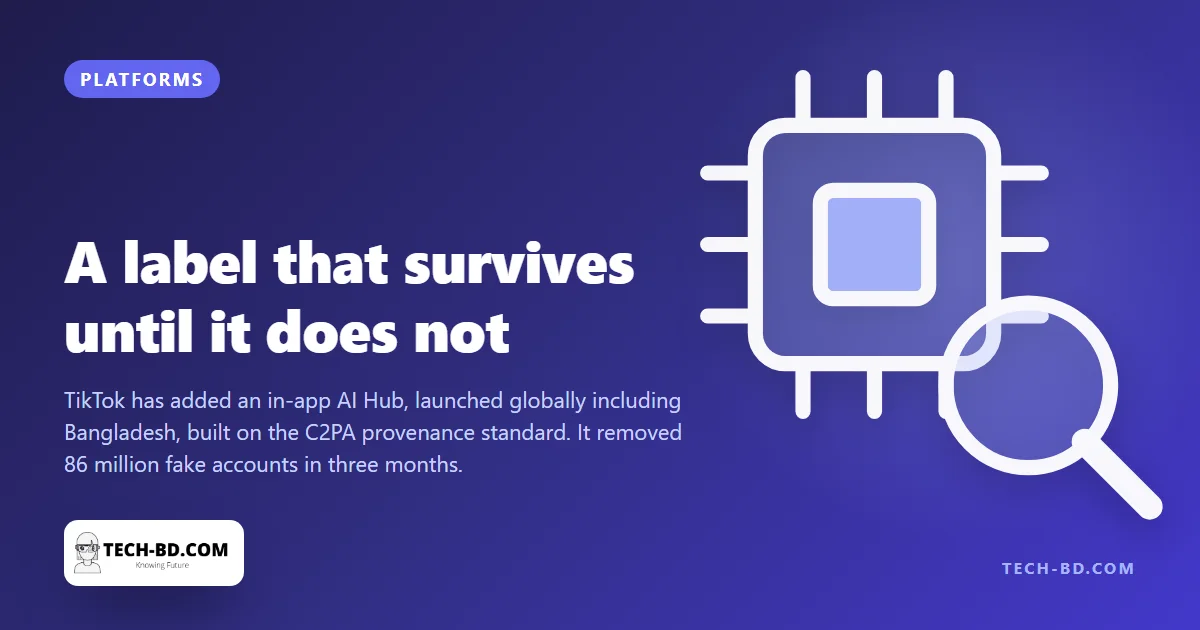
TikTok has added an AI Hub inside its app to help users identify AI-generated content and avoid spam. The company said on Thursday that the hub has been rolled out worldwide, including in Bangladesh.
The feature is built with the Coalition for Content Provenance and Authenticity, and TikTok says a new set of guidelines on using AI tools safely is also being prepared. Since last year the company has worked with NoFilter and the Raspberry Pi Foundation on user awareness. Its enforcement numbers are large: more than 86 million fake accounts were removed in the first three months of this year alone.
What provenance actually is
The coalition behind this — usually shortened to C2PA — is not a detector, and that distinction is the whole thing.
A detector looks at a finished image or video and guesses whether a machine made it. That is hard and getting harder. Provenance works the other way round: the tool that creates or edits the file attaches a signed record of what happened to it — made with this model, edited in this app, cropped here. The platform then reads that record and shows a label.
It is a far more reliable approach, because nothing is being guessed. The file is carrying its own history.
And where it stops working
That history is metadata, and metadata is fragile in exactly the way content travels in Bangladesh.
Take a screenshot of a labelled video and the new image has no record at all — it was made by your phone's screenshot function, which knows nothing about the original. Download a clip and re-upload it through a tool that does not preserve the field and the record is gone. Many ordinary operations — re-encoding, some messaging apps, a lot of download sites — strip it.
So the label is reliable when it appears and silent when it does not, and silence is not evidence of anything. A video with no AI label might be a camera recording, or it might be a synthetic clip that was screenshotted once on its way to you. For content that reaches people through Facebook shares, WhatsApp forwards and re-uploaded TikToks — which is most of what circulates here — the second case is common.
This is not a flaw in the standard. Provenance was designed to let honest tools prove what they made, not to catch a determined forger, and it does the first job well. The failure is in how it gets described, because "AI content will now be labelled" promises something it cannot deliver.
The number that says more than the hub does
86 million fake accounts removed in three months is the figure to hold on to.
It describes a volume of automated account creation that no labelling scheme addresses, because the problem there is not whether a video is synthetic. It is that the account posting it is not a person. Spam and coordinated promotion work through quantity, and a provenance label on each item does nothing to the quantity.
Both things are being announced together, which is reasonable from a company, but they solve different problems and only one of them is the one most users meet.
What to do with a label when you see one
An AI Hub is an education surface rather than a protection, and used that way it is genuinely useful. Three things make it more so.
- Treat the label as positive evidence only. Present means AI-made, or AI-edited. Absent means nothing — it is not a certificate that something is real.
- Check the account before the clip. Age, posting history and whether anything on it predates this week will tell you more than any badge on a single video.
- For anything consequential — a health claim, a price, a political quote — find it somewhere that is not a video. Provenance tells you how a file was made, never whether what it says is true.
Related: a science photo contest unable to settle an AI allegation, Meta's feed of AI-generated video, and China's rules for Douyin.