Last week Starlink slowed down over Ukraine. The service has only just been restored, and in the interval Kyiv’s ability to defend itself against Russian attacks was measurably affected.
Who authorised the restriction is still not clear. There is an unresolved blame-game running between the Pentagon, Donald Trump and Elon Musk. What the episode established beyond argument is the shape of the dependency.
Why Starlink and not something else
Starlink and its military-grade service Starshield are both owned by Musk’s SpaceX. Ukraine uses Starlink for battlefield communications and Starshield for military purposes including drone warfare, because both deliver fast, real-time connectivity.
“You can’t employ drone warfare without this kind of high-speed internet connection,” said Vincent Tourret, a researcher at the French Institute of International Relations.
Soldiers who spoke anonymously to the BBC were blunter. “God forbid they shut it off completely, it would be an absolute catastrophe,” one said. “I don’t give a damn how much an alternative costs when our lives are on the line.”
Another explained the margin: Starlink “gives us the upper hand when it comes to passing commands — even one or two seconds are critical when we can transfer data and orders faster, and you can really feel that advantage on the battlefield.”
The arithmetic of the alternatives
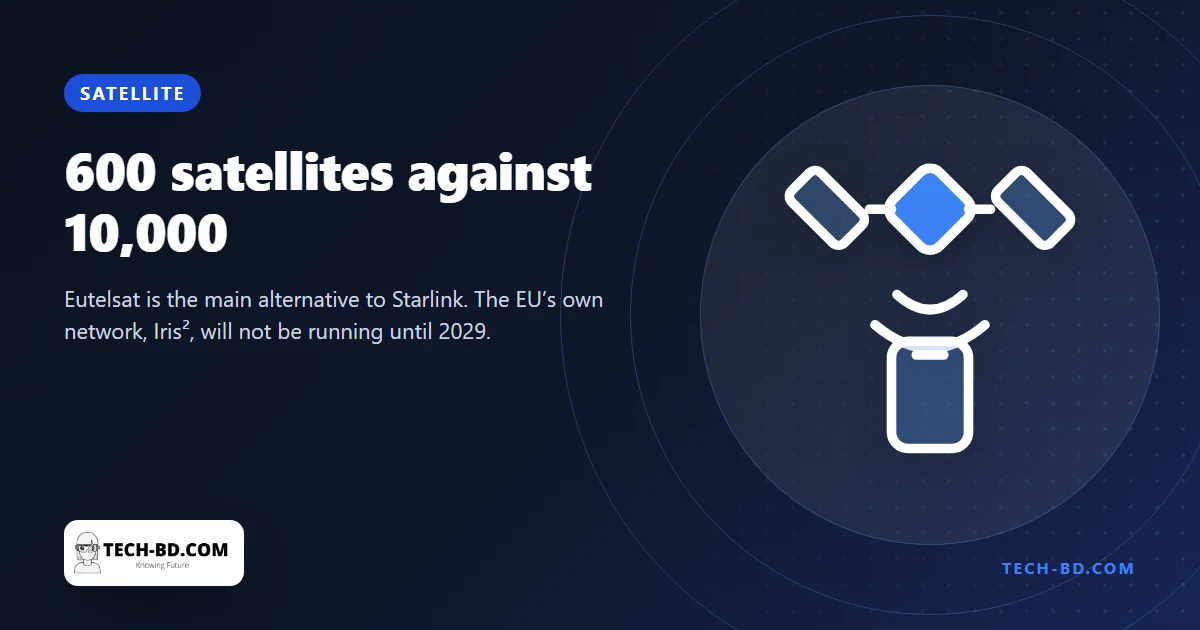
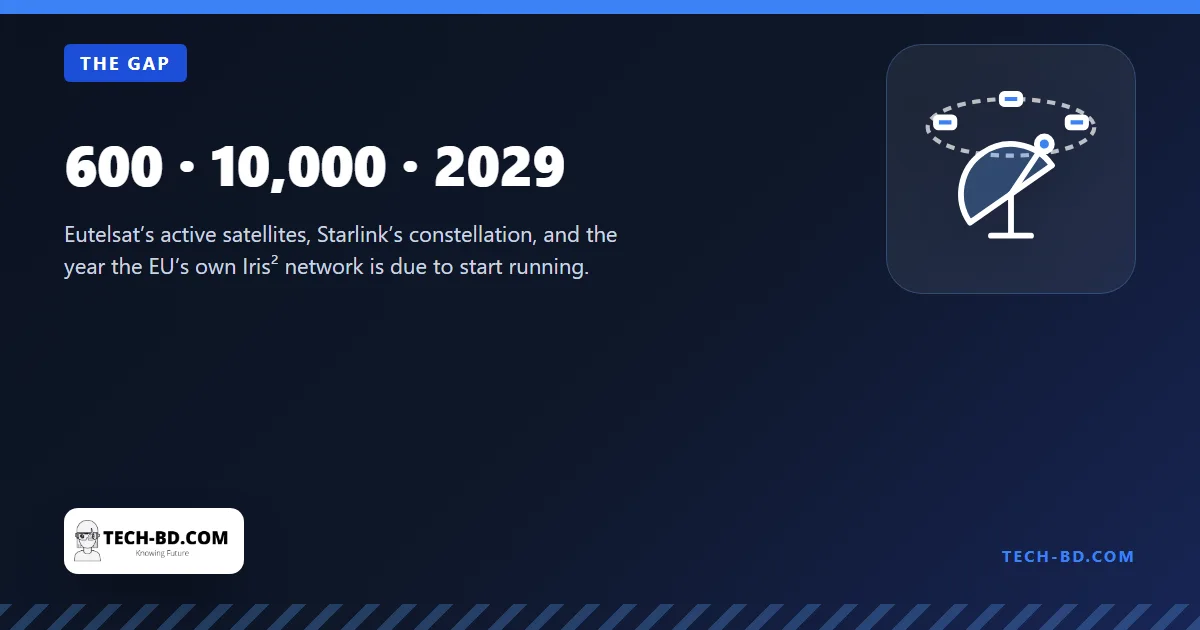
France’s Eutelsat, with its OneWeb service, is the main alternative. It has about 600 active satellites. Starlink has more than 10,000 — the largest constellation in the world.
The terminals matter as much as the satellites. Starlink’s are small and light enough to fix to any vehicle, or to a drone. Eutelsat’s, said former chief executive Eva Berneke, “are slightly larger, so they can be fitted on the roof of a car, or on tanks, but they can’t necessarily sit on small drones.” They are also about five times more expensive.
The EU is building its own network, Iris². It will not be up and running until 2029.
What Europe can offer this year
Right now the EU has Govsatcom, a network set up in January to share existing satellites between member states. Ukraine is not a full member and is trying to become one; the European Commission is in talks with Kyiv.
But even if Ukraine connected tomorrow, Govsatcom cannot be used for warfare operations such as piloting drones — which is precisely what Starshield is used for. That may change early next year, when the Commission hopes commercial operators including OneWeb will join the programme. No timeline has been given for Ukraine’s accession, and when it comes it will most likely be a back-up rather than a replacement.
Berneke told the BBC she is confident Eutelsat can “support quite a lot of Ukraine’s key military needs” — note the qualifier. Eutelsat itself would not comment on Govsatcom, saying only that as “the only European operator of a fully operational [Low Earth Orbit] constellation, we are committed to providing resilient connectivity”.
The political problem underneath
“Ukraine’s defence cannot depend on Trump’s or Musk’s whims,” the French MEP Christophe Grudler posted.
Kari Bingen, who directs the Aerospace Security Project at CSIS, named it precisely: the “flipside of that dependence” has been exposed. “This is a critical military capability that Ukraine relies on, but doesn’t control.”
Musk has not helped the case for patience. “Be quiet, small man... there is no substitute for Starlink,” he posted at Poland’s foreign minister last year, after the politician said he would look for other suppliers if SpaceX proved unreliable.
A European Commission spokesperson told the BBC that Europe has realised its security depends on space, and must “strengthen its satellite capacities, urgently”.
The question for everyone else
Starlink has been licensed in Bangladesh since 2025, and for parts of the country with no realistic fibre path it is a genuine answer rather than a luxury. The Ukrainian experience does not make that less true. It makes a different point, which applies to any country or business putting critical traffic on a single foreign-owned network: the service level you get is a commercial and political decision taken somewhere else, and you will find out what it is at the moment you most need it not to change.
The useful response is not refusal. It is knowing, in advance, what you fall back to.