What does mining mean in the world of digital currency? It is the process by which transactions in a cryptocurrency such as Bitcoin are verified and new coins are created. The name borrows from pulling gold out of the ground, but beyond the metaphor the two have almost nothing in common.
The two jobs it does at once
Cryptocurrency mining is the process of adding new blocks to a proof-of-work blockchain using specialised computers. A batch of transactions is verified and written into the blockchain, and under the rules of that particular blockchain, new digital currency may be created at the same time.
Those are two separate functions bolted together, and the pairing is deliberate. Somebody has to check the transactions; the new coins are what makes it worth somebody's while.
How proof of work works
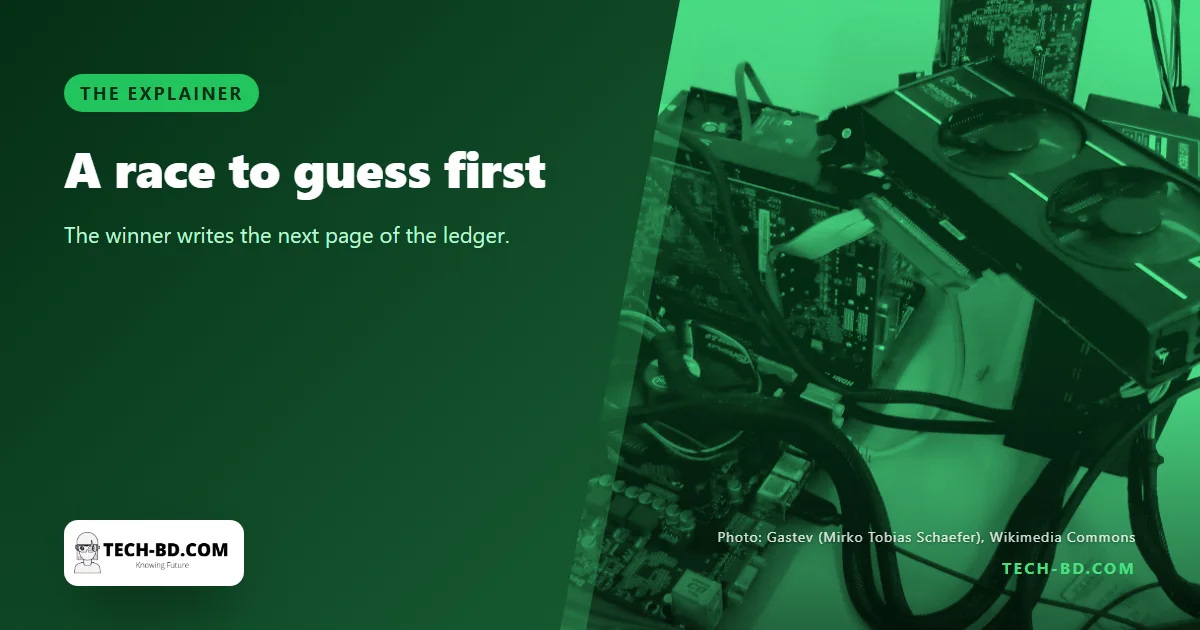
To add a new block under proof of work, miners have to solve a complex mathematical problem. Doing so takes an enormous amount of computing power.
Miners compete over who can solve it first. Whoever finds the correct solution earns the right to add the new block to the chain — and as a reward may receive the transaction fees from that block plus the newly created cryptocurrency.
The competition is the security model. Because being first requires having genuinely done the work, rewriting the record after the fact would mean redoing all of that work faster than everyone else is doing it now.
Hash rate, and what a hash is
Mining demands vast computing power, and the unit used to measure that power is the hash rate. It is determined by how many times per second a computer can produce a hash.
Hashing itself is a cryptographic process. It takes data — transaction information among other things — and converts it into a code of fixed length made up of letters and numbers. That code is the hash.
The fixed length is the useful property. Whatever goes in, what comes out is the same size, so a block of a thousand transactions and a block of ten produce codes of identical shape.
Why not an ordinary computer
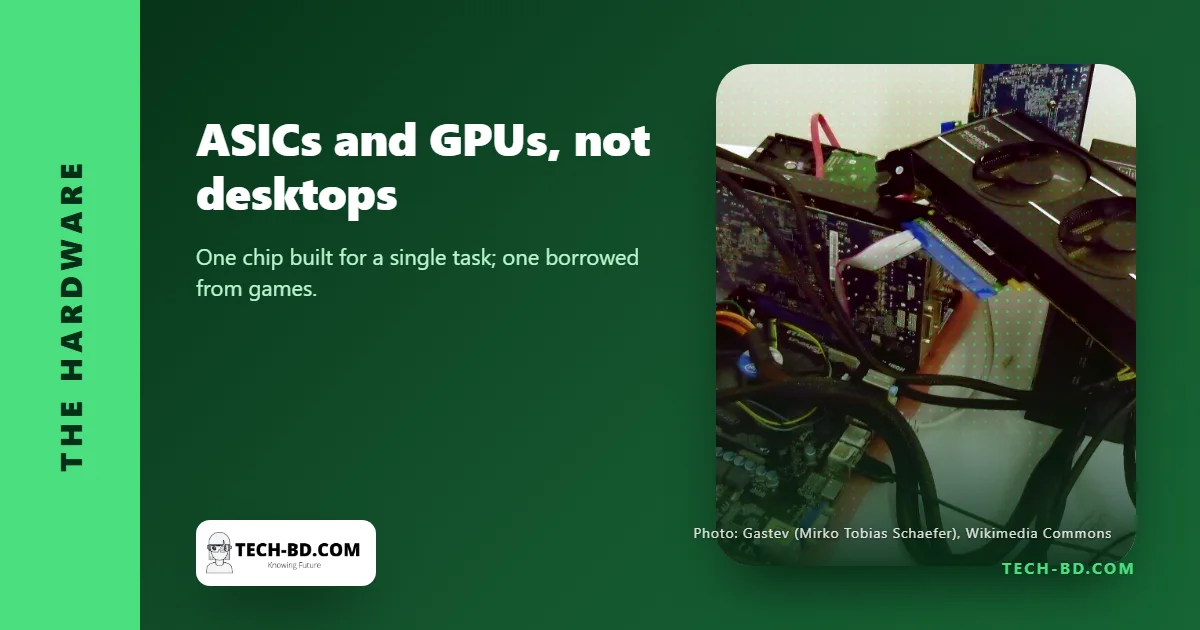
Mining is not done on the machine on your desk. The hardware is specialised, and falls mainly into two categories: ASICs, or application-specific integrated circuits, and GPUs, graphics processing units. Both are built to solve these particular mathematical problems quickly and efficiently.
An ASIC is a chip designed to do one task and nothing else, which is why it is faster at that task than general-purpose silicon. A GPU is the same component that renders games, repurposed because the arithmetic involved happens to suit it.
The point of all of it
One of the defining features of cryptocurrency mining is decentralisation. No single person or institution runs the verification of transactions. Participants spread across the network verify them collectively, and that is what helps maintain the security and reliability of the blockchain.
This is the part that explains the expense. A central bank or a payment processor can verify a transaction with one database write, because you have agreed to trust it. A blockchain has no such party, so it substitutes cost — thousands of machines racing, almost all of them losing — for the trust it does not have.
Whether that trade is worth making is the argument the whole field has been having for more than a decade. But it is the trade, and understanding it is the difference between knowing what mining is and knowing why it looks so wasteful from the outside.