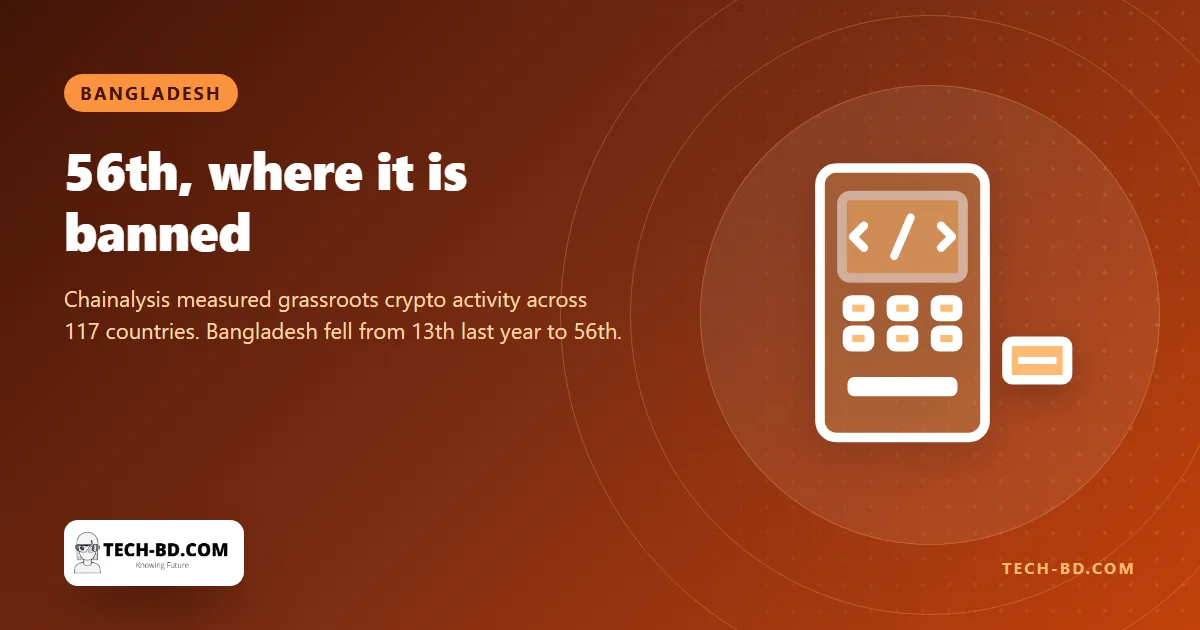
Cryptocurrency is illegal in Bangladesh, and its use keeps growing. The blockchain analysis firm Chainalysis has published The 2026 Geography of Crypto Report, covering 117 countries, and places Bangladesh 56th in the world for grassroots crypto use. India is 6th, Pakistan 25th and Sri Lanka 82nd.
The number that is actually news
Last year Bangladesh was 13th. A fall of forty-three places in a single edition is a much bigger statement than the rank itself, and it needs reading carefully, because the index does not measure what most people assume.
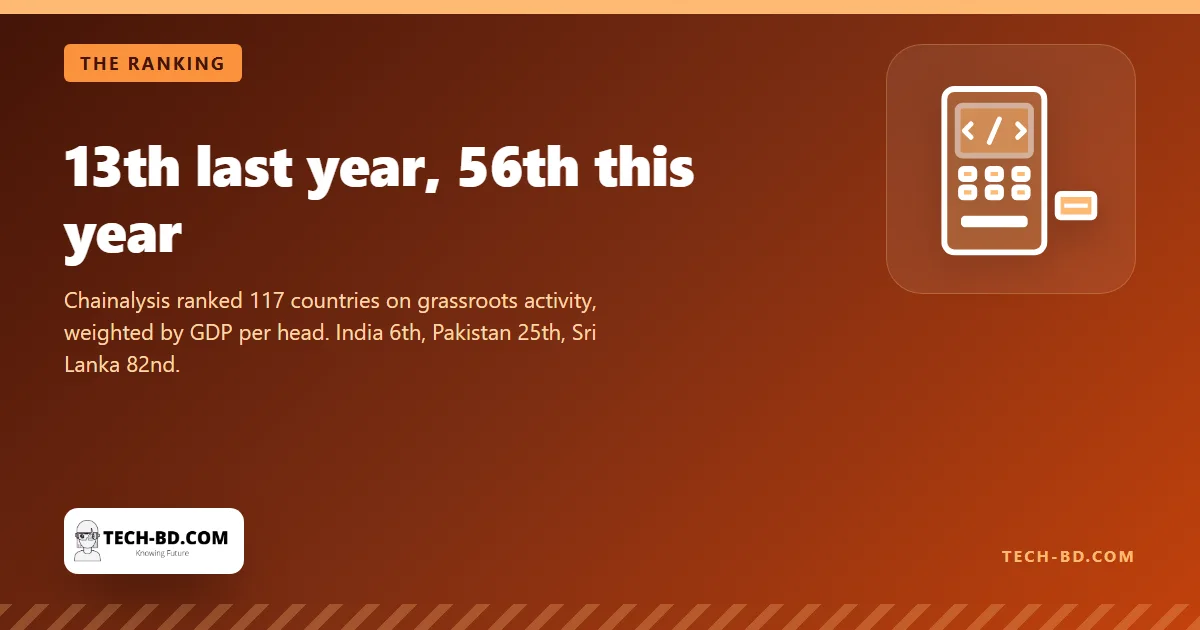
The ranking is built from four components — service flows, domestic peer-to-peer activity, cross-border transfers and on-chain balances — over the period from 1 July 2025 to 30 June 2026, and it is weighted by GDP per head. That weighting is the key to the whole table. A developing country with modest absolute volumes can outrank a rich one, because the comparison is against what people there can afford, not against the raw dollar total.
So a large fall does not necessarily mean Bangladeshis stopped using crypto. It can equally mean other countries grew faster, or that the mix shifted between the four components. The report itself describes a global picture that was broadly flat: total market capitalisation fell by around 50 per cent, or $2.1tn, while on-chain economic activity slipped only 1.6 per cent, from $9.5tn to $9.4tn. Within the same window, Bitcoin hit an all-time high and then suffered its largest ever fall in dollar terms, dropping as much as $67,000 from the peak.
Brazil tops the index, with a crypto economy worth about $252.5bn and a lead in every sub-index.
The legal position, and what it means in practice
Virtual currencies are not issued by any national authority, so no financial claim against them is recognised. Bangladesh Bank does not authorise transactions in them, and no other regulator does either.
Professor Md Mohiuddin, of Dhaka University’s IBA, draws the distinction that matters: trading is not legal and the prohibition is strict, but the Chainalysis index does not assess legal recognition. It measures how much real activity is happening at street level — and the report has caught users carrying on informally despite the ban.
A 2023 World Population Review report claimed 4.3 million crypto users in Bangladesh. Bitcoin, Ethereum, Ripple and Litecoin all change hands here.
The consequence nobody advertises
The practical meaning of “illegal but widespread” is not that users are being hunted. It is that they have no recourse. If an exchange freezes a balance, a counterparty in a peer-to-peer trade takes the cash and never releases the coin, or a wallet is drained, no regulator will take the complaint, and any court filing has to start from an unlawful transaction. The transaction the victim must describe is itself prohibited.
That is a worse place to be than either a clear ban or clear regulation. It is also why the index number is less interesting than the question behind it: several million people are using an instrument the state refuses to recognise, which means the state has no visibility into it either — not for fraud, not for capital flight, not for the remittance flows that are almost certainly part of the activity being measured.
Related: what self-custody looks like when somebody comes for your keys.