Four o’clock in the afternoon, and a small shopkeeper gets a message from his bank: application refused. He asks why. The officer says: “the system says so.”
What the officer is describing is AI credit scoring — an automated assessment of creditworthiness. A model looks at income, transaction patterns and repayment history and estimates the probability that a borrower will repay. It is now the first filter on a large share of loan decisions worldwide.
The case for it is real
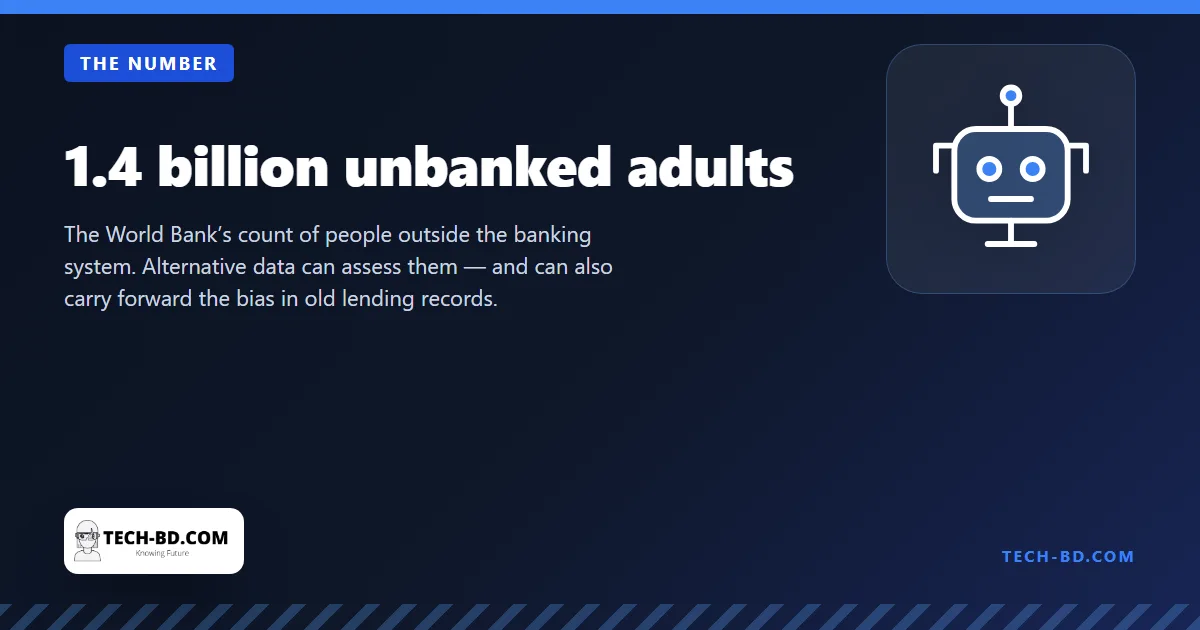
The strongest argument is about the people conventional lending cannot see. By the World Bank’s count, around 1.4 billion adults worldwide remain outside the banking system. A bank asking for payslips and a credit history has nothing to assess them on, so the answer is no by default.
A model that can use alternative data — mobile money transaction records, utility payments, the rhythm of a small trader’s daily receipts — can assess someone who has never held a bank account. In a country where mobile financial services reach far more people than bank branches do, that is not a theoretical benefit.
And the two problems
It learns the past, including the unfair parts. A model trained on historical lending data learns which kinds of applicant were approved before. If that history was biased — against women without property in their own name, against particular districts, against informal traders — the model reproduces the bias and presents it as arithmetic.
An unexplained decision cannot be appealed. This is the deeper problem. If nobody states why an application failed, there is nothing for the applicant to correct or contest. “The system says so” is not a reason; it is the absence of one.
That is why the European Union’s AI Act classes credit scoring as a high-risk use and requires transparency and human oversight for it. Bangladesh has no equivalent rule.
Three things to do if you are refused
1. Ask for the reason in writing. Asking is your right as a customer, and a written answer is the only thing you can act on.
2. Correct your own data. Scoring draws on records that contain errors — a loan recorded as unpaid that was settled, a mistaken identity match. Those can be fixed, and fixing them changes the score.
3. Ask for human review. Request that an officer reconsider the file rather than the model. In a well-designed process the machine drafts the decision and a person owns it.
Which is the real test of any of these systems. The question is not machine versus human. The question is who is answerable for explaining the decision.
Where your record actually sits in Bangladesh
One specific thing is worth knowing, because it is the file most refusals here are based on. Bangladesh Bank runs the Credit Information Bureau, and scheduled banks and licensed financial institutions report borrowings and defaults into it. A bank pulling a CIB report is the first thing that happens to a loan application.
CIB records contain errors — a settled loan still marked outstanding, a guarantee recorded as a borrowing, a name collision. You are entitled to see your own report, and a correction has to be made by the institution that filed the entry rather than by the bureau. That is slow, and it is the single most effective thing a refused applicant can do, because it fixes the input instead of arguing with the output.
Note what this means for the people AI scoring is meant to help. Someone with no CIB history at all is invisible to the conventional process, which is exactly why alternative data is attractive — and exactly why there is no established way to contest it when it is wrong.