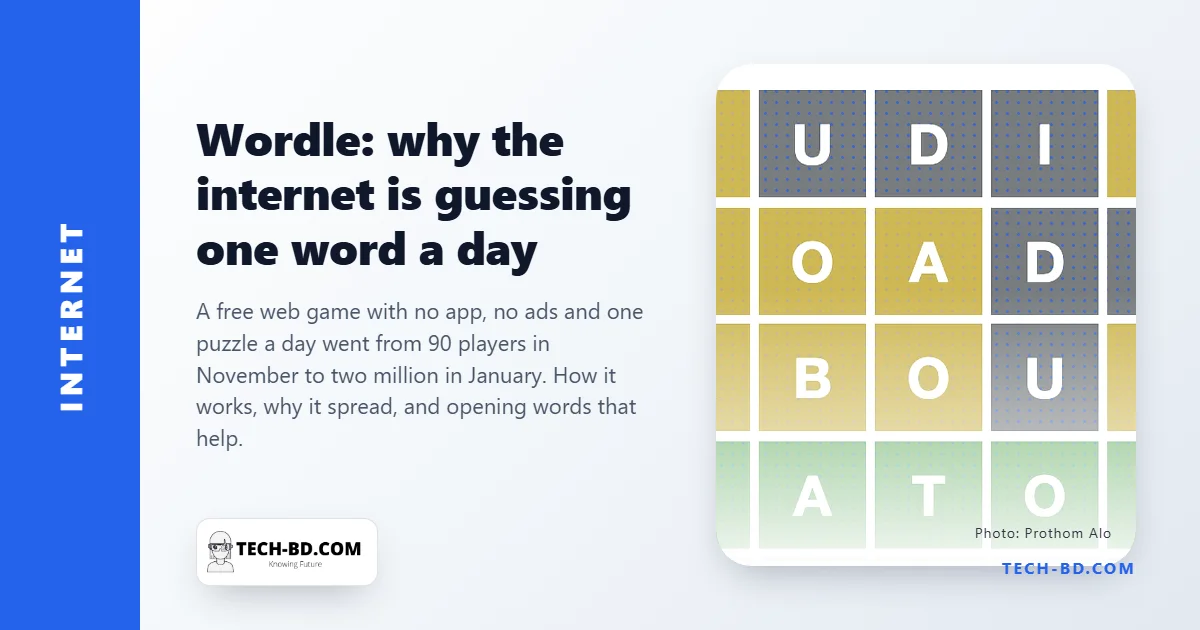
If your Facebook feed has filled up with little grids of grey, yellow and green squares, you have met Wordle. Every day the free website offers one five-letter English word. You get six guesses. After each guess the tiles change colour: grey means the letter is not in the word, yellow means it is in the word but in the wrong place, green means right letter, right place. Solve it and you can share your grid, but never the word, because everyone in the world is playing the same puzzle.
A love story that got out of hand
Josh Wardle, a software engineer in Brooklyn, built the game for his partner Palak Shah, who loves the New York Times crossword and Spelling Bee. He had tried a word-guessing prototype in 2013 and shelved it; during the pandemic he finished it, and the couple played it privately before sharing it in the family WhatsApp group. On 1 November 2021 it had 90 players. By early January that was 300,000; by the end of the month, around two million a day. The share-as-emoji feature that made it go viral was copied from a player in New Zealand who typed her result out in coloured squares on Twitter.
Why it works
- No app, no account, no data. It runs in any browser. There is nothing to install and nothing to sign up for.
- One puzzle a day. There is no next level, no notification, no streak nagging you back. It takes three minutes and then lets you go.
- No points, no ads. Wardle built it for two people and never added the "growth hacks" other games rely on.
- A small, shared win. Everyone solves the same word, so the grid is a conversation, not a scoreboard.
Opening words that help
Around 12,000 five-letter words are in the game's dictionary, but the daily answers come from a shorter list of common ones. Vowel-heavy openers such as AUDIO, ADIEU or QUERY find the vowels quickly; then work through the commonest consonants, T, N, S, R, H and L. Some players use a fixed set of three openers that cover 15 different letters. In Dhaka, university teachers and night-shift freelancers alike wait for the new word at 12:01 am, and Bangla-language clones appeared within weeks. If you want the same idea in Bangla with a clue, Prothom Alo's daily Shabdabhed has been doing it for years.
Update: on 31 January 2022 the New York Times bought Wordle for a price "in the low seven figures". It remains free to play at nytimes.com.