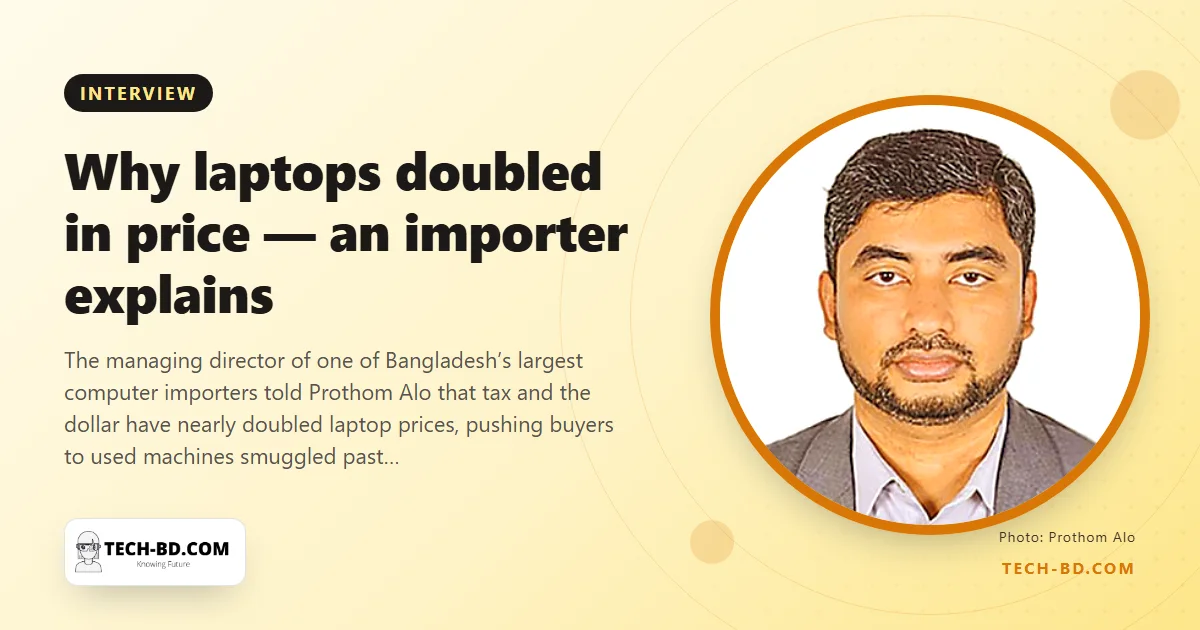
Md Zahirul Islam runs Smart Technologies (BD) Limited, one of the country’s two or three largest computer distributors — the company behind a large share of the laptops, monitors and parts on the shelves of Elephant Road and IDB Bhaban. He spoke to Prothom Alo’s Pallab Mohaimen about the state of the market. Edited extracts.
On the market now
“Reasonably good. But the market is flooded with old products, brought in by evading customs in various ways. Otherwise the market will grow fast.”
On why prices doubled
“Taxes on new laptops and the rise of the dollar have nearly doubled laptop prices. A laptop of a quality you could buy for 40,000 taka now costs 70,000. That is why old laptops are entering the market — and they break quickly. But computer sales will only rise. There is no reverse gear.”
The numbers support him. The 2023–24 budget added a 15 per cent VAT to imported laptops that had been VAT-exempt, on top of existing duty, and the taka fell from 85 to 118 to the dollar between 2022 and 2024. The two together explain almost exactly the 75 per cent rise he describes.
On what buyers want
“People want to buy at a fair, correct price. Banks give consumer loans for all sorts of products — but not for computers. A loan for a computer would be a great help to students; 50,000 taka would be enough. They are the future. Pakistan is giving a million laptops free to students. In our country there is not even a loan facility for students to buy one. Nation-building needs such facilities.”
On making computers in Bangladesh
“There is certainly a need — products would be somewhat cheaper. But government policy is anti-production. When customs sees raw materials imported for a computer factory, it imposes very high duty. The law and the attitude at customs have to change. We too have built a factory in the Hi-Tech Park and will go into production soon, but it is becoming difficult because of the National Board of Revenue’s existing rules. Daffodil has also set up a factory there and faces the same problem. Walton has kept its factory running.”
On hardware’s place in ICT
“The software sector exports — it is said a billion dollars a year of software and IT services. Hardware exports nothing. But the local market exists and is growing, so local computer factories can be built. They must be allowed to; then the ICT sector will move further ahead.”
The point he is making
Bangladesh assembles phones — Samsung, Walton, Symphony and others make most handsets sold here — because the 2017 budget made components cheaper to import than finished phones. Laptops never got the same treatment: a finished laptop and a laptop motherboard attract similar duty, so there is no reason to assemble. Islam’s argument is that the phone policy worked, and should be copied. The counter-argument, from the NBR, is revenue: laptops are a 4,000-crore-taka import and the VAT on them is easy to collect. Between the two sits a student paying 70,000 taka for the machine that was 40,000 two years ago.