Three things on this date that shaped how Bangladeshis work with computers — one of them a building, one a form, one a man — and a fourth that reminds us what software can break.
2002: the incubator
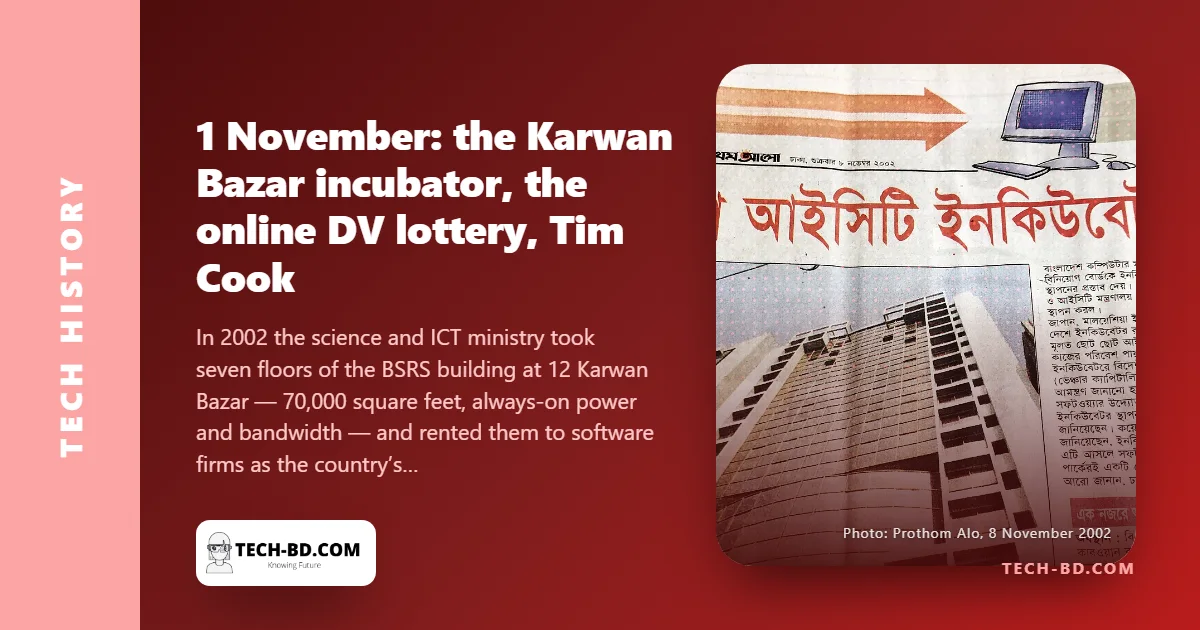
On 1 November 2002 the then Ministry of Science and ICT opened the country’s first ICT Incubator in the BSRS Bhaban at 12 Karwan Bazar: floors three to nine and part of the eleventh, about 70,000 square feet, fitted with the two things a software company in Dhaka could not then get — uninterrupted electricity and high-speed internet, supplied centrally — and rented to software and IT-service firms at subsidised rates to give them an export-grade workplace. The Bangladesh Computer Council managed it, with BASIS, the software association, as partner; BASIS’s own office is on the fifth floor. When the Shilpa Bank and BSRS merged into the Bangladesh Development Bank in 2010 the building became BDBL Bhaban, and in 2011 the incubator passed to the Hi-Tech Park Authority, which proposed renaming it Software Technology Park-1. It is still, formally, the ICT Incubator, still managed by BASIS, and still full: a generation of the companies that now export software started with a desk in it.
2003: the DV lottery goes online
For years Bangladeshis applied for the US Diversity Visa lottery on paper, by post. From 1 November 2003, applications for DV-2005 were accepted only online, at a State Department website, until 30 December. The effect on the country was out of all proportion to the 3,500 or so visas at stake: within weeks every town had shops offering digital photographs and form-filling for a fee, and the first computer many people ever touched was the one that submitted their lottery entry. Bangladesh was later excluded from the lottery for sending too many immigrants, but the cybercafés stayed.
1960: Tim Cook
Timothy Donald Cook was born in Robertsdale, Alabama, on 1 November 1960. An industrial engineer from Auburn with an MBA from Duke, he joined Apple as senior vice-president in March 1998 to fix its supply chain, became chief operating officer, and on 24 August 2011 succeeded Steve Jobs as chief executive. Under him Apple’s revenue doubled, it became the first company worth a trillion dollars, and it learned to sell services and watches as well as phones. He also sits on the boards of Nike and the National Football Foundation.
2005: the exchange that stopped
And on 1 November 2005 a bug introduced during a software upgrade halted trading on the Tokyo Stock Exchange at the 9 am open; shares and bonds could not trade until 1:30 pm. It was the exchange’s worst failure since it went fully electronic in 1999 — a reminder, for a week in which Dhaka’s own exchange runs on software of uncertain age, that the incubators produce the code and the code needs testing.