Valentine’s Day has a second life in the history of computing. Four things that shape the device in your hand — the video you watch on it, the keyboard you type on, the company that built the first business machines and the machine that started it all — trace to 14 February.
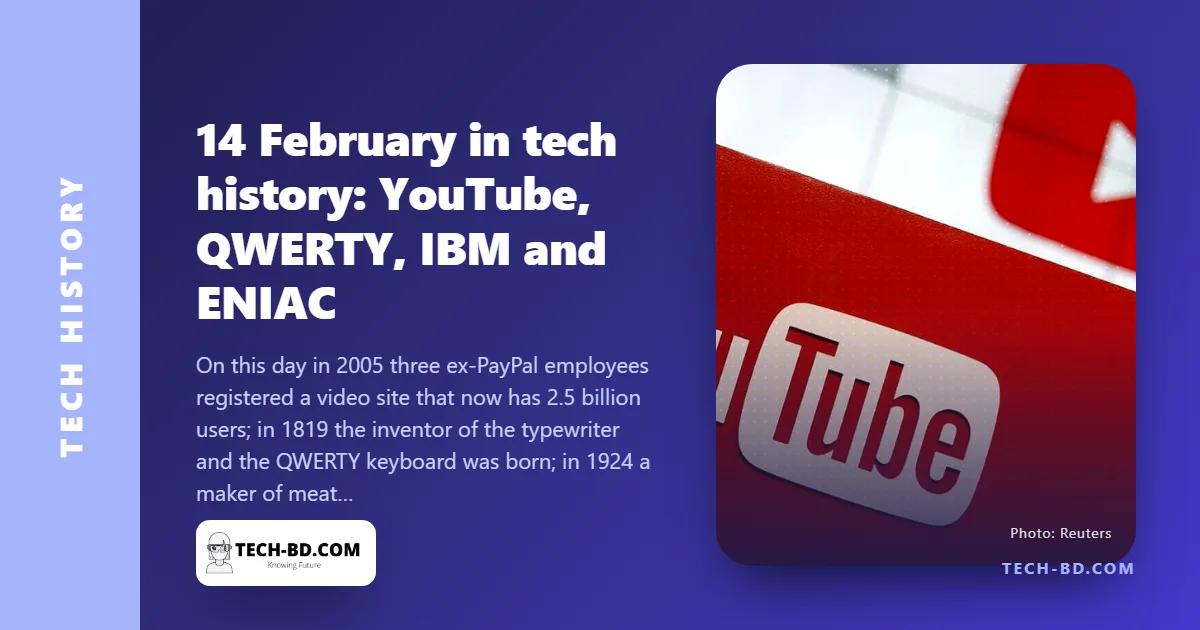
2005: YouTube
Three former PayPal employees — Steve Chen, Chad Hurley and Jawed Karim — registered youtube.com on 14 February 2005. Karim uploaded the first video, nineteen seconds at the San Diego Zoo, that April. Google bought the company in October 2006 for $1.65 billion, a price that seemed reckless and was not. YouTube now has about 2.5 billion monthly users who watch more than a billion hours a day; by 2023 it held an estimated 14 billion videos, most of them made by individuals — “YouTubers” — while Disney, Paramount, NBCUniversal and Warner run channels alongside them. Its headquarters are in San Bruno, California; its owner, through Google, is Alphabet. In Bangladesh it is, for a large share of the population, simply what television has become.
1819: the man behind QWERTY
Christopher Latham Sholes was born in Mooresburg, Pennsylvania. A printer, newspaper editor and Wisconsin state senator, he was also, with partners, an inventor: first of a numbering machine that sold well, then, with the German clockmaker Matthias Schwalbach, of a machine that typed letters, numbers and punctuation, modelled in September 1866 and patented on 23 June 1868. The QWERTY layout was his too, arranged to keep frequently paired type bars from jamming. Sold as the Sholes and Glidden typewriter from 1 July 1874, it fixed the arrangement of every English keyboard since, including the glass one on your phone. Sholes died on 17 February 1890.
1924: IBM gets its name
The Computing-Tabulating-Recording Company, founded in Endicott, New York, in 1911, made employee time clocks, automatic meat slicers and punched-card tabulators. On 14 February 1924 it renamed itself International Business Machines. Calculators and then computers followed; so did most of the twentieth century’s business computing.
1946: ENIAC
At the University of Pennsylvania, John Mauchly and J. Presper Eckert unveiled ENIAC, the long-awaited electronic computer. It executed 5,000 instructions a second — a thousand times faster than anything before it — using 18,000 vacuum tubes, occupying 1,500 square feet and weighing 30 tons. The phone in your pocket is billions of times faster and weighs less than one of its tubes. Everything in between began on this date.