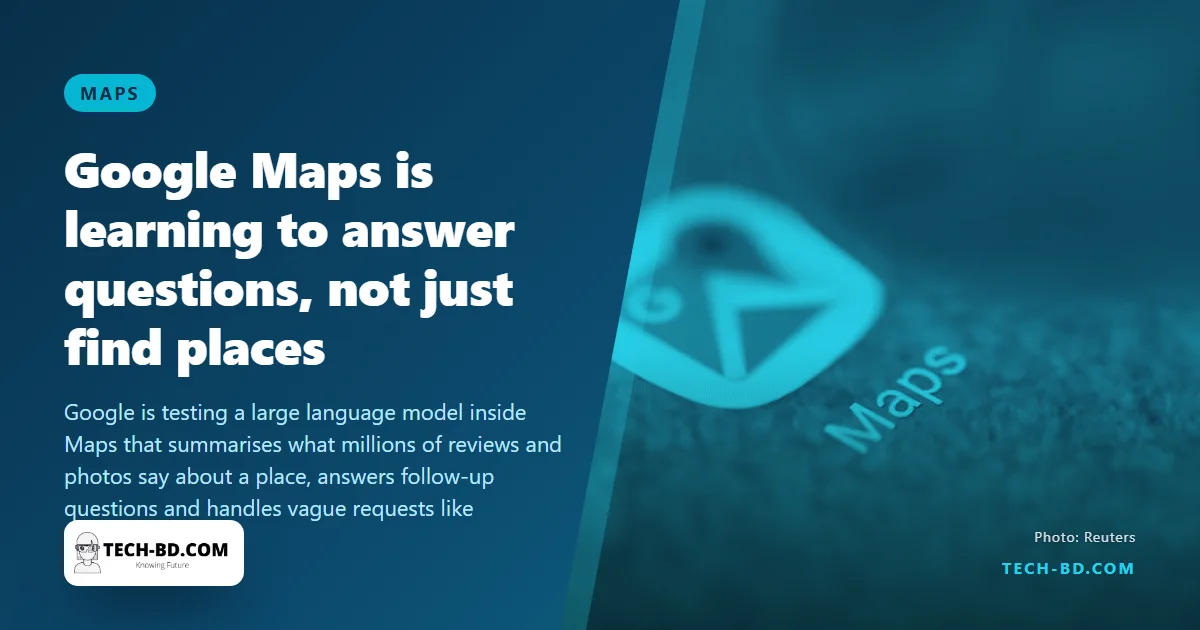
Google Maps has always been good at a precise question — where is this address, how long to get there — and poor at a vague one. Type “nice place for dinner with parents, not too loud” and you get a list of restaurants sorted by nothing in particular, and an evening of reading reviews. Google now says it is testing the fix: a large language model built into Maps that reads the reviews for you.
How it works
In a blog post, Google explained that the model draws on Maps’ existing data — the details of more than 250 million places, plus the photos, ratings and written reviews contributed by users — and analyses it in response to a natural-language request. Ask for a restaurant, a shop or a spot, and Maps returns a short summary of what the reviews and photos actually say, grouped by what you asked for. Then you can keep going: “which of these has parking?”, “is the second one open on Fridays?” — and Maps answers in the conversational style of Google’s Bard chatbot rather than making you start a new search. The result is meant to be faster and more detailed than reading through reviews yourself.
Who gets it, and when
The feature is in early testing with a selected group of Local Guides — Maps’ most active reviewers — in the United States. Google has given no date for a wider release, and no word on languages other than English, which for a Bangla-speaking audience is the detail that matters.
What it will get wrong
A model that summarises reviews inherits the reviews’ problems. Fake ratings, bought five-stars and revenge one-stars are common everywhere and endemic in Dhaka, where restaurant listings routinely carry hundreds of reviews written in a single week. A summary that confidently reports “diners praise the friendly service” from a paid batch is worse than the raw list, because it hides the pattern a human would notice. Google says its spam filters run first; how well they run in Bangla is untested.
The Dhaka problem
Maps data in Bangladesh is thin and uneven: opening hours are guesses, many businesses are listed by customers rather than owners, and the Bangla and English names of the same place often appear as two entries. An AI layer on top of that can be helpful — it may be better at reconciling the two entries than the search box is — or it can produce fluent nonsense. When the feature reaches here, the useful habit will be the same as with any chatbot: treat the summary as a starting point and tap through to the reviews before you get in the car.
Source: Mashable, via Prothom Alo.