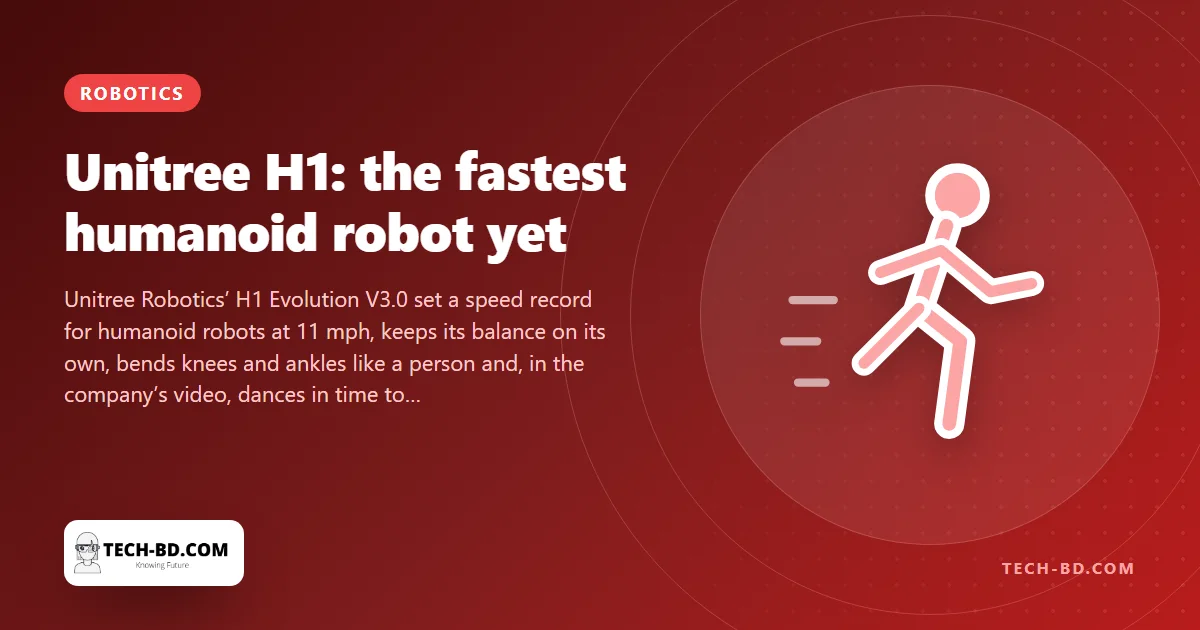
For most of the history of humanoid robots, the impressive thing was that they could walk at all. This week the Chinese company Unitree Robotics published a video in which its H1 Evolution V3.0 runs — properly runs, both feet off the ground — at 11 miles per hour, or 17.7 km/h. That is the fastest any two-legged humanoid has gone, and it is roughly the speed of a fit adult jogging hard.
What the robot is
The H1 stands 5 ft 11 in and weighs under 50 kg. It balances itself, bends its knees and ankles the way a human leg does, and uses that to climb and descend stairs. In the video it dances to music, sprints, and at one point runs forward while looking backward. Sensors and cameras let it avoid obstacles and handle what the company calls difficult tasks; walking speed is about 7.4 mph. Unitree has said the robot will be usable in homes, workplaces and factories within a few months, and has quoted a price in the region of $90,000 — a great deal of money, and also about a tenth of what comparable research robots cost a decade ago.
Why speed matters
Running is not the job. Nobody needs a robot to jog. What a running humanoid demonstrates is control: the ability to keep a heavy two-legged body balanced through a gait in which each foot leaves the ground, to recover from slips, and to do it with motors and batteries light enough to carry. Those are the same capabilities that let a robot carry a box across an uneven factory floor or climb the stairs of a building with no lift, which are the jobs the companies actually want. Boston Dynamics’ Atlas showed such control years ago as a research platform; Unitree is showing it in a product with a price tag.
China’s position
Unitree began as a maker of four-legged robot dogs — cheaper than Boston Dynamics’ Spot, and now the most common quadrupeds in university labs worldwide, including several in Bangladesh. Its move into humanoids, alongside Xiaomi, UBTech and others, is backed by a national policy that named humanoid robots a strategic industry in 2023. The result is a race with Tesla’s Optimus and the American startup Figure in which China has the manufacturing base and, increasingly, the demonstrations.
And for Bangladesh
A $90,000 robot will not walk into a garment factory soon; a sewing operator costs far less and needs no charging. But the direction is clear enough to plan for. The tasks such machines take first are the ones nobody wants — lifting, night shifts, hazardous rooms — and the countries that come out ahead will be those that train people to build, program and repair the robots rather than to compete with them.
Source: Live Science, via Prothom Alo.