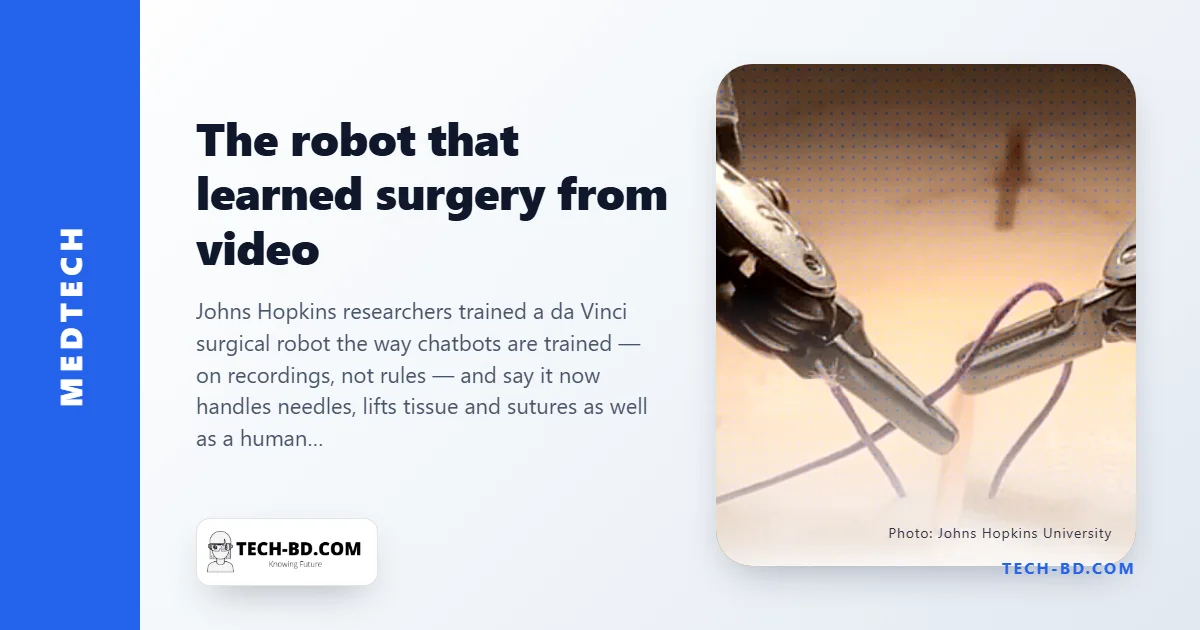
Researchers at Johns Hopkins, with colleagues at Stanford, trained a da Vinci Surgical System robot to perform three fundamental surgical tasks by showing it video of human surgeons. The work — "Surgical Robot Transformer (SRT): Imitation Learning for Surgical Tasks" — was presented at the Conference on Robot Learning in Munich.
The tasks were manipulating a needle, lifting body tissue and suturing. The robot performed them to a standard comparable with the human surgeons it had watched.
The part that makes it work
Two things combine here, and the second is the one worth noticing.
The first is imitation learning with a transformer — the same machine learning architecture that underpins ChatGPT, applied to sequences of surgical motion instead of sequences of words. That removes the need to program each individual movement a procedure requires, which is how surgical robots have historically been instructed.
The second is the training data, and it is the genuinely clever part. The model was fed hundreds of videos from wrist cameras mounted on da Vinci arms — footage recorded by surgeons all over the world during real procedures, used for post-operative analysis and then archived.
Nobody created that corpus for machine learning. It accumulated as a byproduct of surgical practice, in a consistent format, from a standardised instrument, with the camera already in the right position. The research did not have to generate data; it had to notice that the data existed.
Why the camera position matters
Learning a physical skill from video is usually hard because the viewpoint keeps changing. A model watching from across a room has to infer depth, occlusion and scale before it can infer technique.
A wrist camera removes that problem. It sits in a fixed relationship to the instrument, so every recording shows the task from the same perspective, at the same scale, with the tool in the frame. That consistency is what makes hundreds of videos sufficient rather than hundreds of thousands.
What this does not mean
Three limits belong beside the result.
Three tasks are not a surgery. Needle handling, tissue lifting and suturing are component skills, performed in isolation. An operation is the sequence, the judgement about what to do next, and the response when something unexpected appears — none of which is demonstrated here.
Comparable skill on a task is not comparable outcomes. A surgeon's value is substantially in deciding, not only in executing. The hard part of surgery is rarely the stitch.
The failure mode is unexamined. The interesting question for any autonomous system in a body is not how well it performs when things go normally, but what it does when they do not — and a model trained on archived footage of successful procedures has seen comparatively little of that.
Where it genuinely leads
Not to autonomous surgery in the near term, despite the framing. The realistic near-term use is assistance: a robot that can take over the repetitive, well-defined portions of a procedure — closing, suturing a routine wound — under supervision, leaving the surgeon's attention for the parts that require it.
The broader lesson is about data rather than medicine. The most valuable training corpus in a field is frequently one that already exists, generated for another purpose and archived without anyone thinking of it as data. That is worth looking for before anyone commissions the collection of a new one.
Sources: Johns Hopkins University; the SRT paper presented at the Conference on Robot Learning; Stanford; Futurity; and Prothom Alo's original report.