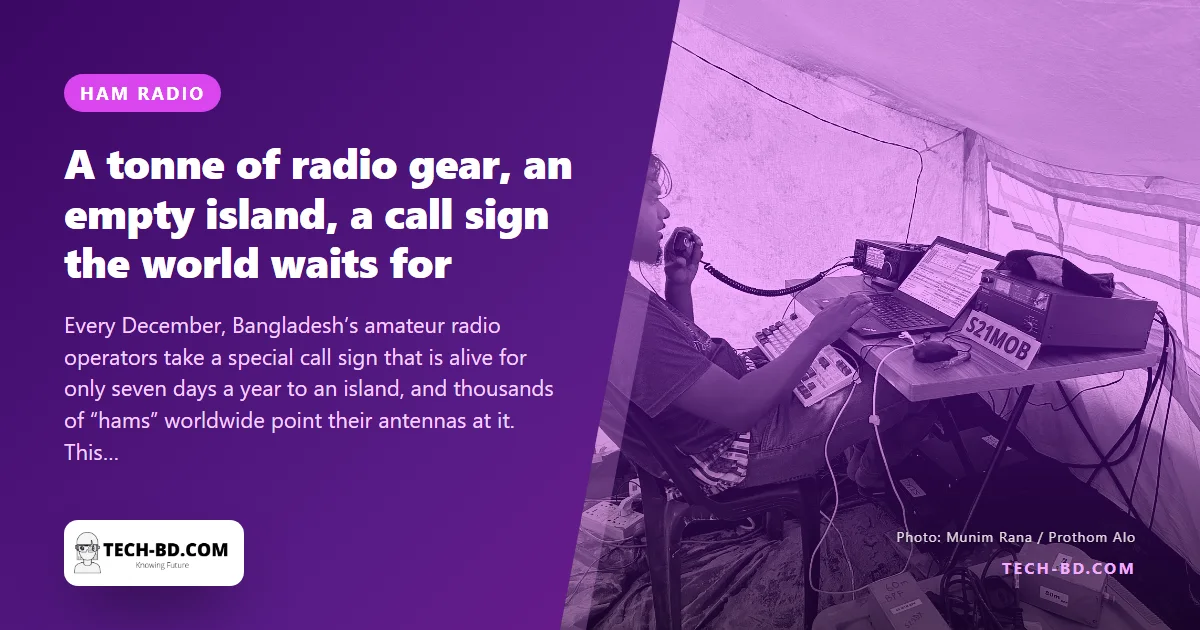
On 10 December a launch left Sadarghat for Bhola carrying fifteen people, and waiting at Kachchhapia ghat was a truck holding roughly a tonne of tents, solar panels, generators, batteries, coils of feeder cable and antennas. Two and a half hours by trawler later they waded ashore on Tarua, an uninhabited beach at the southern tip of Char Fasson where the Meghna meets the sea. For the next twelve days their address was a call sign: S21DX.
What amateur radio actually is
Amateur — "ham" — radio is a licensed hobby in which private individuals talk to one another across the world by radio, with no internet, no operator and no network in between. The pleasure is not that it works but that making it work is difficult. A signal from a Bangladeshi beach reaches Texas only if the antenna, the power, the hour and the state of the upper atmosphere all cooperate, and the operator who builds a station that achieves it has done something closer to applied physics than to conversation.
Every licensed operator holds a call sign issued under International Telecommunication Union rules, and the prefix identifies the country. S21 is Bangladesh. When an operator keys the microphone, anyone on any continent who hears those two characters knows where the signal originated before a word of the exchange is spoken.
How a signal gets to another continent
Everything else follows from this, and it is rarely set out.
High-frequency radio does not travel in a straight line to the horizon and stop. Between roughly 60 and 400 kilometres up, solar ultraviolet light strips electrons from atoms in the upper atmosphere and leaves a set of electrically charged layers — the ionosphere. An HF signal aimed upward at a shallow angle is bent back down by those layers and returns to earth hundreds or thousands of kilometres away, where it can bounce off the surface and go up again. A few of those hops and the signal is on another continent.
Which layer does the bending, and whether it bends or absorbs, changes constantly. The lowest layer absorbs low frequencies during daylight and disappears after dark, which is why the lower bands open at night and go quiet at dawn. The highest layer is sustained by the sun, so the higher bands work in daytime and over paths where the sun is up. And all of it rises and falls with the eleven-year solar cycle: near solar maximum the upper atmosphere is more strongly ionised, the usable frequencies rise, and contacts that are impossible in a quiet year become routine. A DXpedition's calendar is set partly by that cycle.
Why an island, and why the beach specifically
There is a practical reason the gear goes to a shoreline, and it is not scenery.
A vertical antenna needs a conductive surface beneath it to work against — a ground plane. On dry land that means burying dozens of radial wires and still getting a mediocre result, because soil is a poor conductor and a large share of the transmitted power is lost heating the ground. Saltwater is an excellent conductor. A vertical standing at the water's edge gets a near-perfect ground plane for free, and radiates at the low angle that long-distance propagation needs rather than wasting power straight upward. An antenna that would be ordinary in a Dhaka courtyard becomes a serious station on a beach with an unobstructed sea path.
That is why island expeditions outperform permanent stations with far better budgets, and why a tonne of equipment is worth moving by trawler.
Islands On The Air
IOTA is a long-running international programme in which operators earn credit for contacting stations located on islands, catalogued into island groups worldwide. Bangladesh has mounted an IOTA expedition every year since 2009, and the regulator, BTRC, issues the special call sign S21DX for just seven days a year.
Scarcity is the whole mechanism. Because the call sign exists for one week annually, operators on every continent wait all year to log a contact with it — which is why a dozen antennas went up within hours of landing and why the team worked shifts through the night. When a rare station appears, hundreds of operators call at once; the station works "split", listening on a different frequency from the one it transmits on, and works through the pile methodically. Each contact is later confirmed, traditionally by exchanging printed QSL cards and now mostly through electronic logging systems, because an unconfirmed contact does not count toward anything.
How you get a licence in Bangladesh
Transmitting was closed to private citizens for decades; an enthusiast in the 1970s could build a receiver and listen, and nothing more. The Bangladesh Amateur Radio League pushed for years to open the hobby, and in 1992 a US-licensed examination was run in Dhaka with help from the Foundation for Amateur International Radio Service.
Today BTRC holds an amateur radio examination every year. Pass it, meet the conditions, and you are issued your own S21 call sign. It is one of very few technical licences in the country a teenager can earn on merit alone, and the syllabus — regulations, basic electronics, propagation, operating practice — is a genuine introduction to radio engineering rather than a formality.
Why it still matters
When a cyclone takes down mobile towers, licensed operators are among the people who can still pass messages, because a station that runs on a battery and a wire does not depend on any infrastructure that the storm can remove.
The honest limits are worth stating alongside that. Amateur radio carries voice and small amounts of data, not photographs or databases; it needs operators who are already licensed and already practised, since an emergency is a poor time to learn; and it is a supplement to official disaster communications rather than a replacement for them. But in a country whose coast floods every few years, a hobby that trains people to assemble a working station on a beach with solar power is not nostalgia. It is a skill held in reserve.