On the last night of the twentieth century a large part of the world sat up not to celebrate but to watch. Would the lights stay on at midnight? Would the ATMs work? Would a plane somewhere be told by its computer that it was 1 January 1900? This was Y2K — the Year 2000 problem, the Millennium Bug — and the answer, when it came, was the strangest possible one: almost nothing happened, and nobody has agreed since about why.
What the bug was
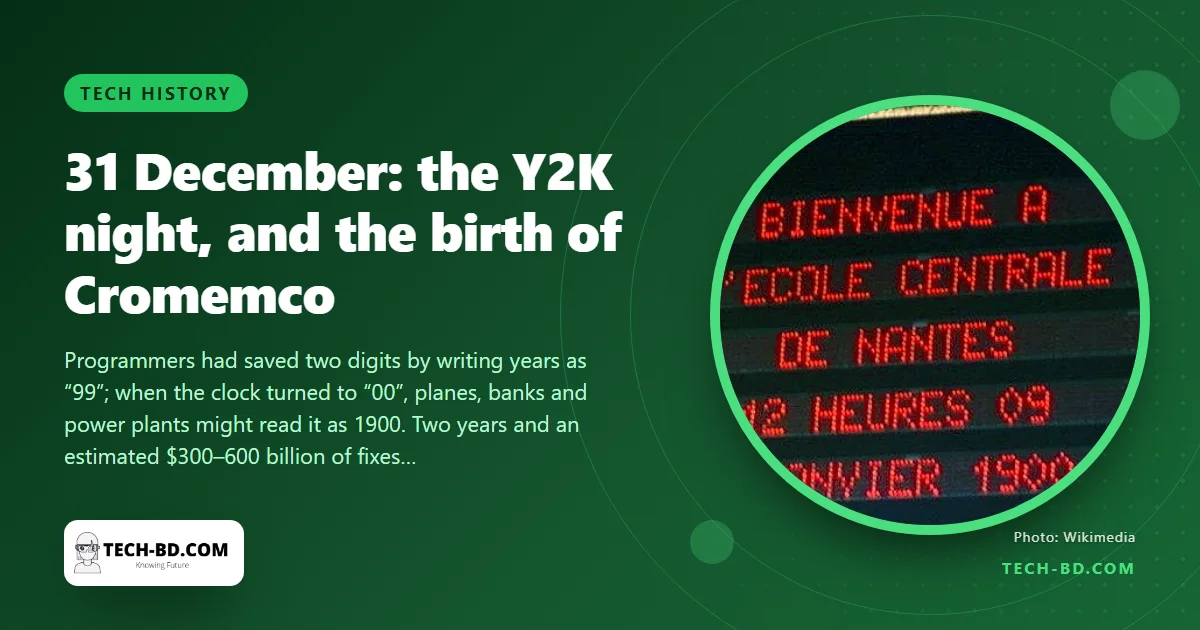
For decades programmers, working with memory that cost real money, had stored years as two digits: 1975 was “75”, 1999 was “99”. Systems calculated age, interest, expiry and schedules by subtracting one two-digit year from another. At midnight on 31 December 1999 the year would become “00”, and any such calculation would go wrong — 00 minus 99 is not one year but minus 99 — and some systems would assume the date was 1900. The code was everywhere: mainframes at banks and airlines, billing systems at telephone companies, the embedded chips in lifts, power-station controls and medical equipment. Nobody knew exactly which of them would fail.
The repair
From about 1997 the world did the largest maintenance job in the history of software. Companies hired armies of COBOL programmers out of retirement to read every line of code that touched a date; governments set up Y2K commissions; the total cost has been estimated at between $300 billion and $600 billion. Airlines, banks, insurers and utilities tested their systems against a simulated midnight. And when the real one came, the failures were small: some slot machines in Delaware stopped, a US spy-satellite ground station lost data for hours, a few bus-ticket machines in Australia jammed, some websites displayed the date as 19100. The argument ever since has been whether the world was saved by the repair or frightened by a problem that was never that large. The honest answer is both: countries that spent almost nothing, like Italy, also had few failures, but the systems most at risk were in the countries that fixed them.
31 December 1976: Cromemco
On the same date, twenty-three years earlier, two Stanford roommates from Crothers Memorial Hall, Harry Garland and Roger Melen, founded Cromemco — “Cro” from the hall, “memco” for the company — to build microprocessor-based computers. A year earlier they had connected their Cyclops digital camera to an Altair, one of the first digital cameras attached to a personal computer; in October 1976 they advertised a Z-80 processor board for the S-100 bus, and through the early 1980s Cromemco built rugged, well-regarded machines for business and the military, peaking in 1983 with 450 staff and $42 million in sales. It merged into Dynatech in 1986; Garland and Melen founded Canon Research Center America in 1990.
The Bangladesh footnote
Bangladesh had few computers in 1999 and fewer old ones; the banks that had automated had done so in the 1990s, on software written after the problem was known. The country’s Y2K experience was mostly the cost of the certificates that foreign buyers demanded from garment exporters proving their systems were compliant — an early lesson in how the rich world’s software problems are paid for, in part, here.