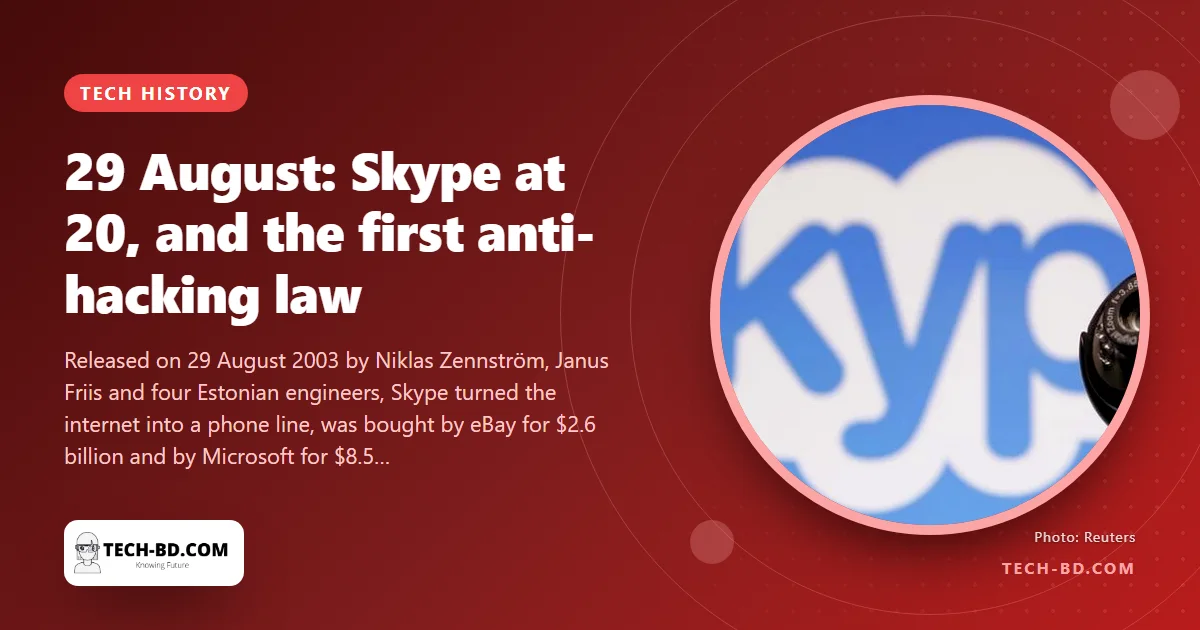
For a generation of Bangladeshi families, the sound of a relative abroad was the Skype ringtone. The software that made that possible was released twenty years ago today, on 29 August 2003, by a Swede, a Dane and four Estonian programmers — and before Skype, a call to Dhaka from London cost a pound a minute.
What Skype did
Niklas Zennström and Janus Friis had built Kazaa, the file-sharing network, with a team in Tallinn — Ahti Heinla, Priit Kasesalu, Jaan Tallinn and Toivo Annus. They used the same peer-to-peer technique for voice: Skype sent calls as internet packets between users’ own computers, so it needed almost no infrastructure and could give calls away free. Calls to ordinary phones cost pennies through SkypeOut; video came in 2006. eBay bought it in September 2005 for $2.6 billion, never worked out what to do with it, and sold most of it back; Microsoft paid $8.5 billion in May 2011, its largest acquisition at the time, and folded Windows Live Messenger into it. By March 2020 Skype had about 100 million monthly users and 40 million daily. Then the lockdown arrived, and the world chose Zoom — simpler to join, better with large groups — while Microsoft pushed its business users to Teams. Skype now has around 36 million daily users, and Microsoft’s attention is elsewhere.
Why it mattered here
Bangladesh has ten million people working abroad, and until Skype the only affordable link home was a calling card and a queue at a call shop. Skype — and later Viber, imo and WhatsApp, which copied its model — turned the diaspora call from a weekly luxury into a daily habit, and did more for the family life of migrant workers than any policy. It also ran straight into the state: VoIP was illegal in Bangladesh for years to protect BTCL’s international call revenue, and the “illegal VoIP” raids of the 2000s were, in effect, raids on people doing what Skype did.
29 August 1990: the first hacking law
On the same date in 1990 the United Kingdom’s Computer Misuse Act came into force — the first law in the world written specifically to make unauthorised access to a computer a crime. It was prompted by an embarrassment: in 1984 two men had used a Prestel engineer’s credentials to read the Duke of Edinburgh’s mailbox, and the courts found that no existing law covered it. The Act’s three offences — unauthorised access, access with intent to commit a further crime, and unauthorised modification — became the template for most of the world’s computer-crime statutes, including the sections of Bangladesh’s ICT Act 2006 and the Digital Security Act 2018 that deal with hacking. The controversies of those laws are about the other sections; the hacking provisions are the 1990 Act, translated.