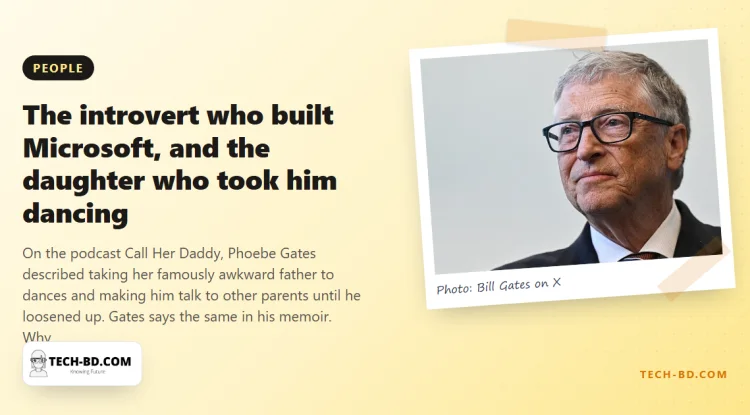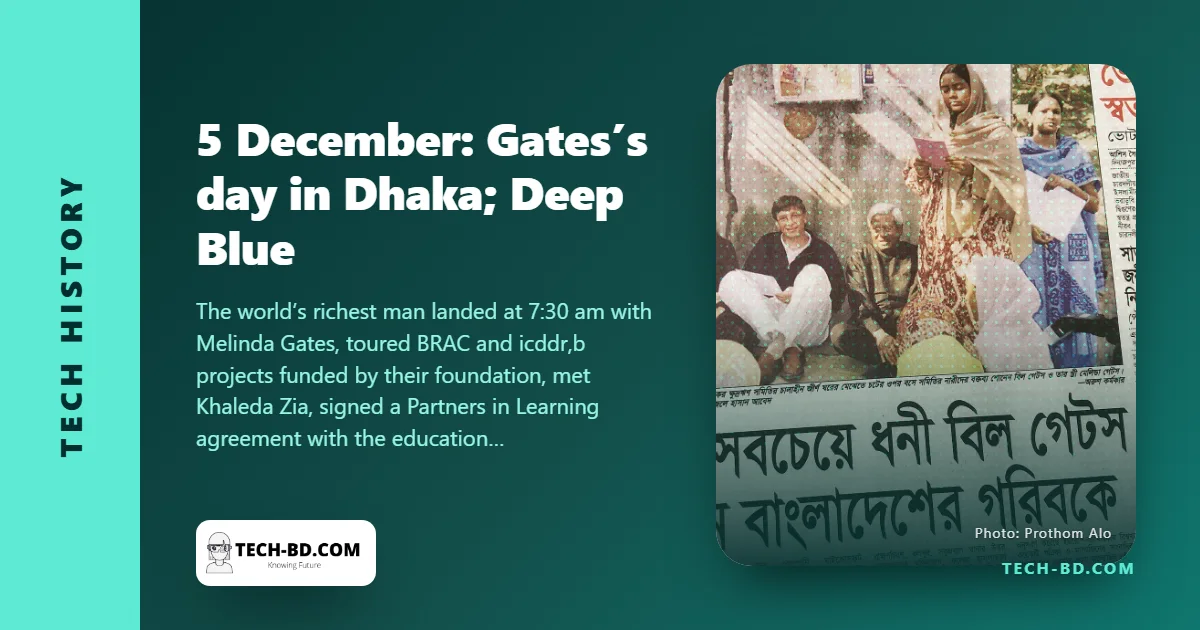
Eighteen years ago today the richest man in the world spent a working day in Dhaka. Bill Gates, then chairman and chief software architect of Microsoft, landed at 7:30 am on 5 December 2005 with his wife Melinda, and left for Delhi that evening. The twelve hours in between were, for the country’s small technology industry, the first time anyone of that size had looked at it.
The day
The morning was the foundation’s: the Bill & Melinda Gates Foundation was already among the largest funders of health work in Bangladesh, and the Gateses visited BRAC project sites and the icddr,b, the diarrhoeal disease research centre whose oral rehydration work the foundation has supported for years. After noon Gates met Prime Minister Khaleda Zia at her office. In the afternoon, at the Sheraton (now the InterContinental), he held a roundtable with ministers, at which Microsoft and the Ministry of Education signed a Partners in Learning agreement to put its software and training into schools. Then a press conference and a reception, where he made the announcement the room had come for: Bangladesh’s Bangla — its own locale, keyboard and fonts, distinct from the Indian Bengali already supported — would be built into the next Windows, Vista, and the next Office. Microsoft had opened its Bangladesh office a year earlier, in 2004; the visit was the company saying the office was not a formality.
What came of it
Vista shipped with Bangla the following year, and the Partners in Learning programme trained teachers through the late 2000s. The larger effect was on morale: the software companies of the Karwan Bazar incubator, then a few hundred people, took the visit as evidence that the industry they were building was visible from Redmond. Gates has not returned; his foundation’s money — for vaccines, sanitation, agriculture and, lately, the country’s digital financial services — has never stopped.
5 December 1995: Deep Blue
On the same date ten years earlier IBM presented Deep Blue, a parallel-processing supercomputer built for one purpose: chess. The project had begun at Carnegie Mellon in 1985 as ChipTest, moved to IBM as Deep Thought, and was renamed in 1989. In February 1996 it played world champion Garry Kasparov over six games and lost 4–2, winning the first — the first time a machine had beaten a reigning champion in a classical game. Rebuilt and doubled in speed, it played him again in May 1997 and won 3.5–2.5, two wins to one with three draws. Kasparov accused IBM of cheating; IBM dismantled the machine. The victory is the date most histories give for the moment artificial intelligence beat human intelligence at something humans had considered their own — twenty-six years before a chatbot did it for writing.