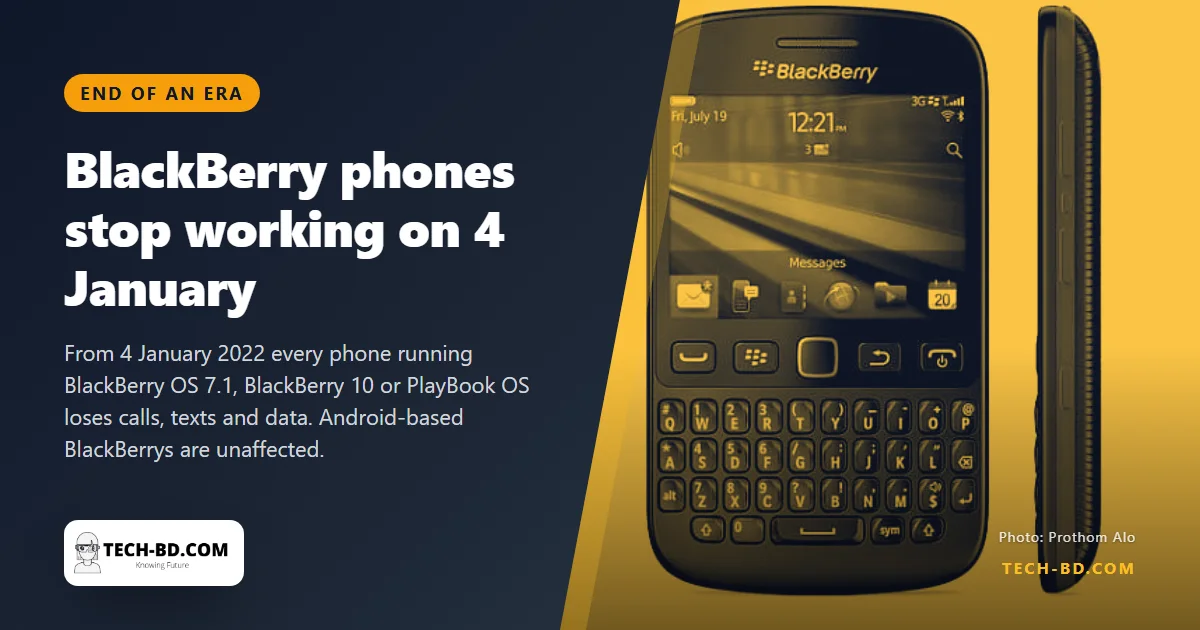
For a decade the BlackBerry was the phone of the Dhaka executive: a physical keyboard, a blinking red light and BBM, the messenger everyone in the office was on. That era formally ends on 4 January 2022. BlackBerry Limited has confirmed that from that date, phones running its own operating systems will "no longer reliably function".
Which phones stop working
The shutdown covers BlackBerry OS 7.1 and earlier, BlackBerry 10, and PlayBook OS 2.1 and earlier — every Bold, Curve, Torch, Q10, Z10, Passport and Classic ever sold. After 4 January they may fail to make calls, send SMS, use mobile data or Wi-Fi, or even dial emergency numbers. The handset becomes a keyboard with a battery.
Phones carrying the BlackBerry name but running Android — the KEYone and KEY2, made under licence by TCL — are unaffected. They keep working like any other Android phone, though TCL stopped making them in 2020.
Why a server being switched off kills a phone
A twelve-year-old Android phone still makes calls. It is insecure, its apps have stopped updating and its browser fails on modern sites, but it works. A BlackBerry does not, and the difference is architectural rather than a matter of age.
BlackBerry's advantage, the thing that made it the corporate standard, was that it did not simply use the mobile network like other phones. Data traffic was routed through BlackBerry's own infrastructure — compressed, encrypted and relayed through the company's network operations centres before reaching its destination. That is what produced the famous battery life on slow connections, the push email that arrived before anyone else's, and the security guarantees that got the devices into banks and governments.
It also meant the phone was not a standalone device. It was a terminal for a service. Email, messaging, the browser and much else depended on a live relationship with servers the company operated, and a handset that cannot reach them is not a degraded phone — it is a client with no server.
So the shutdown is not neglect. It is the bill for a design that delivered real advantages for years and had a dependency at the centre of it, and when the company stopped being a phone company the dependency came due.
How it came to this
BlackBerry, based in Waterloo, Canada, replaced its ageing software with BlackBerry 10 in 2013, a late attempt to match iOS and Android. Users did not follow. In 2015 it moved its own phones to Android, in 2016 it handed hardware to TCL and an Indian partner, and after October 2018 no new BlackBerry-branded phone appeared. A Texas start-up, OnwardMobility, promised a 5G BlackBerry for 2021; it never shipped.
The company itself is not disappearing. It sold its last phone years ago and now makes security software for governments and corporations, including the QNX system inside millions of cars.
If you still have one in a drawer
- Move contacts and photos now. Once services stop, the easiest export routes may stop with them. Copy everything to a computer over USB, or email yourself the contact list as a vCard.
- Put the SIM in any Android phone. Your number, your bKash and your bank OTPs work as before; only the handset is retiring.
- Do not sell it as a working phone. Second-hand listings in Dhaka still carry BlackBerry 10 devices; after 4 January they are collectors' items.
- Recycle rather than bin. Several brands' service centres in Dhaka and Chattogram accept old handsets for e-waste disposal.
The part that did not stay in 2022
The lesson outlived the platform, and it applies to a great deal of hardware sold today.
Ask of anything you buy: what does it do when the manufacturer's servers are gone? A phone, a speaker, a camera, a thermostat, a car feature — each sits somewhere on a line between a device that happens to connect and a terminal that cannot function alone. The first keeps working badly. The second stops.
That question is rarely answerable from a product page, which is itself informative, and it has been asked and answered the hard way several times since: smart speakers silenced when a service closed, fitness trackers bricked after an acquisition, car features withdrawn by update. The BlackBerry shutdown is the clearest early case of a pattern that has since become ordinary — and the physical keyboard, which is what everyone remembers, was never the thing that died.