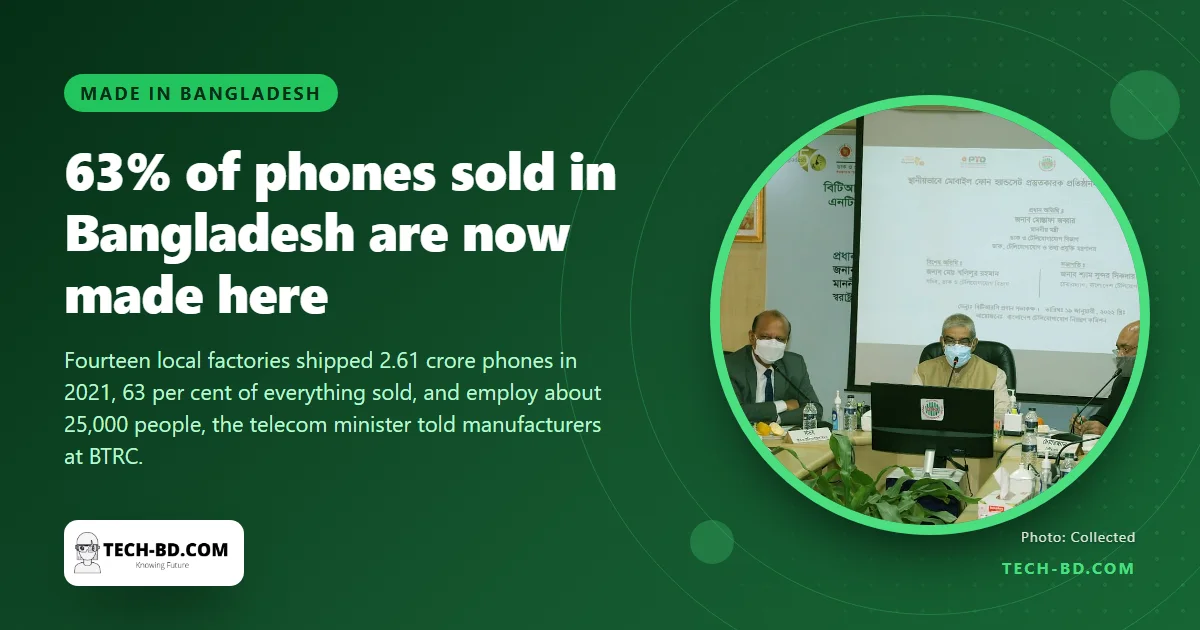
Sixty-three per cent of the mobile phones sold in Bangladesh over the past year were made in Bangladesh, telecommunications minister Mustafa Jabbar told the country's handset makers on Wednesday, 19 January 2022. The 14 licensed factories shipped 2.61 crore phones in 2021 and now employ around 25,000 workers.
What was said at BTRC
Speaking at a meeting with factory representatives at the Bangladesh Telecommunication Regulatory Commission, chaired by BTRC chairman Shyam Sunder Sikder, the minister said Bangladesh had gone from a phone-importing country to an exporting one, and that the regulator would give "no concession, now or in future" on the international quality standards local phones must meet. He urged the factories to move on to tablets, laptops and other digital devices.
How the industry got here
Four years ago almost every phone in a Bangladeshi pocket was imported, mostly from China. The turning point was the 2017-18 budget, which cut duty on components and raised it on finished phones, followed by a licensing regime for local assembly. Walton and Symphony built the first plants; Samsung, Vivo, Oppo, Xiaomi, Realme, Tecno, Itel and others followed, most of them in Gazipur and Narayanganj. In 2020 Walton shipped the first Bangladeshi-made phones abroad, to the United States and then Nepal.
"Made in Bangladesh" is, for now, mostly assembly. Screens, chips and batteries are still imported; the local value added is casing, packaging, testing and the labour of putting them together. The 14 factories operate at different levels of integration, and the regulator has said it wants to see more component work done locally as the next step.
What it means for buyers
- Prices. Locally assembled phones avoid the higher duty on imports, which is why a Tk 12,000 Redmi or Realme costs roughly what the same model does in India.
- Grey-market phones. The same duty gap makes smuggled handsets attractive. The BTRC's NEIR database, which registers every IMEI sold legally, is the enforcement tool; an unregistered phone can be blocked from the networks.
- Warranty and service. A phone made and sold through the official channel comes with a local warranty and service centre; a grey import usually does not.
The next milestone the ministry is chasing is local manufacture of laptops, and the first Walton and Symphony laptop lines are already being cited as proof that it can be done.